 |
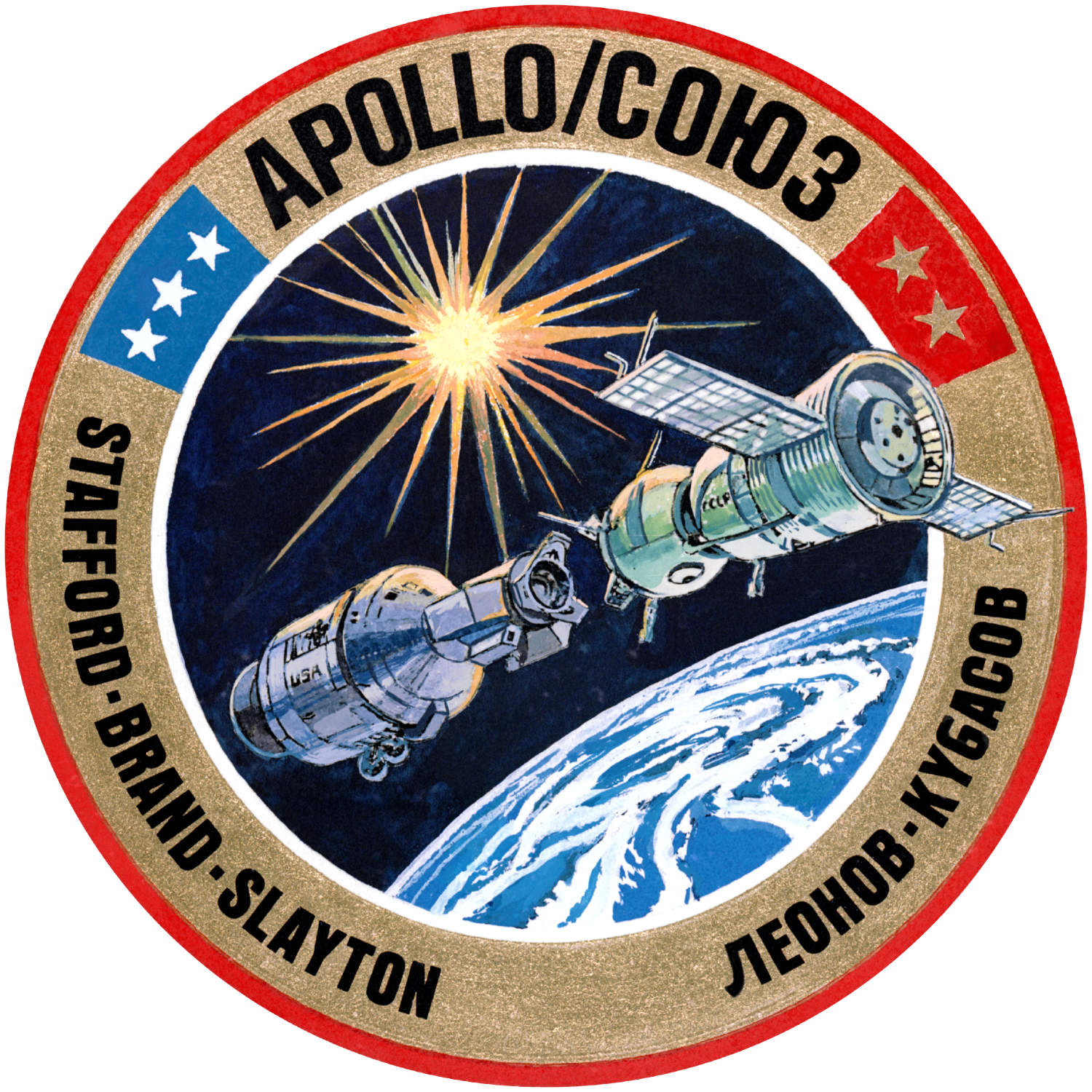
| APOLLO – SOYUZ | |
USA – Apollo 15 July 1975 – 24 July 1975 Tom Stafford 9 Days 1 Hour 28 minutes |
USSR – Soyuz 15 July 1975 – 21 July 1975 Alexei Leonov
|
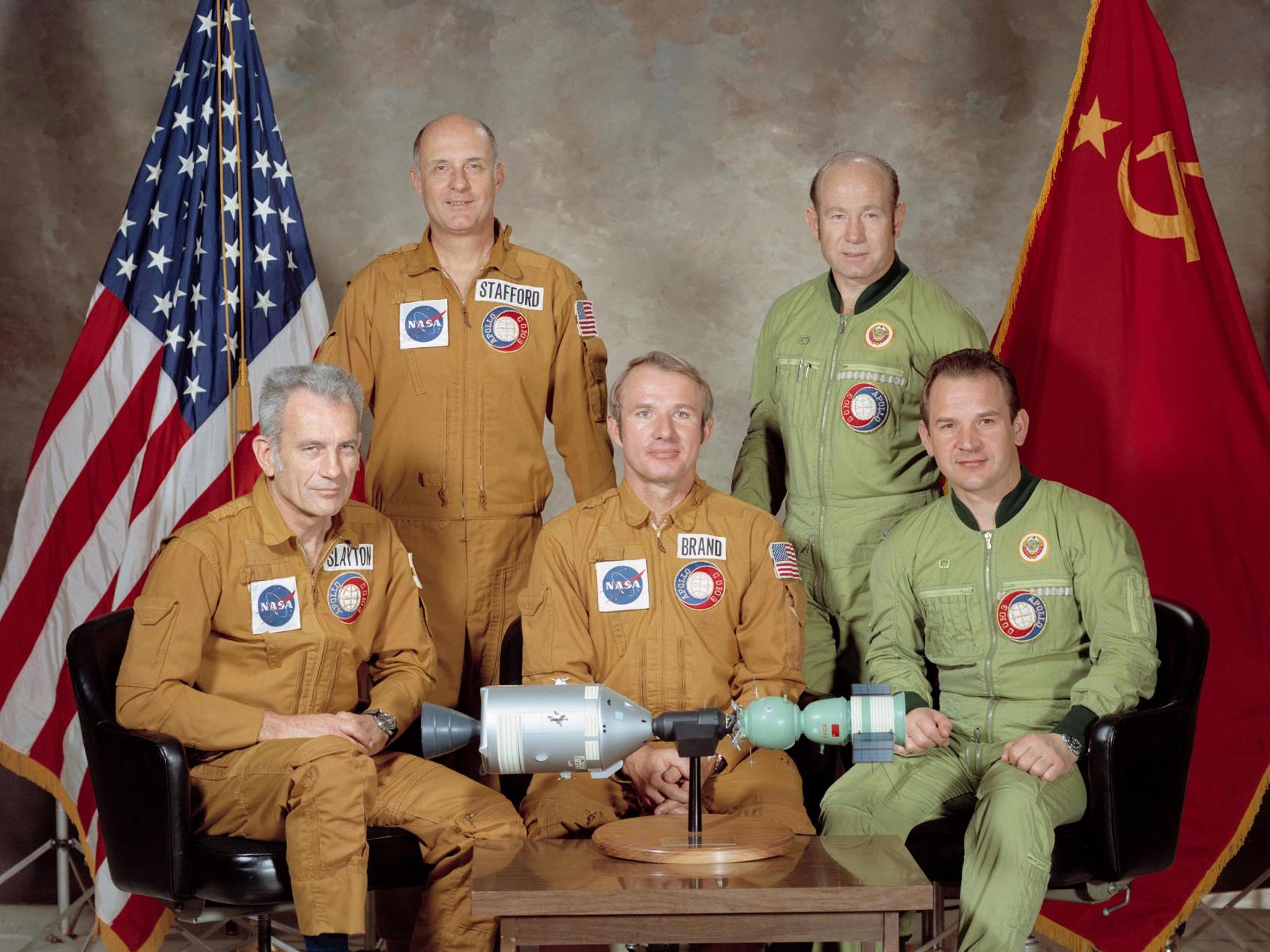 |
The crew of the Apollo-Soyuz Test Project. L-R: Deke Slayton, Tom Stafford, Vance Brand, Alexei Leonov, Valeri Kubasov. |
While the abandoned Skylab was still spinning around the Earth, accompanied in space by a Russian manned Salyut space station, the Americans and Russians finally shook hands in the doors of their spacecraft over Verdun in France, for a moment dropping the barrier between Communism and Democracy with the politically motivated Apollo-Soyuz mission. Whatever happens in the future, this act tied up the rivalry of these two great space-faring nations and neatly sealed the first era in space.
The ASTP mission was originally conceived in the Nixon-Kissinger days, and agreed to by President Nixon, Soviet leader Leonid Brezhnev, and A. Kosygin, Chairman of the Soviet Council of Ministers, on May 24 1972. The mission became a focal point for a number of factions. The Russians saw an opportunity to observe the mainstream of US space technology, and to appear to the world to be at least on equal terms with the Americans by flying a joint mission. They also saw the possibilities of developing a technical base for an international space rescue system. The Americans objectives seemed to be mainly political, but they recognised the usefulness of rescue in space, and it was another opportunity to encourage scientific support for manned space flight.
The Apollo-Soyuz mission was simply an experiment. There was no new technology involved – both countries were using old spacecraft and conventional operational techniques. The Apollo spacecraft was the earlier “H” series model, not the later “J” series. The Soyuz (Russian for Union) had been developed about the same time as Apollo. Formidable technical, linguistic, and operational challenges had to be overcome before the two spacecraft could get off the ground. The open American philosophy clashed against the covert Russian outlook. Tom Stafford refused to fly the mission unless he and his crew were allowed to inspect the Russian Soyuz spacecraft, which was eventually approved.
Apollo-Soyuz was a strange mission for the Americans – a mixture of speeches, hand shaking, gift exchanging, television covered politics on one hand and hard working, laboratory experimental science on the other. The Russians insisted the link-up should be over Russia, while the Americans wanted it over America, and it ended up over France and West Germany, where they could both see their respective tracking stations.
This mission was also the last opportunity for Deke Slayton to fulfil his dream of flying in space. Although one of the seven original Mercury astronauts, and now the Senior NASA Astronaut, he became the oldest space rookie at the age of 51. After a constant battle to get back onto flight status with the doctors and management over a slight disturbance of the regular rhythm in the upper chambers of his heart, Slayton found that taking lots of vitamin tablets to beat a cold seemed to stop his fibrillations.
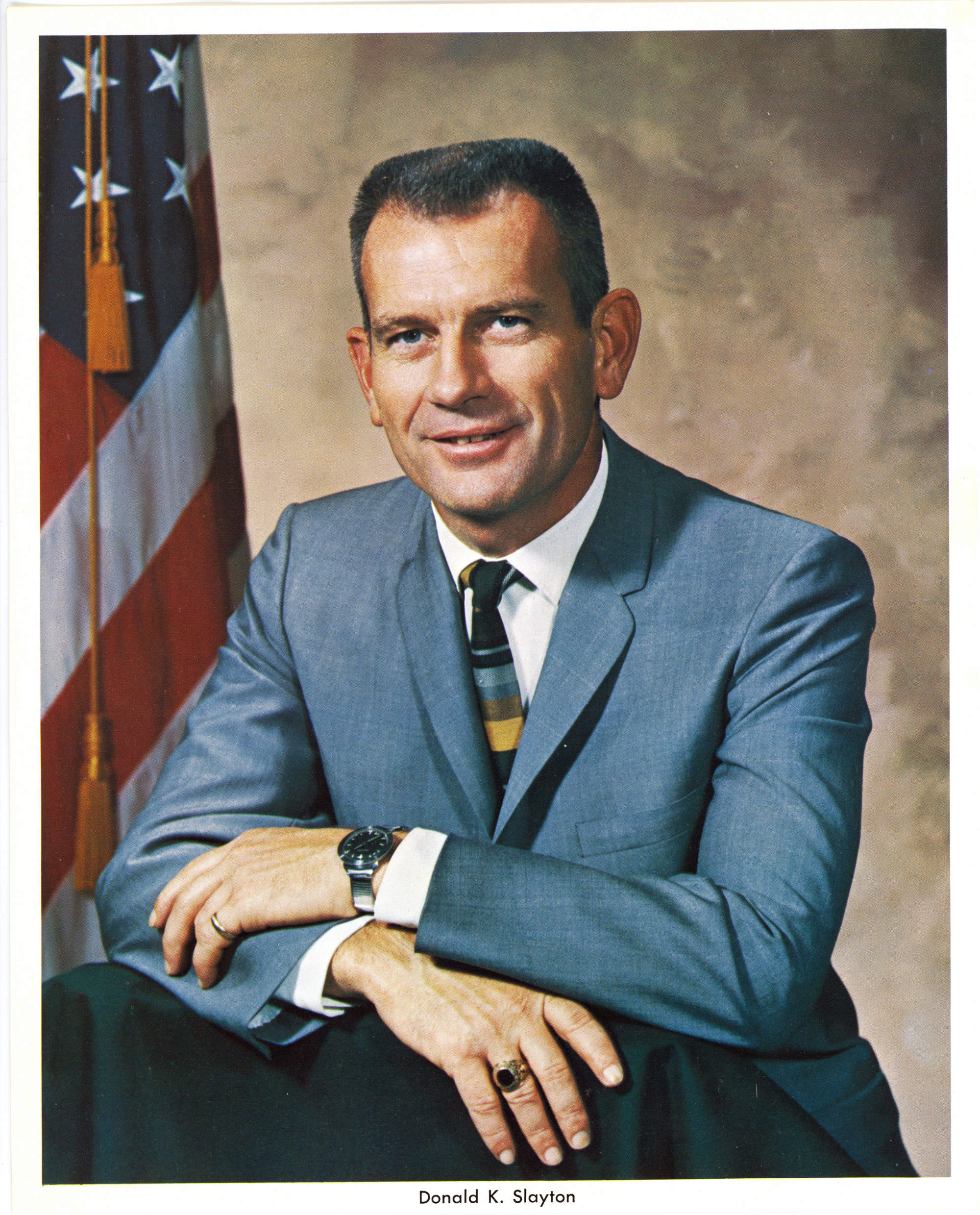 |
Deke Slayton’s official Project Mercury portrait. This copy preserved by the PMG’s John Lambie, Muchea and Carnarvon. |
After a solid week of tests with heart specialist Dr. Hal Mankin he was cleared and on March 13 1972 returned to flight status. With his age, the last Apollo crews already in training, and the Skylab crews announced, his options for a flight boiled down to the Apollo-Soyuz flight. So when Chris Kraft, Director of the Manned Spacecraft Center, asked Slayton for his crew recommendations for the Apollo-Soyuz flight, he submitted his own name as commander, with Jack Swigert and Vance Brand.
However, when he was called to Kraft’s office just after Apollo 17, he found Tom Stafford replaced Jack Swigert and was appointed the Commander because of his space flight and rendezvous experience, and he already had a good relationship with the Russian cosmonauts, as well as their trust.
Stafford: “I lived in Russia for six periods at a time. Minimum for about two weeks, maximum about six weeks. The Cosmonauts came to the United States for five times for about a month each. We trained at Star City near Moscow in the simulators and procedures trainers on their systems, the language…the whole thing.”
ORRORAL VALLEY PREPARES FOR THE APOLLO-SOYUZ MISSION.
Orroral Valley, over a mountain ridge from Honeysuckle Creek, was the main Australian support for the Apollo-Soyuz mission, as Honeysuckle Creek was already an established Deep Space Station, and Carnarvon had gone. As Orroral Valley had no voice sending or receiving equipment, new equipment had to be installed.
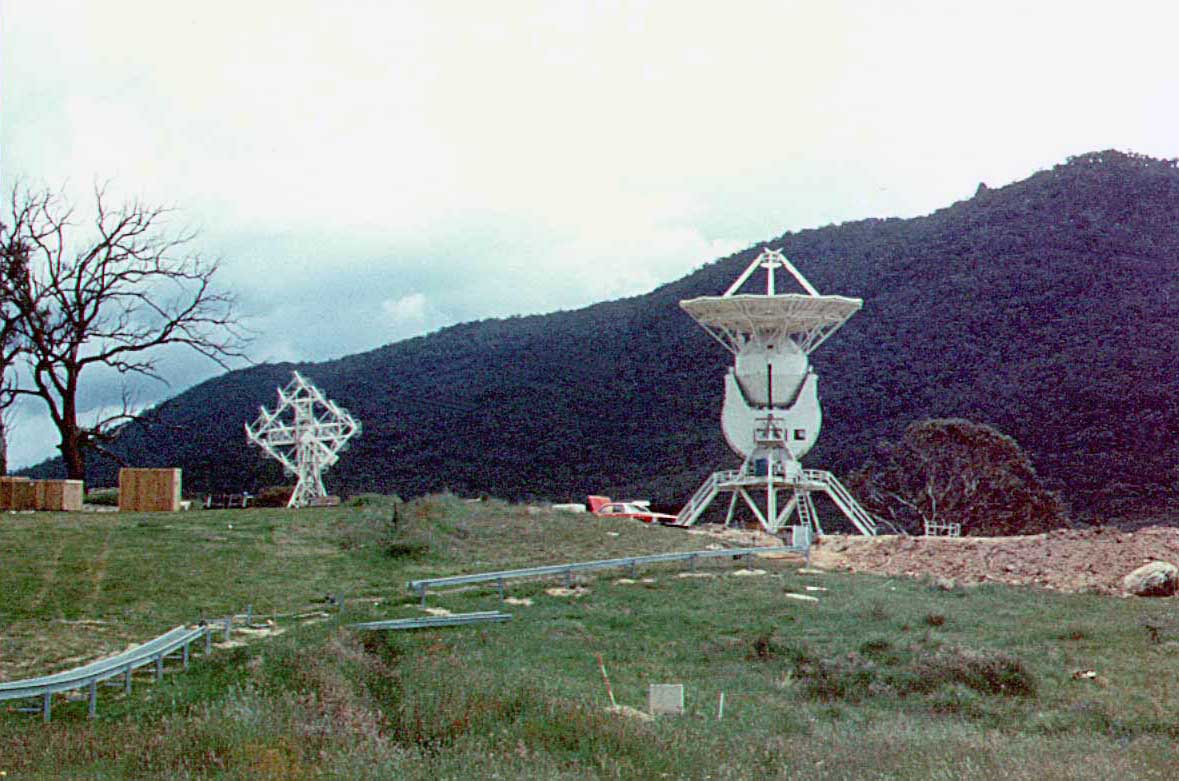 |
To support the Apollo-Soyuz Test Project, a 9 metre USB antenna (right) was installed at Orroral Valley in 1974. (I believe this was the USB antenna previously at Corpus Christi, Texas. Does anyone know if that is the case?– CM) Photo: Philip Clark. |
Ian Fraser, the Apollo-Soyuz Coordinator in Australia:
“During the Apollo and Skylab missions Orroral Valley provided support for the scientific spacecraft used to monitor the Sun’s potentially lethal radiations, as well as weather satellites. When it was our turn to fully support manned flight, Orroral Valley’s approach to Apollo-Soyuz was very much an outcome of its STADAN beginnings. Being a multi-link, continuous operation station supporting up to 40 satellite passes per day, to us, Apollo-Soyuz was just another spacecraft – except it was manned.
For the Apollo-Soyuz we dedicated a team of operational specialists combined with selected maintenance personnel. Honeysuckle Creek was a ‘wing’ site with VHF voice support only, providing redundancy in the case of a USB system failure at Orroral Valley. We expected the Honeysuckle gear to be shifted across the mountain but it didn’t happen that way. It came from various places, and they extended the building to take the extra equipment.”
Ian Edgar, the Communications Technician (Comtec):
“For Apollo-Soyuz, the station ran the normal four shifts for the scientific satellites, normally about 28 people. There were only four of us operating the equipment for Apollo-Soyuz. We covered 12 to 14 hours with the one shift, we had camp beds set up in the training room, and for that whole period we didn’t go home. The longest pass was about five minutes most of them were only about two to two and a half minutes, some were only thirty seconds.”
Two ARIA (Apollo Range Instrumented Aircraft), modified Boeing 707 jet aircraft with 16 crew members in each, arrived at Perth Airport to cover the first three orbits of the Apollo spacecraft, much as they had done for all the previous Apollo flights. They left at 2.20 am and flew at a height of 9,144 metres for 7 hours, one aircraft 2,600 kilometres in a south westerly direction to take over from an ARIA from Cape Town, and one in a south easterly direction.
The Soviet Mission Control Centre was located at Kaliningrad, about 45 minutes north east by car from Moscow. Kaliningrad takes over from launch control at Baikonur after the spacecraft has separated from the launch vehicle in orbit.
JULY 15 1975 – APOLLO-SOYUZ GETS UNDER WAY.
Soviet television devoted a whole five hours of their programming to the mission, from Yuri Gagarin’s flight to Apollo-Soyuz launch, the first live broadcast of a Russian liftoff. For days, newspaper headlines told the people of the Soviet Union about the great spirit of cooperation between the two super powers.
July 15 1975 arrived with clear skies and light breezes, promising a perfect launch for the Russians. Their Soyuz 19 spacecraft left the ground at 3:20:10 pm Moscow time from the same pad that launched the Sputnik and Gagarin missions. Afternoon in Baikonur was early morning in Florida where the Americans listened to the Russian launch and realised it was, “Our turn to hit the ball. Now we’ve got to get into orbit.” The American astronauts were still asleep while, on the launch pad, the Apollo launch rocket was gorging on liquid oxygen at a rate of 4,540 litres per minute. Although thunderstorms were hovering around Cape Canaveral they were not expected to affect the launch.
Deke Slayton, the man who waited for so long to get into space, who never gave up, was finally approaching his spacecraft. Thirteen years late, he was feeling good, though he had never meant to be the world’s oldest astronaut.
Seven and a half hours after the Soyuz launch, the last Apollo spacecraft, with three astronauts and a stowaway mosquito, was launched from Cape Canaveral at 3:50 pm EDT, 6,224 kilometres behind the Russians, who were flying over Belgrade at that moment.
Two thousand skilled workers, with a perfect record of successful Saturn launches behind them, stood and watched “the Stack” – and their jobs – go. The seven year old rocket, the 32nd Saturn and last Apollo to be launched, was the best booster as far as technical problems went. “We saved the best till last,” said Chief Saturn test supervisor, William Schick.
Walter Kapryan, Director of Launch Operations lamented: “We are losing a team that I don’t think we’ll ever have together again.” The Saturn launch facilities were maintained for another 12 months in case NASA reversed its decision to end the Apollo missions.
As they shot into orbit, an elated Slayton called out, “Man, I tell you, this is worth waiting 13 years for! This is a helluva lot of fun – I’ve never felt so free.”
Out in space, aboard the Salyut 4 space station above the Apollo-Soyuz mission, Pyotr Klimuk and Vitaly Sevastyanov were woken up from a sleep to listen to the launch. Launched on May 24, they were well settled into a 60 day mission. Later Sevastyanov called the Soyuz crew on their radio link through the Russian tracking stations for a long talk which included: “I think that all those who are in space right now are aware that this is a grandiose task, and there are seven people in space right now… the magnificent seven!”
FIRST INTERNATIONAL RENDEZVOUS IN SPACE.
By 8:00 am, July 17 the two spacecraft were approaching each other. When they were 322 kilometres apart, Brand called Houston, “Okay, we got Soyuz in the sextant.”
“Got a good view of him, Vance?” asked Capcom Richard Truly.
“He’s just a speck now.”
The Americans did all the manoeuvring as only they had enough fuel. It took 388 kilograms to rendezvous; the Russians only had 136 kilograms in their tanks. Another reason was Soyuz had no windows to see out, only a periscope. Using techniques originally developed in the Gemini missions, Apollo began the final approach over the Pacific and sidled up to within 30 metres of Soyuz, on its 36th orbit. As they were leaving the Atlantic over Portugal, Capcom Dick Truly in Houston passed up two messages: “Moscow is go for docking and Houston is go for docking. It’s up to you, guys. Have fun.”
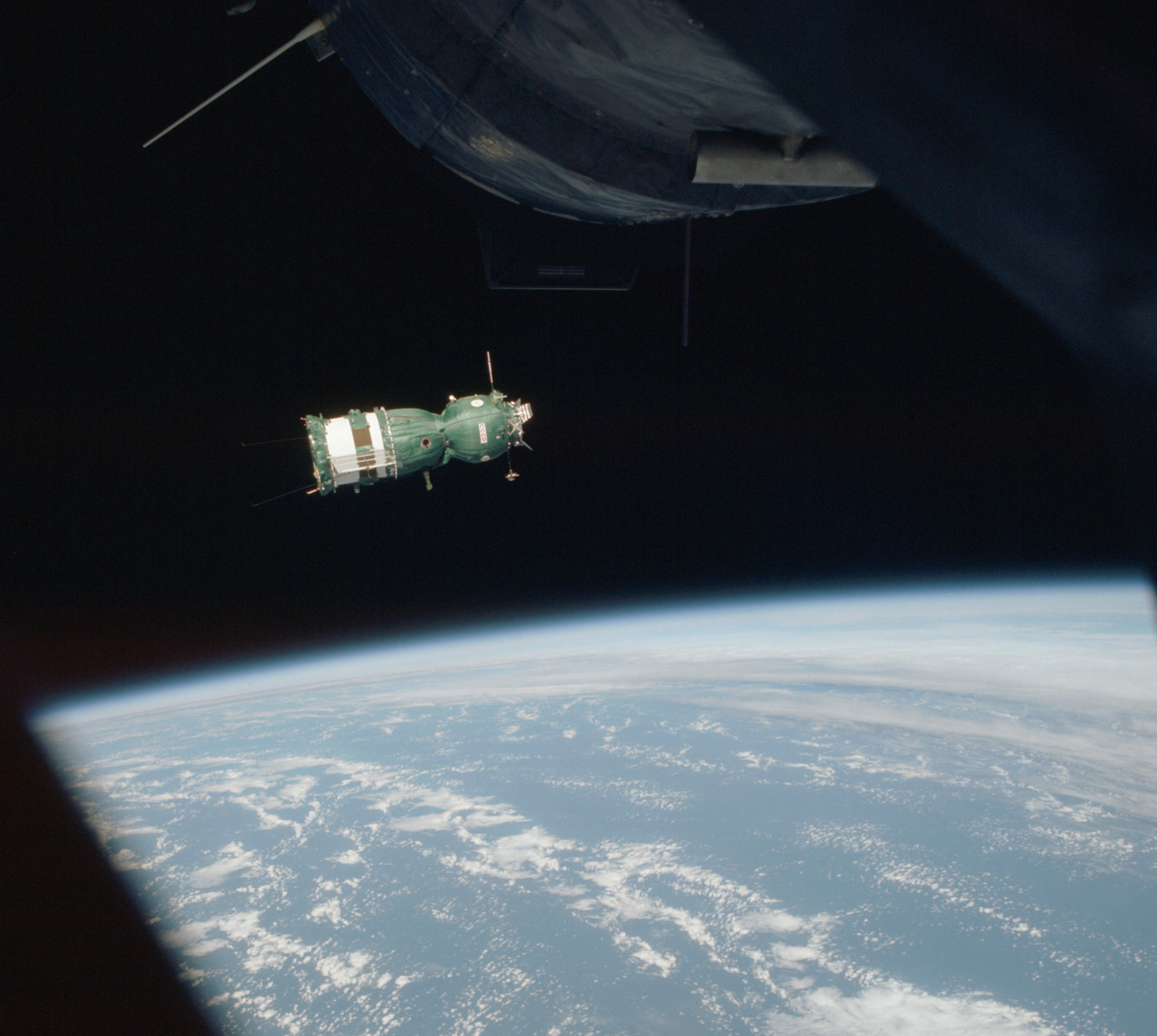 |
Soyuz 19 as seen from the Apollo CSM. Note the docking adaptor – as the top of the picture – attached to the Command Module. Cropped NASA image. |
“I’m approaching Soyuz,” called Stafford in Russian as Leonov rolled the Soyuz around 60° to help line up the two spacecraft.
“Oh, please don’t forget your engine!”, replied Leonov in English, meaning Stafford might have rammed him. Everyone in space and at the Mission Control Centers saw the humour and laughed, including a visiting Soviet Ambassador.
“Three metres… one metre… capture… we have succeeded.” Stafford announced.
“Well done, Tom. That was a good show. Apollo, Soyuz, are shaking hands now,” said Leonov.
The two spacecraft initially locked together at 11.09 am Houston time.
“It was a good show,” Leonov sang out happily.
“Spasebo, Aleksei,” returned Stafford with satisfaction.
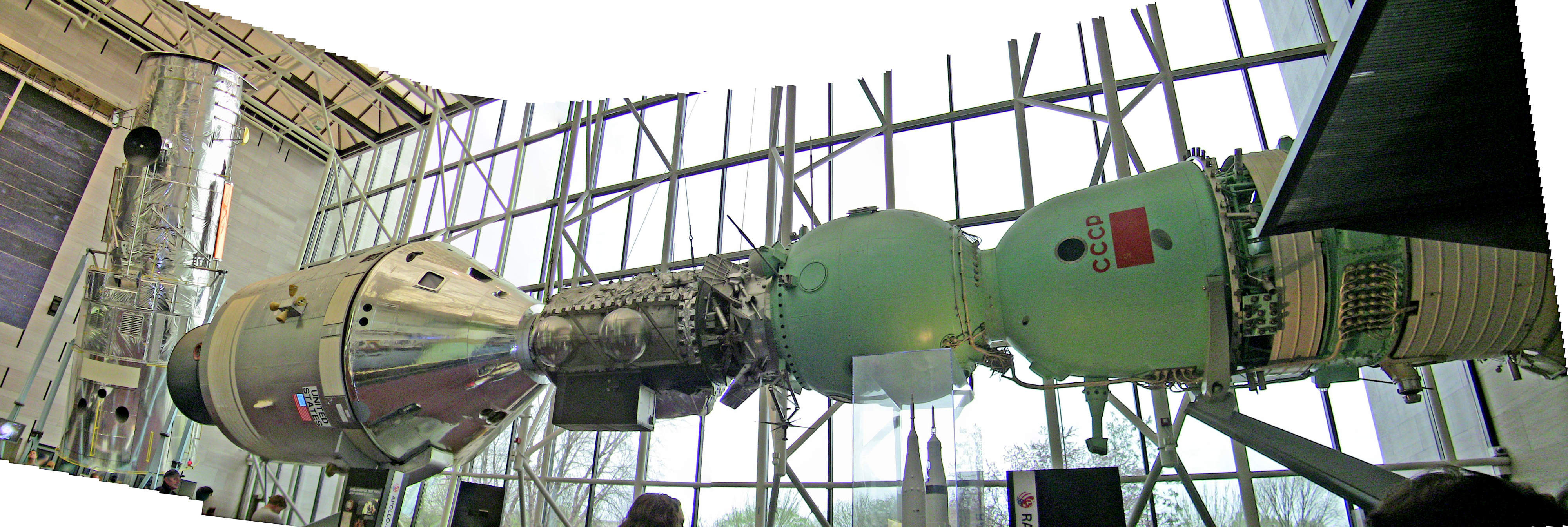 |
A full-size mockup of the Apollo and Soyuz vehicles docked – at the National Air and Space Museum in Washington, DC. Photo: Colin Mackellar. |
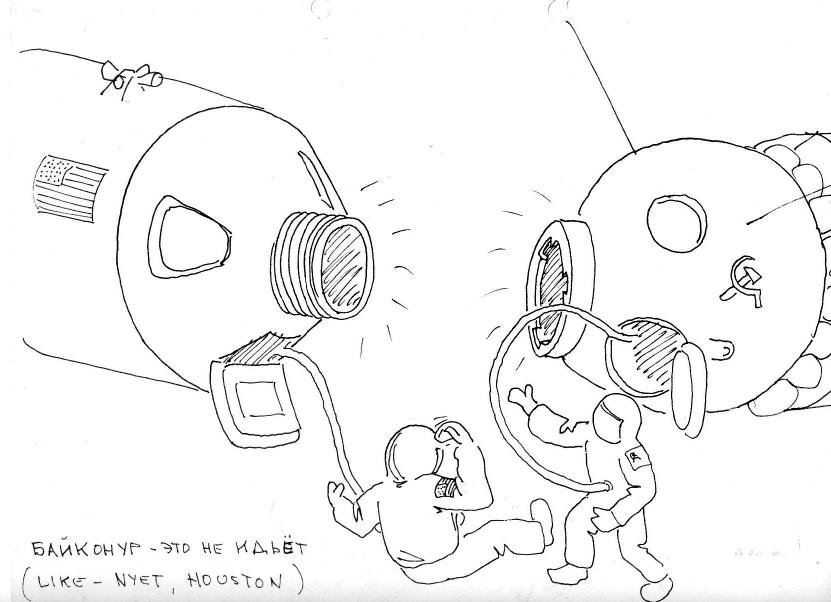 |
Honeysuckle’s Ed von Renouard (who was fluent in Russian) drew this cartoon to illustrate the need for a docking adapter so that Apollo and Soyuz could link up in space. |
At 11:12:30 the latches were closed to complete the first international docking in space, 998 kilometres west of Portugal, and history was made.
Stafford: “We had trained long and hard for several years and when we came up it was a perfect rendezvous I was speaking to them in Russian as we came in and docked.”
Stafford and Slayton were scheduled for the first visit to the Russians. Slayton reached for the docking hatch and smelt what seemed like burned glue. A few moments later it was gone. The Americans had their oxygen masks on standby, but Houston could find nothing wrong, it was probably from an earlier experiment, so they continued equalising the pressure until at last Stafford called out, “Are you ready to open hatch 3?” He then pulled the last door aside at 2:17:36 pm, to reveal Leonov and Kubasov still finishing their preparations. As the camera cables writhed around the astronauts and cosmonauts in zero g, Slayton grinned, “Look’s like they’ve got a few snakes in there too.”
“Aha” said the Russians, “How are things going? We are very happy to see you,” then Stafford and Leonov shook hands and tried to hug each other.
“Tovarich, (Comrade)” replied Stafford as he and Slayton squashed around a table specially set up in to the Soviet spacecraft, and they exchanged gifts of flags and plaques, and some of Leonov’s paintings, before standing by to listen to the Soviet Communist Party Secretary Leonid Brezhnev and President Ford’s messages.
Brezhnev’s solemn speech contrasted with President Ford’s chatty interview. Ford asked Slayton, “As the world’s oldest space rookie, do you have any advice for young people who hope to fly on future space missions?”
“The best advice I can give is decide what you want to do, and then never give up until you’ve done it,” Slayton answered.
“You’re a darned good example, Deke, of never giving up,” the President pointed out.
President Ford reminded Kubasov of the time they had both gone to a crabfest in Virginia. ”We eat good in space, there is some fruit, some juice, and water, a lot of water no crabs,” Kubasov replied with a laugh.
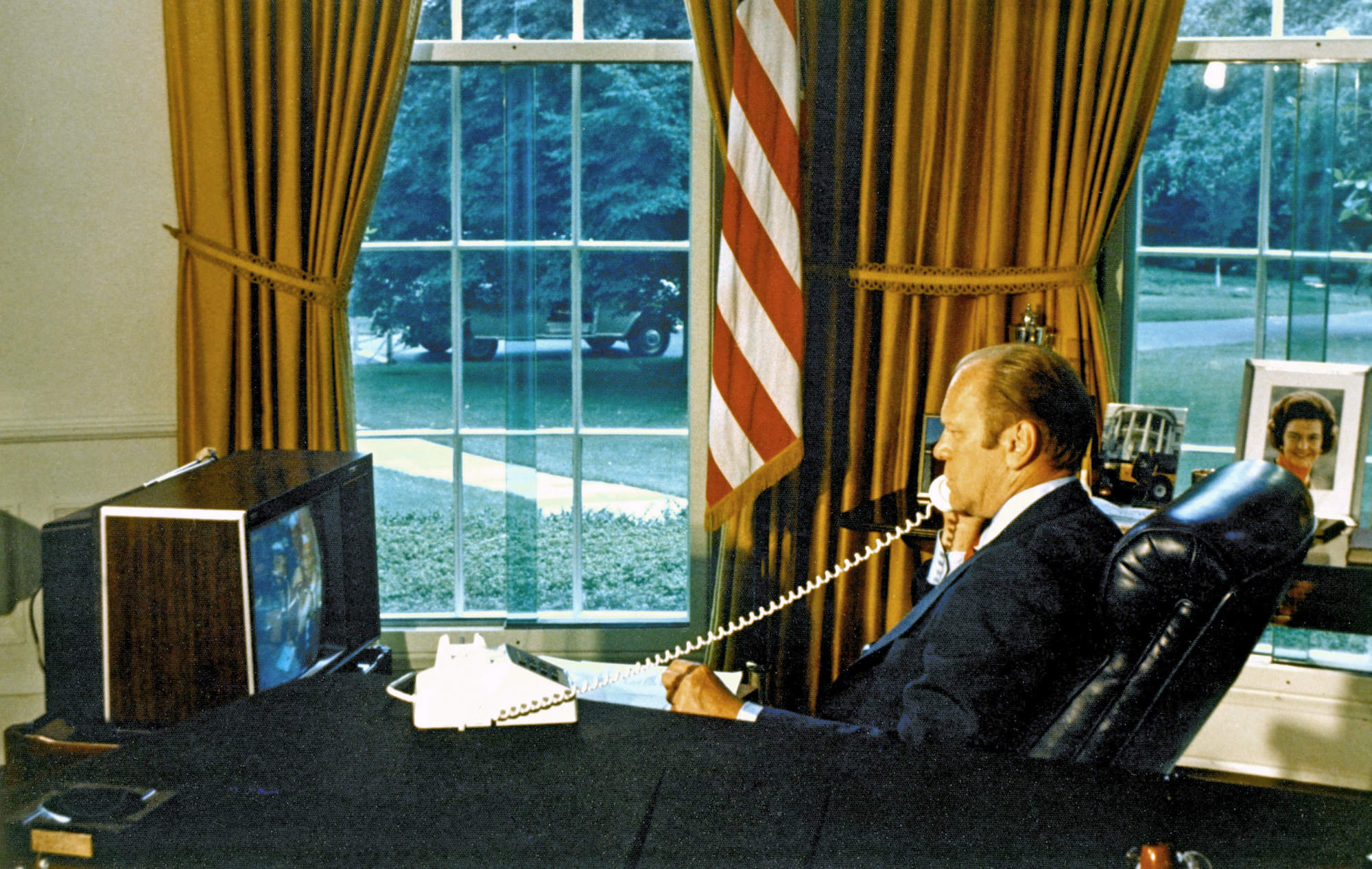 |
President Gerald Ford speaks with the crew. NASA image. |
Stafford and Slayton returned to their Apollo spacecraft at around 6:00 pm. The next day Brand visited Kubasov in the Soyuz spacecraft, while Leonov went across to visit Stafford and Slayton in Apollo. Among the activities that followed were television shows, shared experiments, formation flying, joining two halves of medallions, and eating meals together.
In the Russian ship they ate strawberries, cheese, sticks of apple and plum, and tubes of Borsch, while in Apollo they feasted on potato soup, strawberries, grilled steak and bread. Leonov had promised Slayton a drink of Vodka if and when they ever met in space. As Vodka was banned from the Russian spacecraft Leonov had filled some tubes labelled “Vodka” with soup, and offered it to Stafford and Slayton, with the excuse it was the thought that counted.
The Americans passed across seeds of a hybrid white spruce, while the Russians handed back Scotch pine, Siberian larch, and Nordmann’s fir, an ancient Soviet tradition considered a gesture of true friendship. Part of the television shows included narrated views from space of the USSR by both Russians, and of the US by Brand. When asked his opinion of the food Leonov said, “It’s not what you eat but with whom you eat that is important.”
MISSION ACCOMPLISHED.
After 44 hours together the two spacecraft parted over the Atlantic Ocean on Saturday July 21 1975. As Soyuz pulled back Leonov called: “Mission accomplished,” and Stafford replied with: “Good show.”
Something new for Apollo was the docking module jettison and then its use for a doppler experiment. They first loaded it with rubbish from their Command Module before casting it off on July 23, and the crew put their suits on for the first time since launch.
Because the Russians insisted on using a frequency commonly used by airport control towers (121.75 MHz), there were moments of confusion while the two spacecraft were docked. At Orroral Valley Tracking Station Ian Fraser commented: “We had trouble finding the spacecraft while they were together, but once they separated we had no trouble finding Apollo straight away.”
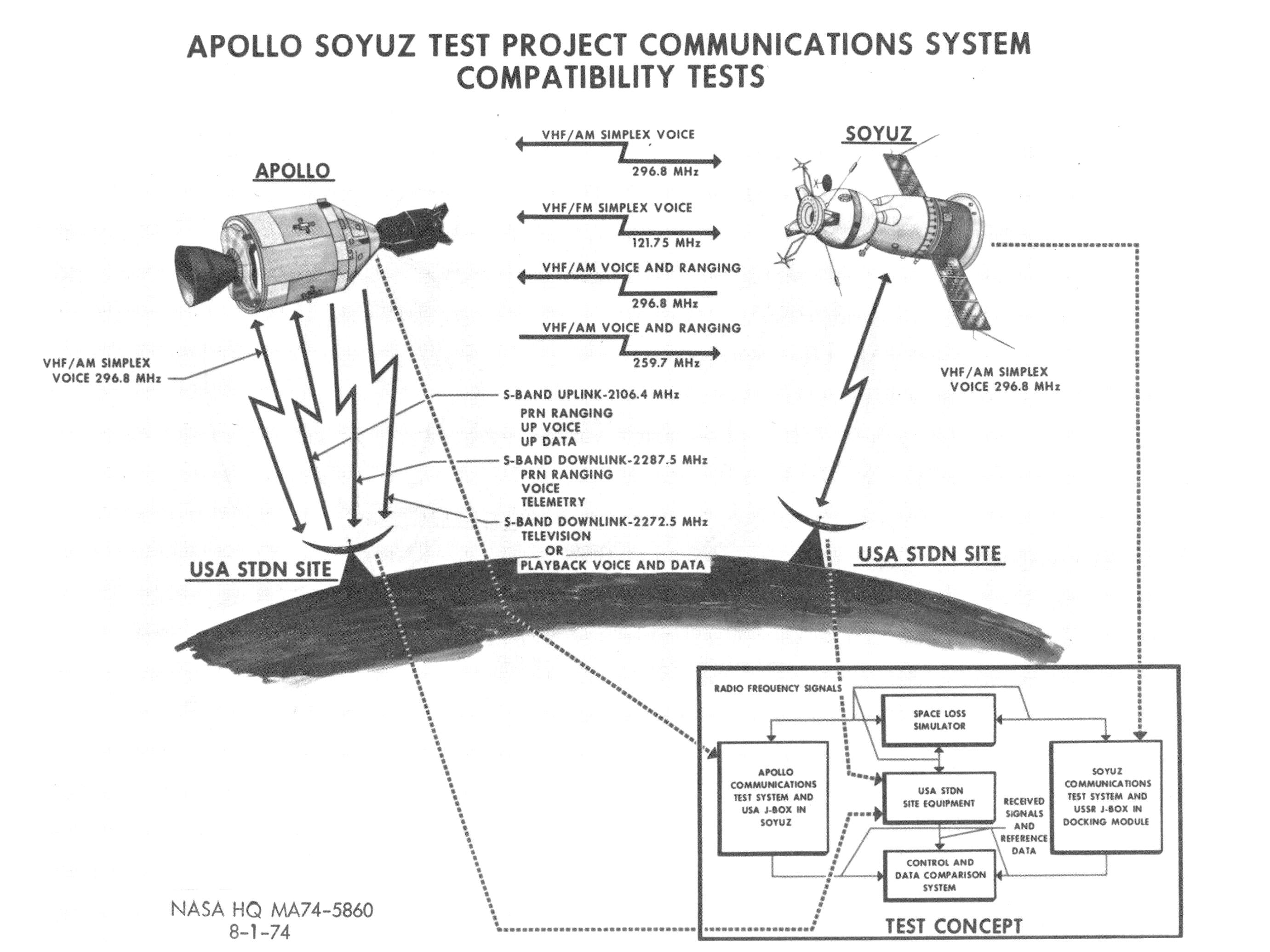 |
APOLLO SOYUZ TEST PROJECT COMMUNICATIONS SYSTEM This diagram from the ASTP Fact Sheet gives an idea of the challenges of communications between thetwo spacecraft. |
Once Houston nearly called Apollo up during a sleep period, thinking they were trying to contact them, when really it was an airliner calling the control tower at Atlanta, Georgia. Brand reported, “We’ve been getting every control tower in Europe and parts of the United States.” Houston Flight Director Littleton, “We got a lot of interference over Europe on our television picture and we asked the Soviets to quiet that down. They certainly cooperated on that and turned off some airport communications.”
The Americans noticed that the Russian ground control were quite strict with their cosmonauts, more so than the Americans. “We are watching you we are happy with your work,” the Kalinin control centre told the cosmonauts. Both Leonov and Kubasov became tired from lack of sleep and were ordered to take sleeping tablets before going to sleep.
The Russians began their retro fire sequence on July 21. As the Soyuz spacecraft approached reentry, Kalinin Control Centre ordered; “Report on everything happening, especially during deorbit. The helicopters and aircraft will attempt to establish communications immediately so tell them everything that’s happening on board.”
At 1:00 pm Moscow time many Russian citizens began to gather around television sets to watch their first live Soyuz landing. The automatic reentry burn was begun about 11,265 kilometres from the landing point. At 9,754 metres the drogue followed by the main parachute ringed with red and white, sprang out, and was spotted by one of the waiting helicopters.
The descent was televised from two helicopters, the signal sent to the United States through the Soviet land lines to Raisting in West Germany, then across the Atlantic through the Intelsat satellite.
At 3,000 metres the heat shield was dropped off then television viewers saw a spectacular sight of the spacecraft disappearing in a cloud of dust and smoke as the landing rockets burst into life 2 metres above the ground to slow the spacecraft to a speed of 3.6 kilometres per hour. The area was soon swarming with over a 100 people and their trucks from the surrounding farms, as the cosmonauts were transported off by one of the nine Mi8 helicopters hovering around. Leonov said the flight was, “….as smooth as a peeled egg.”
The Americans in Apollo continued on, busy with endless scientific experiments until July 24, when the Service Propulsion System (SPS) rocket was ignited for reentry over the Indian Ocean, before the Command Module and Service Module separated. The prime recovery ship USS New Orleans, stationed 458 kilometres north west of Honolulu, stood by and waited for the last splashdown the last water landing. Future spacecraft such as the Shuttle were to land on runways.
Edgar: “During that final orbit, at the reentry stage for the CSM the main worry we had was what the predicted velocity was going to be….”
Fraser: “….whether the antenna was going to keep up with the speed of the spacecraft. It was so close it was like you could throw stones at it…..”
Edgar: “…you could almost go outside and watch it you could actually see it and it was daylight. Houston told us, ‘we don’t think you will be able to keep up with it, we’re not scheduling data off this re-entry, but should you get it, we’ll take it.’ To our surprise we did maintain it….”
Fraser: “…the antenna was flat out…..”
Edgar: “…it must have been to design limits and didn’t break… right through to the horizon. We heard them talking but it started to break up…..
Fraser: “…that’s right, the signal started to break up as they came down, but the telemetry stayed okay. We still had the voice on the net (voice line from the USA) after we lost them over the horizon, as they were coming in over the tracking ships and the parachutes were deployed, and suddenly everything went quiet. I think the last thing I remember hearing on the net was coughing before somebody pulled the plug.”
Drama stalked the final moments of the last Apollo flight. Just after the spacecraft had plunged into the Earth’s atmosphere, shedding kilometre long flames, the astronauts were suddenly wincing to a loud squeal in the capsule intercom. “The interference was so loud we had to take our masks off and yell at each other,” Stafford said. During that time Stafford called Brand to turn on two switches to activate the automatic landing sequence but Brand didn’t hear the instruction, and failed to turn the switches on. When the drogue parachutes didn’t appear on time, Brand realised the error and promptly activated them manually, the only time they weren’t activated automatically in an Apollo mission. But everyone forgot to turn off the capsule attitude control system, technically called the RCS, so when the spacecraft began swinging around under the parachute, the control system automatically squirted gas out of the thruster jets to try and steady it. Stafford spotted the thrusters were still firing and shut the system down, but the residual Nitrogen Tetroxide gas was still smoking out of the thruster jets when a ventilation valve opened up at 7,300 metres to let the fresh air in and equalise the air pressures. The lower pressure inside the spacecraft sucked these highly corrosive fumes into the cabin and the astronauts began coughing violently, while their eyes began to burn and sting.
Glynn Lunney, Technical Director for the mission said, “If that gas becomes concentrated enough, it can be fatal.” The crew recovered from the surprise and at 2,700 metres manually released the main parachutes.
During the four minute descent they fought for air to breathe, trying to avoid the acrid brownish yellow gas. After hitting the sea like a ton of bricks the spacecraft fell upside down on the back of a wave, and the astronauts found themselves hanging in their straps as the spacecraft wallowed in the slight sea. Stafford, still coughing with burning throat and eyes, unstrapped himself and fell heavily onto the nose tunnel of the spacecraft before blindly clambering back up for the oxygen masks behind the couches to pass them to the other two.
Brand had passed out, but revived when Stafford clamped his mask on properly. When the spacecraft righted itself the ventilation system cleared the cabin as Stafford yelled, “Get this hatch open as soon as possible!” but managed to open it himself before the Navy frogman poked his head at the window. Without thinking, Slayton gave him a thumbs up gesture; the frogman signalled back to the helicopter the crew were okay; so no special effort was made to get the astronauts out into fresh air quickly.
Stafford: “It was touch and go. The oxygen ran out just as we got upright.”
When the astronauts climbed out of the hatch they appeared to be normal, except for rubbing their eyes. It wasn’t until they were talking to President Ford on the aircraft carrier’s deck that the gas incident was mentioned and press conference was stopped then and there while the three astronauts were bundled off to the ship’s surgery for treatment. When the crew felt as though they had developed pneumonia, the later functions and parties were cancelled. They were then taken to Honolulu’s Tripler Army Medical Centre for intensive care treatment for the effects of the gas, which can lead to the serious lung condition Pulmonary Oedema later on. Although they had trouble breathing for some days after, all three recovered completely.
The 15th and last Apollo spacecraft to take men into space splashed into the Pacific 6.4 kilometres from the USS New Orleans and brought to a close the remarkably successful Apollo era of expensive, expendable spacecraft. The reusable Shuttle was to take over the task of sending people into space, but only into Earth orbit.
The general attitude at Houston was that the flight went off better than expected, there were no major blunders, or accidents, which would have humiliated the space programs in the eyes of the world. Some saw the Apollo-Soyuz as a $250 million political stunt, and felt that the money could have been better spent on another Skylab, but whatever the reaction, it was a congenial way to finish mankind’s first steps into space.
____________
Text by Hamish Lindsay, 2012. Formatting and image selection by Colin Mackellar 2025.
Unless otherwise credited, all photos courtesy NASA.