
Val Jeffery
1935 – 2017
Tharwa General Store.
|
Val Jeffrey at the Tharwa General Store in July 2004. Photo by Hamish Lindsay. |
Valantine (Val) Max Jeffery is best remembered as the proprietor of the Tharwa General Store – just 300 metres past the Tharwa Bridge over the Murrumbidgee River. He played an important supporting role in the success of two NASA tracking stations – Orroral Valley and Honeysuckle Creek.
Val took on the running of what was then a remote country store at the age of 14 shortly after his father, Clarence (Clarrie) Charles Jeffrey died in 1948.
Clarrie and his wife Ruby had bought the store in 1926, running it for 22 years. Val continued to run it for almost another seventy years, until his death in late 2017.
Since then, his son Kevin and family have continued to run the establishment, complete with Clarrie’s cafe and an adjoining antique store.
In March 2026, Lish Fejer at ABC News reported that the family had decided to put the business on the market, with the hope that someone else would carry on the tradition.
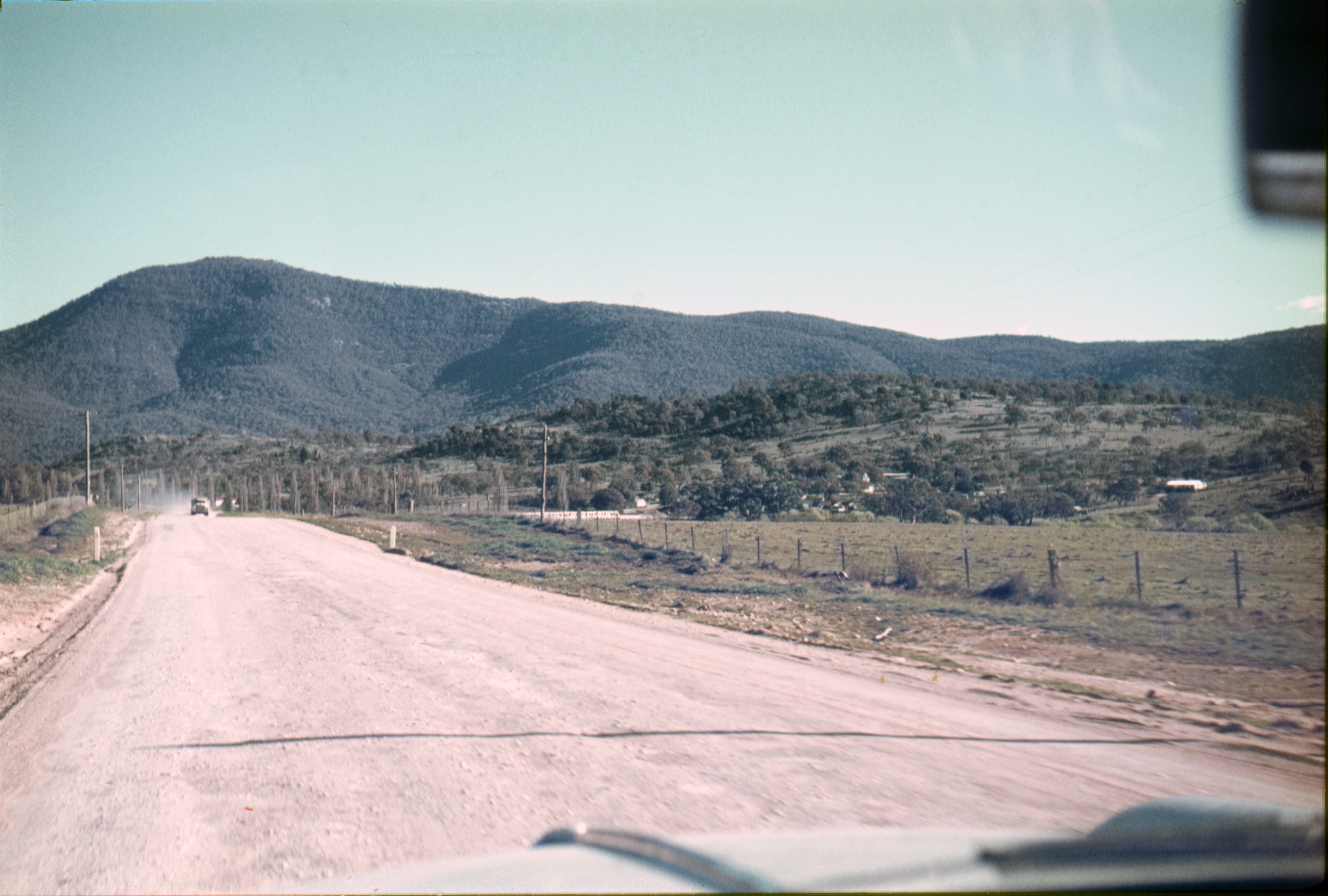 |
Before the bitumen. Honeysuckle’s Ian Hahn took this photo on the drive to work – on Tharwa Drive approaching Tharwa Bridge from Lanyon in 1966. Tharwa village and Tharwa Bridge are in the middle distance. |
Val and the tracking stations
Val’s connection with the tracking stations was much more than hosting a stopping-off place for a drink and something to eat after work.
The Caltex Dealer and Distributor magazine for the last quarter of 1966 explains Val’s additional role –
“Val has been the Caltex distributor in the area surrounding Tharwa for the past 11 years. He runs the store (everything from horseshoes to horse radish), as did his father before him, he runs the two gasoline pumps outside the store (15,000 gallons last year), and he runs the distributorship, employing a driver, Rex Eades, and two trucks.
Up to fairly recently, Val’s business comprised the usual rural accounts in the valleys and hills surrounding Tharwa. But the advent of the space age has resulted in Val Jeffery becoming a VIP in the plans by the United States Government to probe outer space and put a man on the moon. …”
– Full text below.
 |
“In winter, when snow lies heavily on the mountains he sets off at 4.30a.m. while the frost keeps the snow frozen solid. In the worst of the winter weather he can only haul half loads to the stations.” – from the Caltex magazine below. Val Jeffrey and his Caltex tanker on the road to Honeysuckle Creek, 1966. Caltex photo. |
 |
Caltex Distributor Val Jeffery is assisted by Rex Eades in delivering fuel to Honeysuckle Creek in 1966. |
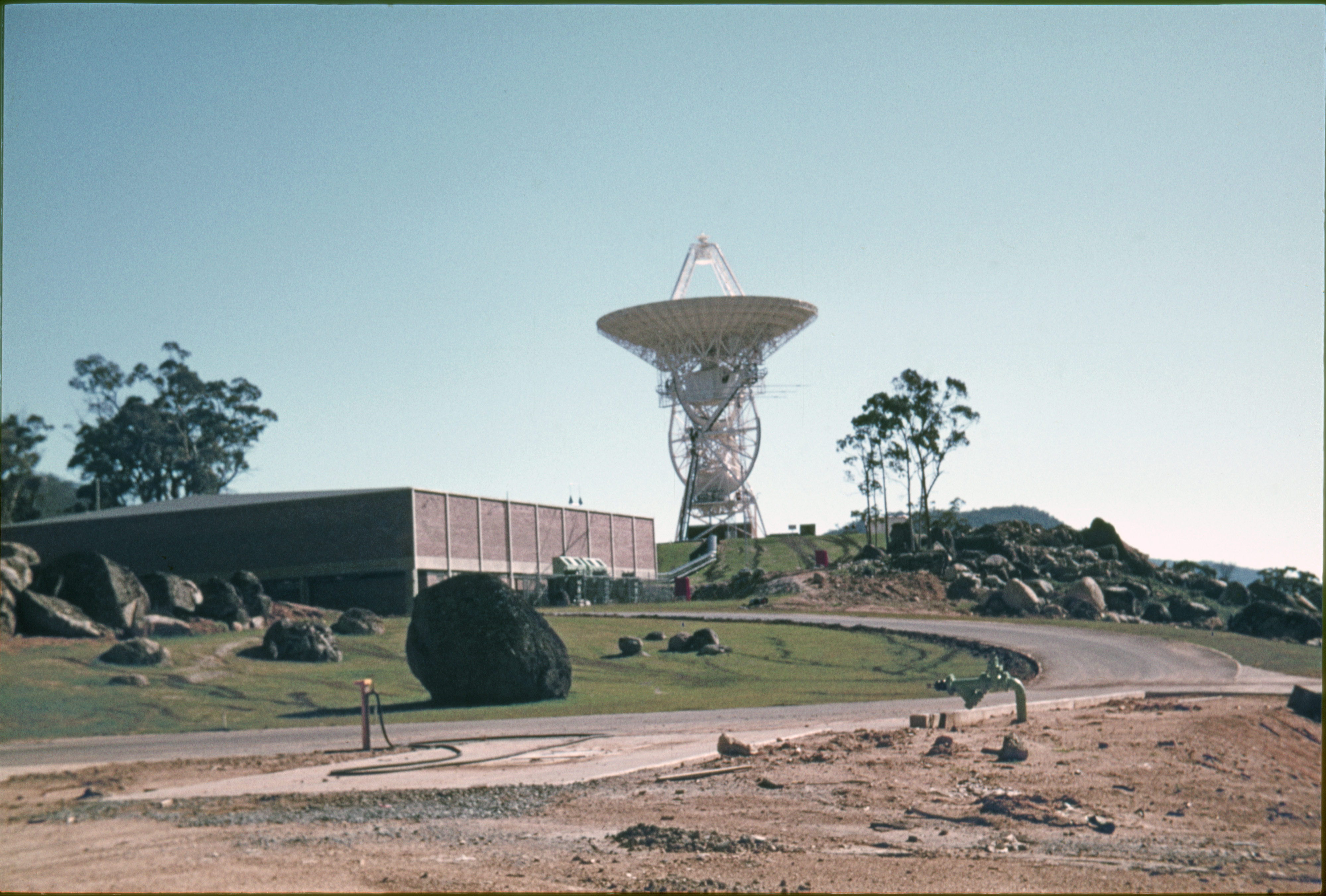 |
Honeysuckle’s Ian Hahn took this photo of the same spot in 1966. |
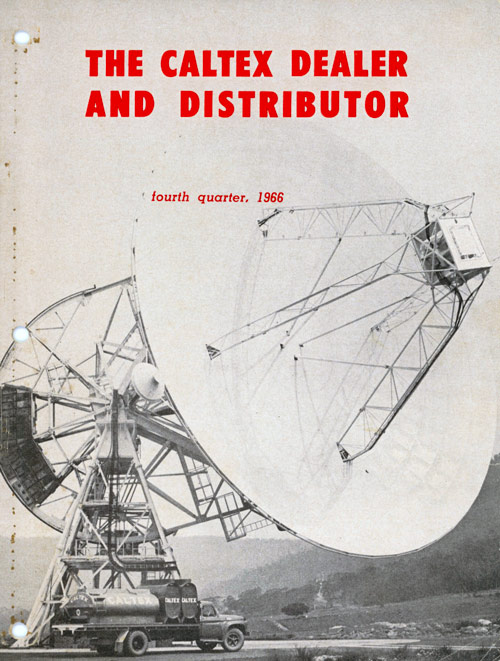 |
The Orroral Valley 85-foot antenna is featured on the cover of The Caltex Dealer and Distributor, Fourth Quarter, 1966. Click the image for a 25MB PDF file. Honeysuckle’s Bernard Smith preserved this copy. Scanned by Colin Mackellar. The text of the (very good) article is also reproduced below – |
TEN miles south of Canberra on the Monaro Highway, the signpost points to Tharwa. The bitumen gives way to patches of gravel and winds through lush grazing country. Cattle graze and sheep are chest high in the green sward which sweeps westward to the mountain range. The road sweeps past the Lan-yon property – now famous as the scene of the barbecue for L.B.J. – and heads towards a row of poplar trees marking the bank of the Murrumbidgee River with its bridge and cluster of houses which shelter the 51 residents of the village of Tharwa. Tharwa has a post office, school, a store, two gasoline pumps (both Caltex) and a Caltex distributor – Val Jeffery. Val has been the Caltex distributor in the area surrounding Tharwa for the past 11 years. He runs the store (everything from horseshoes to horse radish), as did his father before him, he runs the two gasoline pumps outside the store (15,000 gallons last year), and he runs the distributorship, employing a driver, Rex Eades, and two trucks. Up to fairly recently, Val's business comprised the usual rural accounts in the valleys and hills surrounding Tharwa. But the advent of the space age has resulted in Val Jeffery becoming a VIP in the plans by the United States Government to probe outer space and put a man on the moon. To understand Val’s importance in the scheme of things one must take the winding road, which quickly degenerates into a bush track in parts, west from Tharwa into the mountains of the Great Dividing Range. Here, in two adjoining valleys, separated from each other by towering rocky hills, the Australian Department of Supply, on behalf of the United States National Aeronautics and Space Administration (N.A.S.A.), has built two of the worldwide network of tracking stations necessary to the furtherance of the space programmes. Both of these stations, Orroral Valley and Honeysuckle Creek, are about 3,500 feet above sea level. The road, which is now being sealed and improved, provides its share of dust in the summer months and snow in the winter. It is over the roads to the tracking stations that Val and Rex take product four times a week to keep the stations operable. The Australian and United States Governments have entered into a co-operative agreement tc facilitate the space flight operations being conducted by the United States under which Australia has undertaken to establish and operate a number of tracking stations. The Weapons Research Establishment is the responsible agency within the Australian Department of Supply for implementing Australia's commitment with regard to the Australian stations. As a matter of policy, Australian industry is being encouraged to participate in these space-tracking activities and the establishment at Orroral Valley is being operated by E.M.I. Electronics (Australia) Pty. Limited in association with Hunting Engineering (Australia) Pty. Limited and the station at Honeysuckle Creek by Standard Telephones and Cables Pty. Limited. Caltex holds contracts for supply of product to both these companies and Val Jeffery is the man entrusted to get it there. To understand the requirements necessary to maintain a tracking station one must first learn a little about their operation and siting. To site a tracking station one must first establish that the area in relation to other tracking stations throughout the world is geographically suitable. For instance, the Honeysuckle Creek complex has been erected in connection with the manned flight to the moon. It will work in collaboration with two similar stations, also geared to the Apollo mission, located approximately 120 degrees apart on the earth's circumference, at Madrid in Spain, and California in the U.S.A. Next requirement is that the area is free from outside electrical interference. Where it is necessary to screen stations from extraneous sources of electrical interference, such as from nearby towns or cities, they are sited in a bowl of hills. Movement of motor vehicles is usually restricted within a defined radius of the station complex when tracking operations are in progress. To this end, red warning lights flash and messages ordering motor vehicle drivers to switch off engines are broadcast during tracking. The tracking stations do not utilise town electricity but rely for all power on diesel operated Caterpillar alternator sets. These banks of bright yellow alternators are huge consumers of Caltex distillate. The tracking stations are remotely situated from normal places of habitation. Because of this, personnel have to commute daily from Canberra, 40 miles by road. A fleet of motor cars brings the station staff to and from work daily. In the case of the Orroral Valley facility, which is part of the Space Tracking and Data Acquisition Network (S.T.A.D.A.N.), the station is concerned with monitoring and receiving signals from the 30-odd scientific satellites orbiting the earth and sending back photographs and scientific data. The station has to be manned 24 hours a day. To achieve this, three shifts are worked and the transport vehicles are travelling from Canberra to the site almost around the clock. Caltex supplies the fuel and lubricants. Orroral Valley has been operational since May this year. Honeysuckle Creek is due to commence operation in the near future. The Orroral Valley station has one 85 ft. parabolic antenna and five smaller antennae. The large dish is used to track and pass commands to satellites and to receive data transmitted from them. Of the smaller antennae, three are used to receive data and two to transmit command functions to the satellites. Modern satellites have facilities for recording and storing specific data. Orroral Valley can lock on to a satellite when it comes into range, command the satellite to transmit the recorded data, record the data as it is transmitted, and, just before the satellite passes out of range, command it to switch off again. The data received can be transmitted live to the Goddard Space Flight Centre at Greenbelt, Maryland, over telephone links which are routed through the NASCOM facility at the Deakin telephone exchange in Canberra. Teleprinter links are also provided. These lines are hired on a permanent basis and form a vital link between stations in the Canberra area and the world-wide network of N.A.S.A. Once a week, the Goddard Centre, by teleprinter, sends stations their satellite schedules for the week. Instructions include the type of satellite to be monitored, the approximate position to locate it and its orbital path. The data acquired will either be sent back in “real time” (as received), by teleprinter, or recorded on magnetic tape and the tapes flown by aircraft to the U.S.A. The latter method stipulates yet another requirement for the siting of a tracking station. It should be, preferably, close to an airport to enable the rapid despatch of tapes. Orroral Valley, each month, requires 21,000 gallons of distillate for its power alternators and 4,000 gallons of Astron gasoline for its vehicles. The antennae operate hydraulically and Caltex supplies the hydraulic oils. The gear boxes for the antennae use Regal A (R. & O.) and the main bearings, Caltex Uni-Temp Grease with Caltex Multi-Purpose No. 2, for general lubrication. The cog teeth of the giant 85 ft. diameter dish antenna are lubricated with Crater 2X fluid. Val Jeffery or his driver Rex Eades makes four trips each week to each station with product. In winter, when snow lies heavily on the mountains he sets off at 4.30 a.m. while the frost keeps the snow frozen solid. In the worst of the winter weather he can only haul half loads to the stations. Orroral Valley was once a sheep grazing property and is set in a rural valley. The click of the shears has now given way to the blip of the spheres. Honeysuckle Creek, on the other hand, is located in rough mountainous country with huge granite outcrops and eucalypt-clad peaks towering over the antenna. Project Apollo, of which Honeysuckle Creek will be a prime station, is the biggest and most complex project of the United States manned space flight programme. Its goal is to land American astronauts on the moon and return them safely to earth. The tracking station at Honeysuckle Creek will be manned and operated continuously while such activities are in progress. Although, during “off” missions periods, the staff may normally lead a 9 to 5 existence, during missions they will be required to be either operating or standing by their equipment. The station is equipped with sleeping accommodation for rest occasions. Under the agreements between the Commonwealth Department of Supply and the Australian contractors, the Department appoints a Director to each station. The Australian contractors, E.M.I. and S.T.C., are responsible to the Department for operating and maintaining the facility. |
Memories
The Tharwa General Store was a place of many happy memories for Orroral and Honeysuckle space trackers, as well as the local community.
Honeysuckle’s Mike Linney recalls,
“The Tharwa Pub – Oh what a feeling!! There had been a number of times, especially during the summer months, after a long mission or a strenuous SRT when we would stop-off at the Tharwa ‘safe house’ (Pub), and have a cold one. There was just enough space to park a few of the station cars out the front. We would all sit around the old wooden veranda steps and enjoy a laugh at ‘what ever’, much to the amusement of the few locals.”
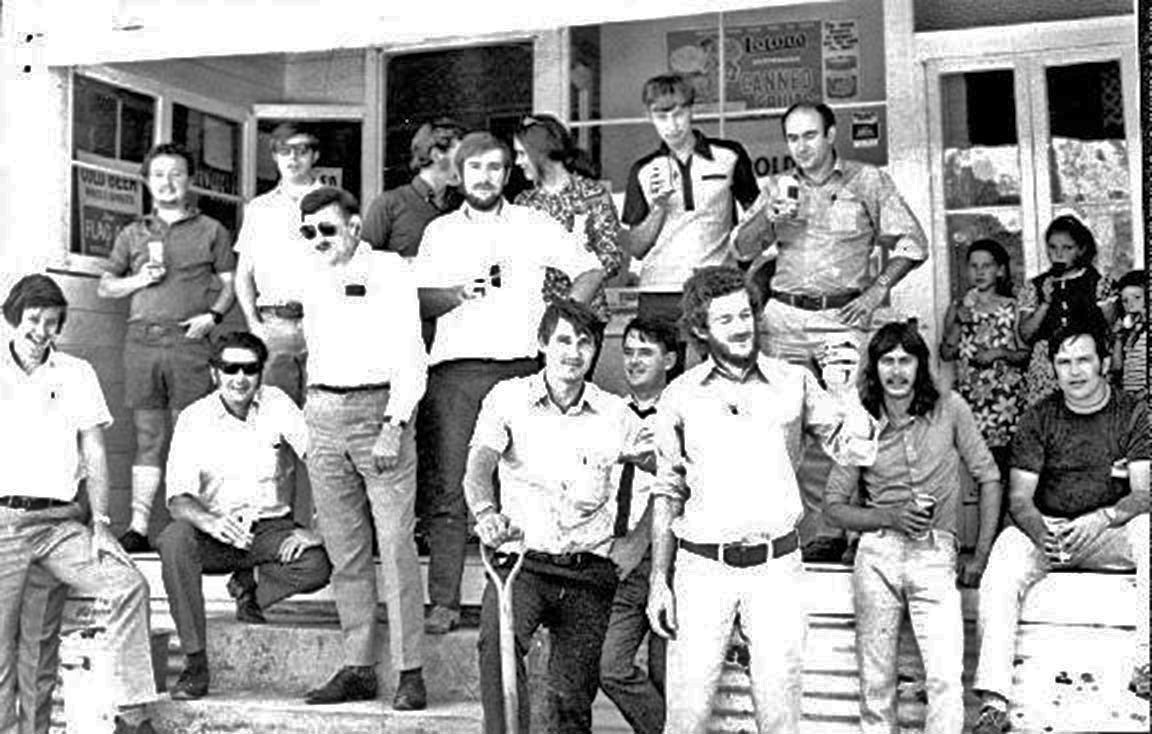 |
Some of the Honeysuckle team at the Tharwa Post Office / store in 1972. Back Row Front from Left Scan: John Berry. With thanks to John Saxon and Ian Edgar for help with the names. |
 |
And, thanks to Glen Nagle, here’s an enhanced and colourised version. |
Lster years
In 2004, during the Apollo 11 35th anniversary celebrations, Honeysuckle’s John Mitchell, who’d lived in Tharwa with his family in the early Apollo days, returned to visit his old friend Val Jeffrey. Hamish Lindsay was on hand to take these photos –
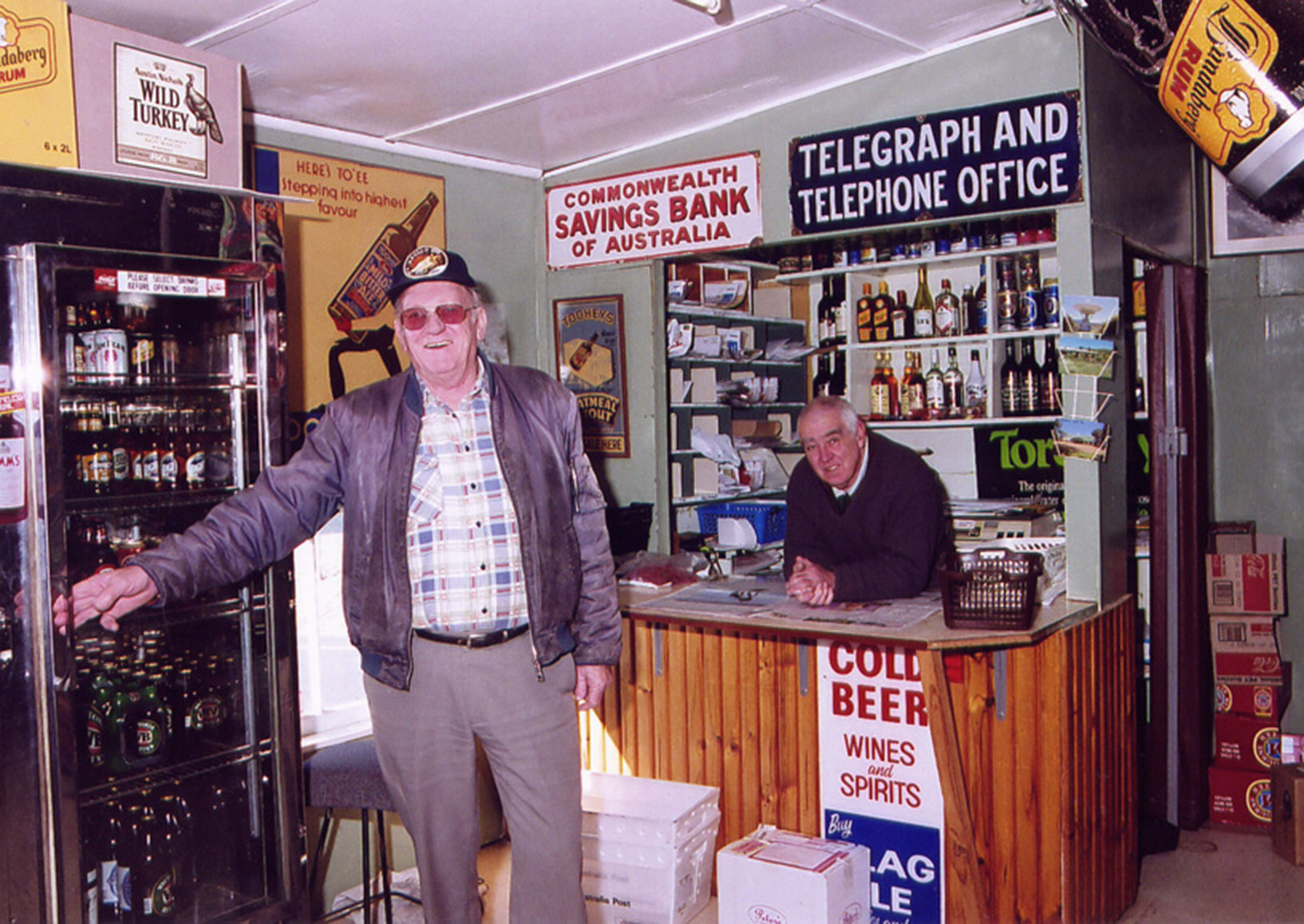 |
John Mitchell and Tharwa’s Val Jeffery during the Apollo 11 35th anniversary celebrations in 2004. |
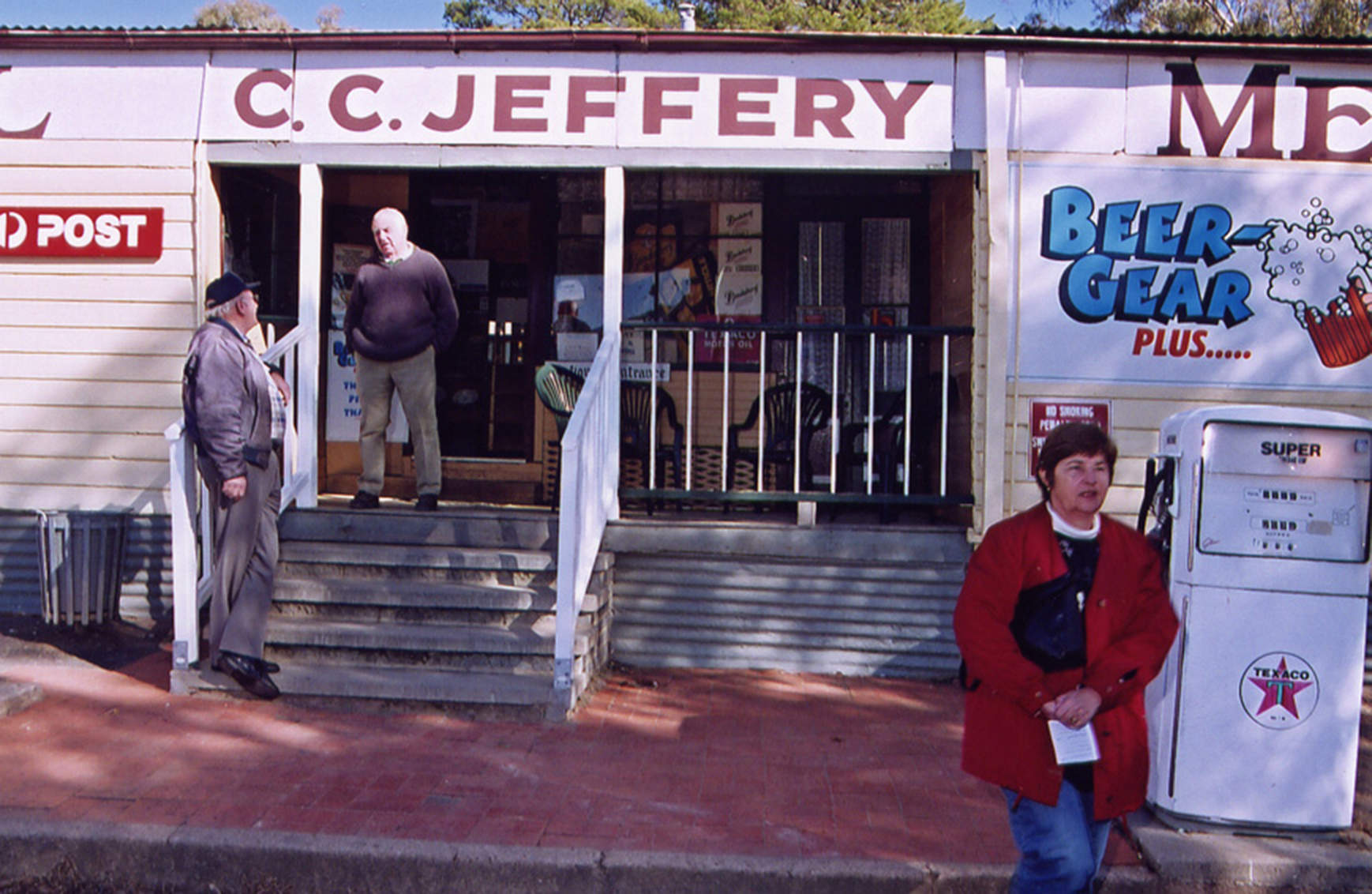 |
The outside of Jefferys Store in Tharwa, July 2004. |
As well as his varied duties in the shop and being the Caltex distributor, Val had many connections in the local community.
For 38 years he was Captain of the local bushfire brigade. He campaigned for changes to Australian Capital Territory fire management after the disastrous 2003 fires.
In 2016 he was elected as the oldest (at 81) Member of the ACT’s Legislative Assembly.
Val’s death in 2017 left a hole in the Tharwa community, but his legacy both in Tharwa and at the tracking stations will be long remembered.
___________