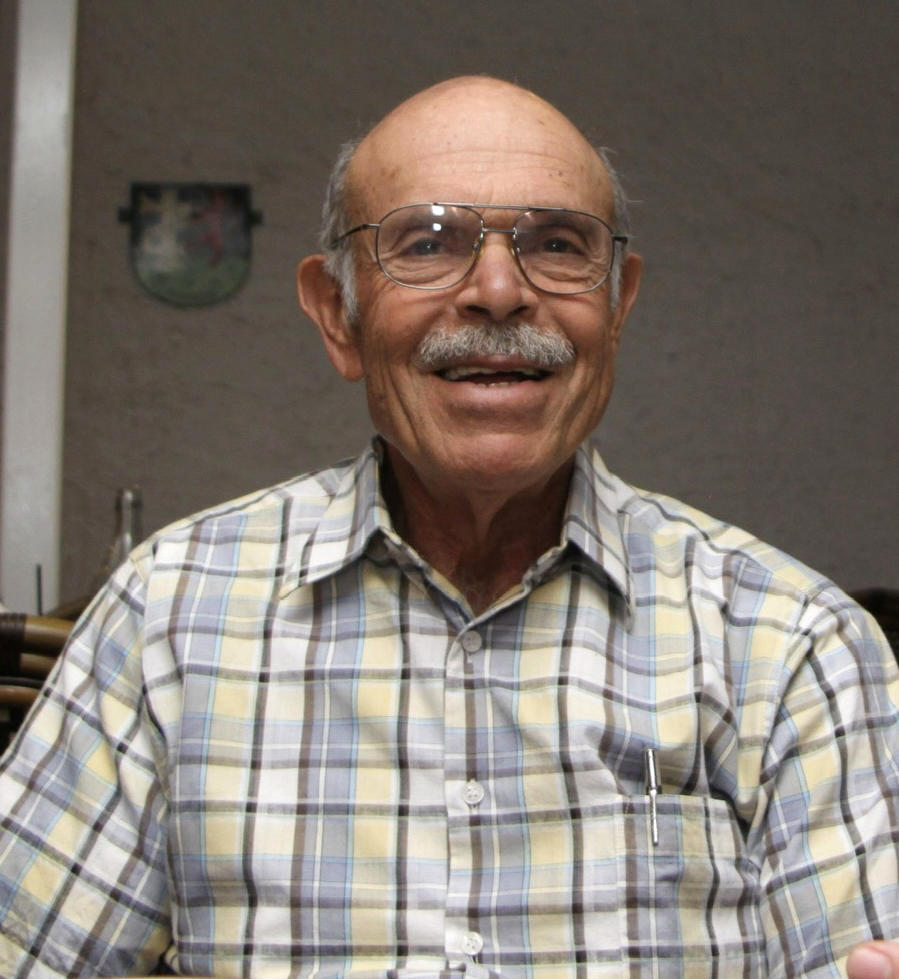
Dave Scaff
Engineer, Jet Propulsion Laboratory
23 May 1937 – 17 December 2025
|
David M. Scaff – Photo by Bruce Window. |
John Heath shares this tribute –
I first met David Mitchell Scaff, usually addressed as Dave, or simply as Scaff, in late 1963, when I was a member of the initial group of Tidbinbilla engineers to visit JPL for familiarisation/training.
I was what was then called the Microwave engineer whose responsibilities were the main tracking feed, the acquisition tracking feed, the travelling wave maser, the parametric amplifier, the test antenna mounted on the collimation tower and all the system’s interconnecting waveguide and coaxial cables. The responsibility for this group of equipment within the JPL system was shared between three engineers, one of them being Dave, whose responsibility was for the parametric amplifier and the test antenna.
Dave was born in Fresno, in the fertile, fruit growing area of the San Joaquin Valley, roughly equidistant between San Francisco and Los Angeles. From the outset he went out of his way to ensure I was given the best training possible. On the personal side, he and his wife Lois became instant family friends, so much so that my wife Joan and I, got to know their parents almost as well as we did Dave and Lois. They were just great people.
The friendship commenced barely a week after I arrived in Los Angeles when Dave generously offered to drive me to the LA airport to meet my wife on 14 September 1963, when she was arriving from the UK. His wife Lois came with him. This was the start of a friendship that lasted a lifetime.
Dave never failed to offer help workwise or personal, whenever it was needed. JPL at the time was a thriving, dynamic and most exciting place to be. I was most impressed that it possessed a helicopter to transport its engineers to various companies within the huge LA area that supplied component parts for the tracking stations, and an Aero Commander commuter aircraft, that was used to transport personnel, and when circumstances dictated, the speedy delivery of small items of equipment, between JPL and Goldstone.
 |
Island Lagoon’s Pat Delgado with JPL’s helicopter at Goldstone in 1965. Scan: Jan Delgado. |
During the time I was at JPL, Dave organised several flights on both types of aircraft and I accompanied him on a few of them. He also arranged for me to accompany him to the Radiation Company located in Melbourne, Florida to witness the acceptance testing of the S-band Test Antenna (STA) that was destined for Tidbinbilla. Whilst visiting Melbourne we also had a quick tour of Cape Canaveral.
Once the maser’s reliability had been established, the lower performing paramp was retained as a back-up until it was replaced by a second maser. This resulted in Dave’s involvement with the station tapering off until the station was upgraded in 1966/67 to participate in the Apollo programme. Dave’s involvement in this was to produce a large box of electrical switches that was christened The Scaff Box, that enabled the microwave and transmitter equipment on the antenna to be safely and quickly connected to either the Apollo receiver equipment or the Deep Space Network receiver equipment, depending on the mission being supported.
Although my space tracking career ended in 1973, the Heath family was fortunate to be able to meet up with the Scaffs on eight or nine occasions in the USA, New Zealand and the UK (England and Scotland but not my native Wales), as well as here in Australia.
The association of Dave and his family with my family has spanned over sixty years as is recorded in these two photos –
The first is of the Scaff and Heath families in 1964 with their newborn sons and was taken at the end of my time at JPL. The Scaffs went on to have two more sons, the Heaths a daughter.
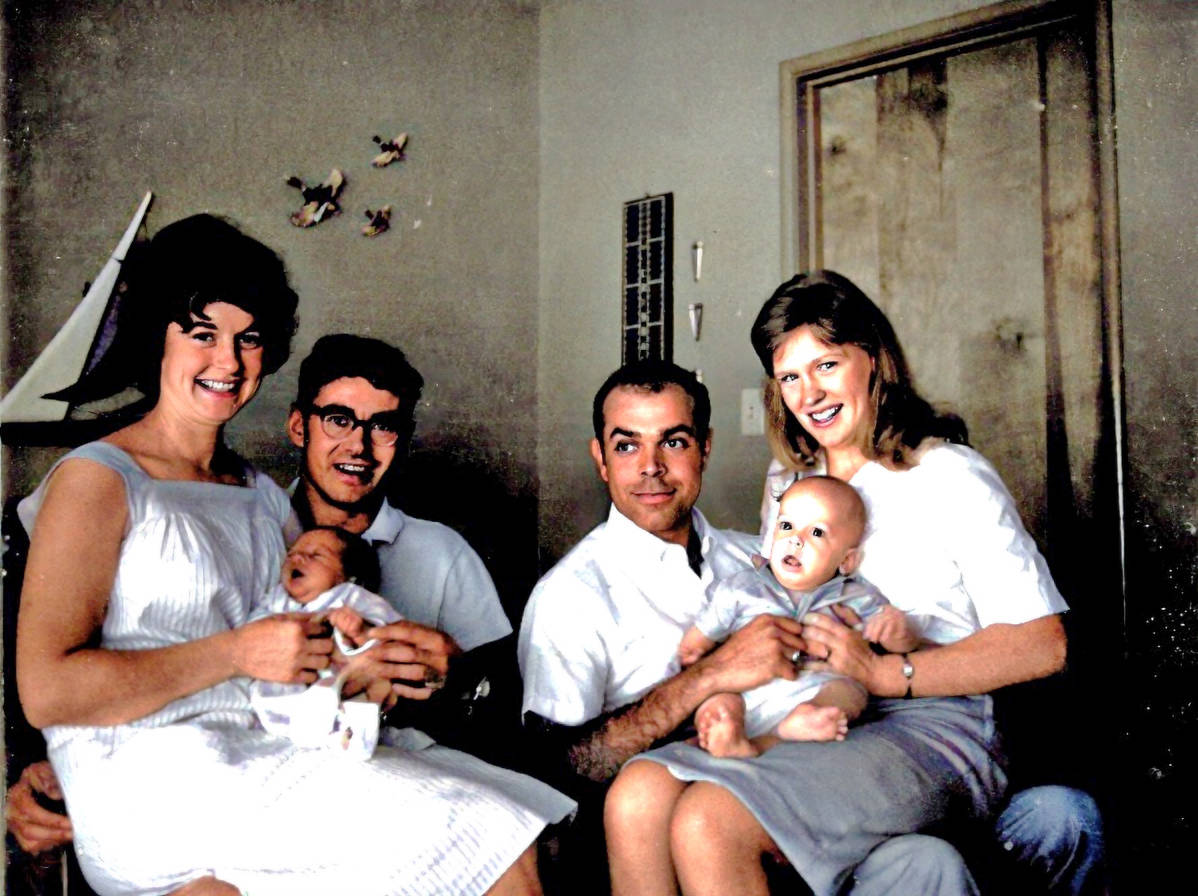 |
Joan and John Heath and Dave and Lois Scaff and their newborn sons, 1964. |
The second photo is of Caro, Heath and Scaff and was taken in 2023.
Ed Caro was, or I should say is, an engineer mainly involved in the development of radio altimeters for various soft landing spacecraft JPL sent to the various planets. Ed, who, like Dave, spent his entire career working at JPL, is well into his nineties, and is still designing radio altimeters.
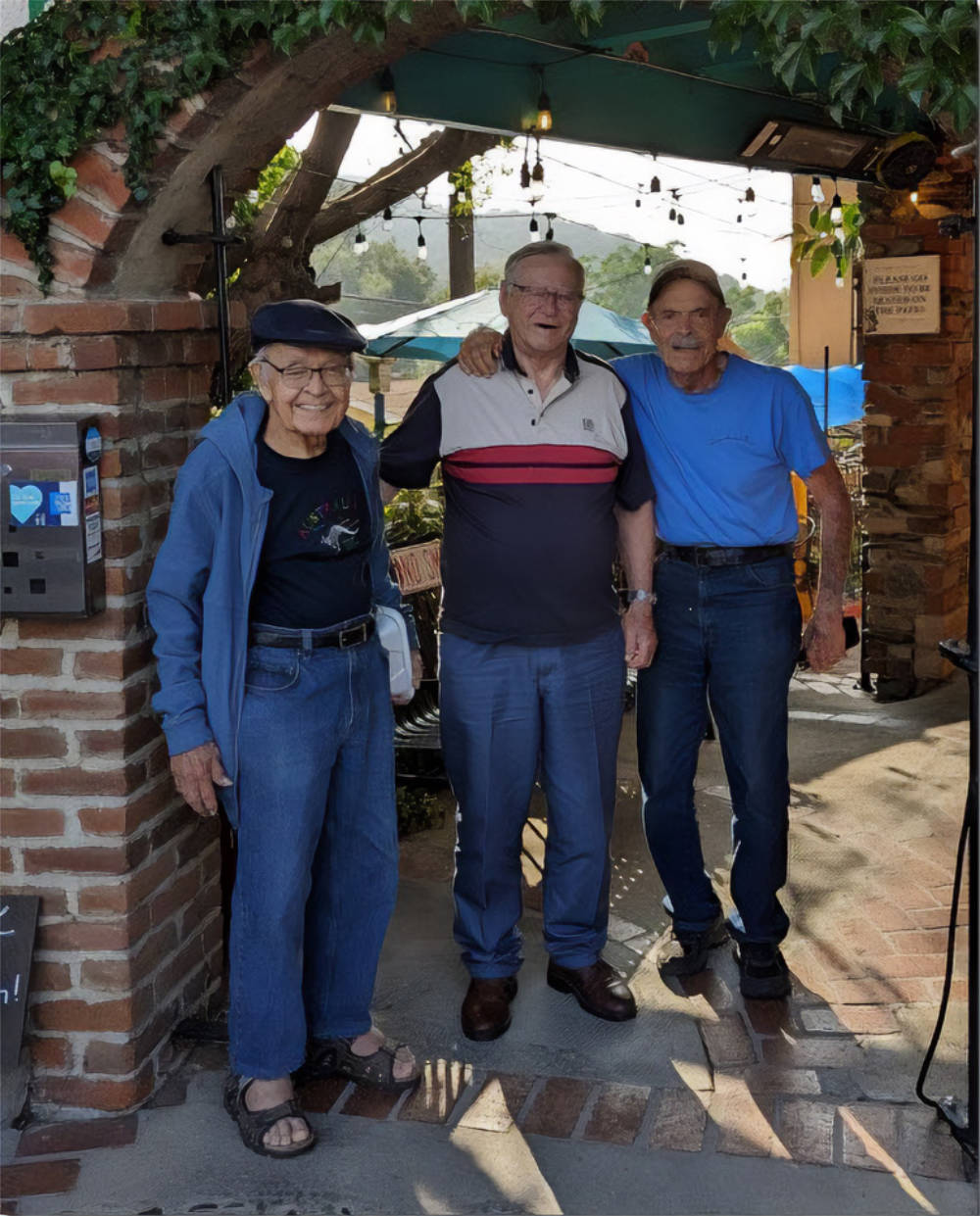 |
Ed Caro, John Heath and Dave Scaff, Los Angeles, 2023. |
This meeting of Ed, Dave and I was the last time I saw my long-time friend.
RIP Dave.
_______________
Bruce Window shares this tribute –
I got to know Dave in 1965-66 when I was Ops Supervisor at DSS42 Tidbinbilla.
After DSS42 was released from Mariner Mars IV he came to install equipment (locally known as the Scaff Box) to switch the RF “front end” equipment of our Station, Receiving and Transmitting, which was designed purely for Deep Space missions, to support Manned Flight Apollo missions.
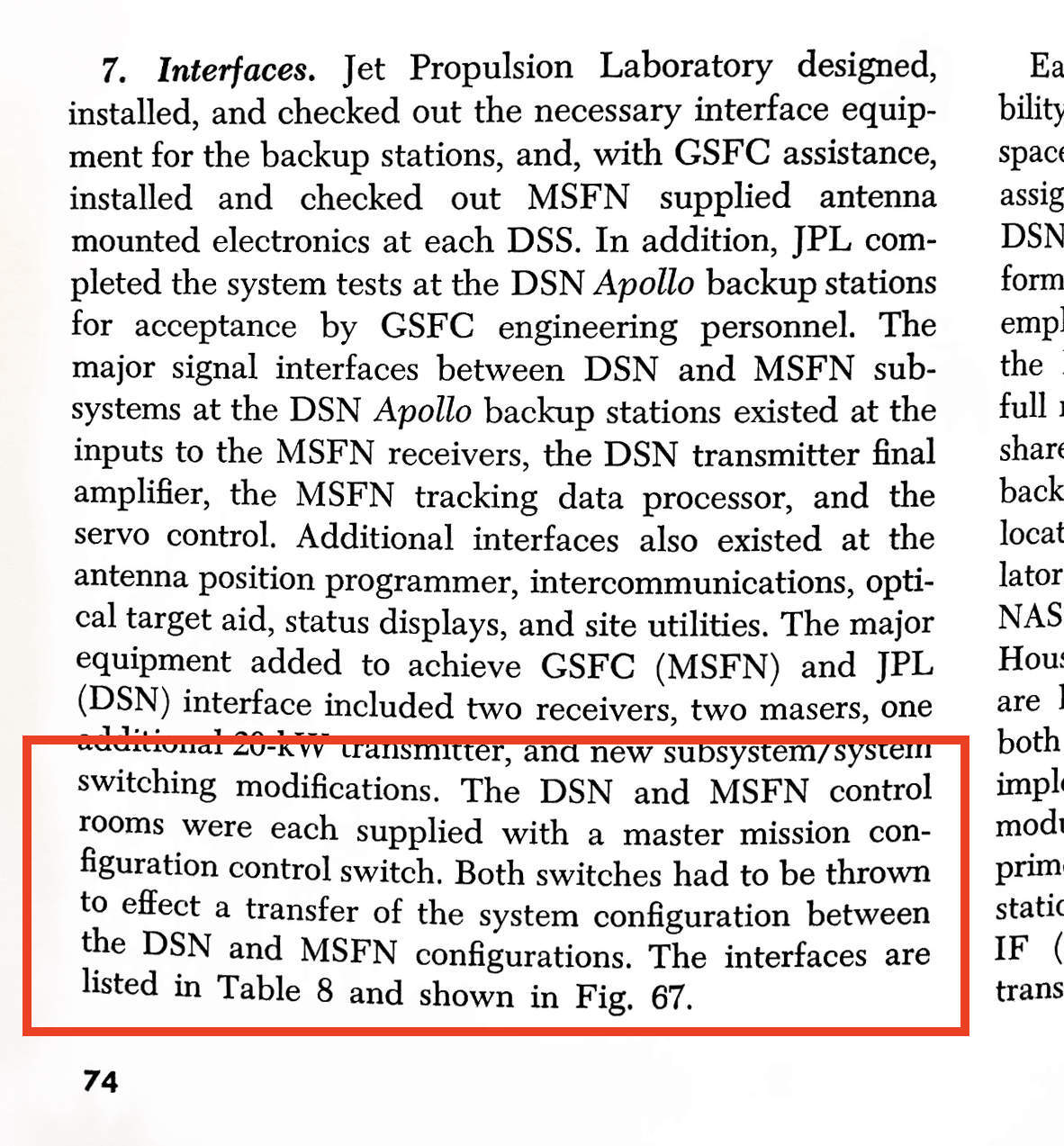 |
This extract from JPL Technical Memorandum 33-452, Vol. 1, page 74, gives a feel for the complexity of switching DSS42 from DSN to MSFN control. |
Dave was a gregarious sort of guy that was easy to get to know. He played volleyball with us during the off-times. I invited him to my home in Canberra a couple of times to meet my young family and we became good friends.
In later years when I was USB Supervisor of Honeysuckle Wing at Tidbinbilla, his equipment worked perfectly.
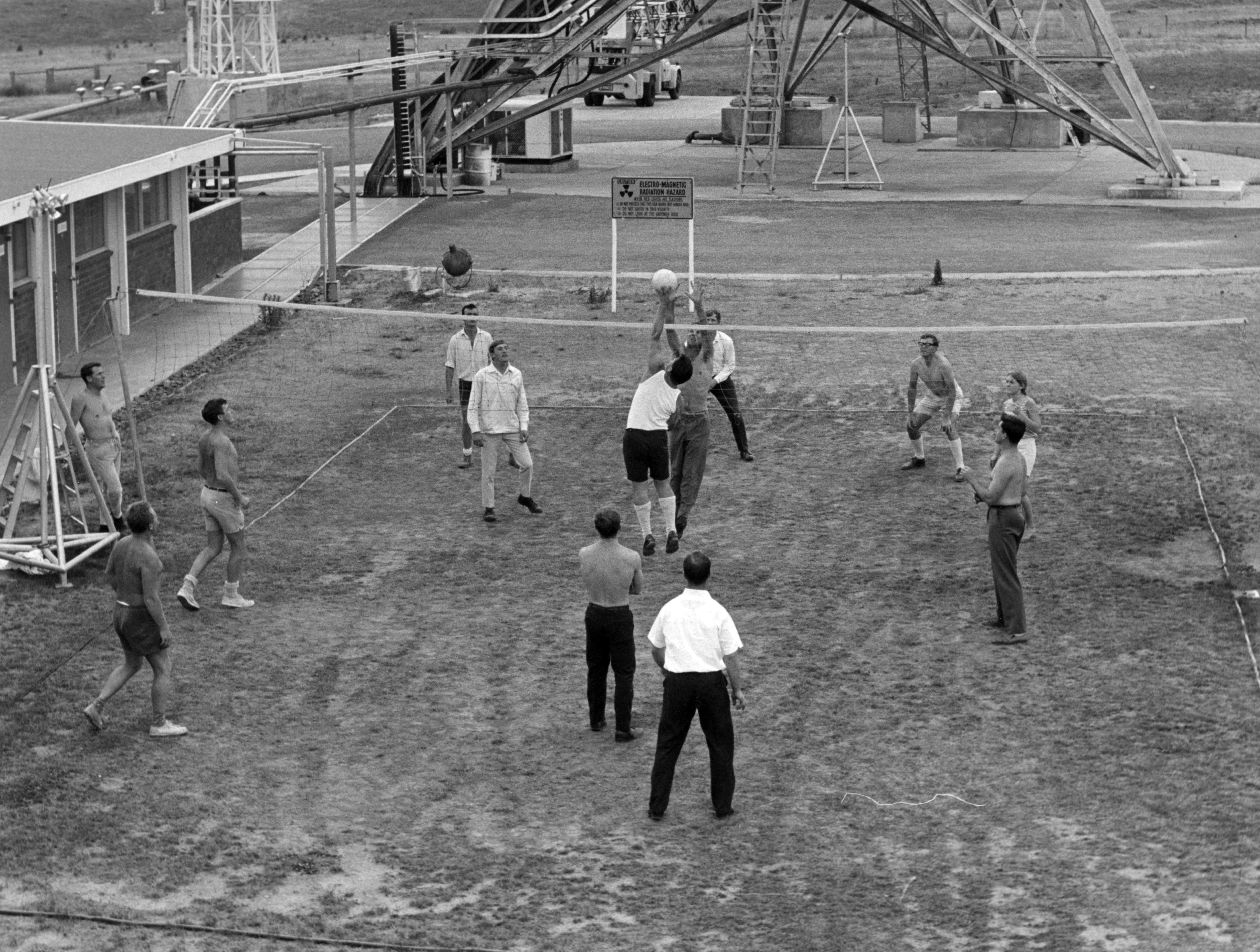 |
“He played volleyball with us during the off-times.” While Dave Scaff is not in this particular photo, it shows the lunchtime volleyball game on ground between the Ops building and the 85-foot antenna. Photo preserved by Stew Burton. |
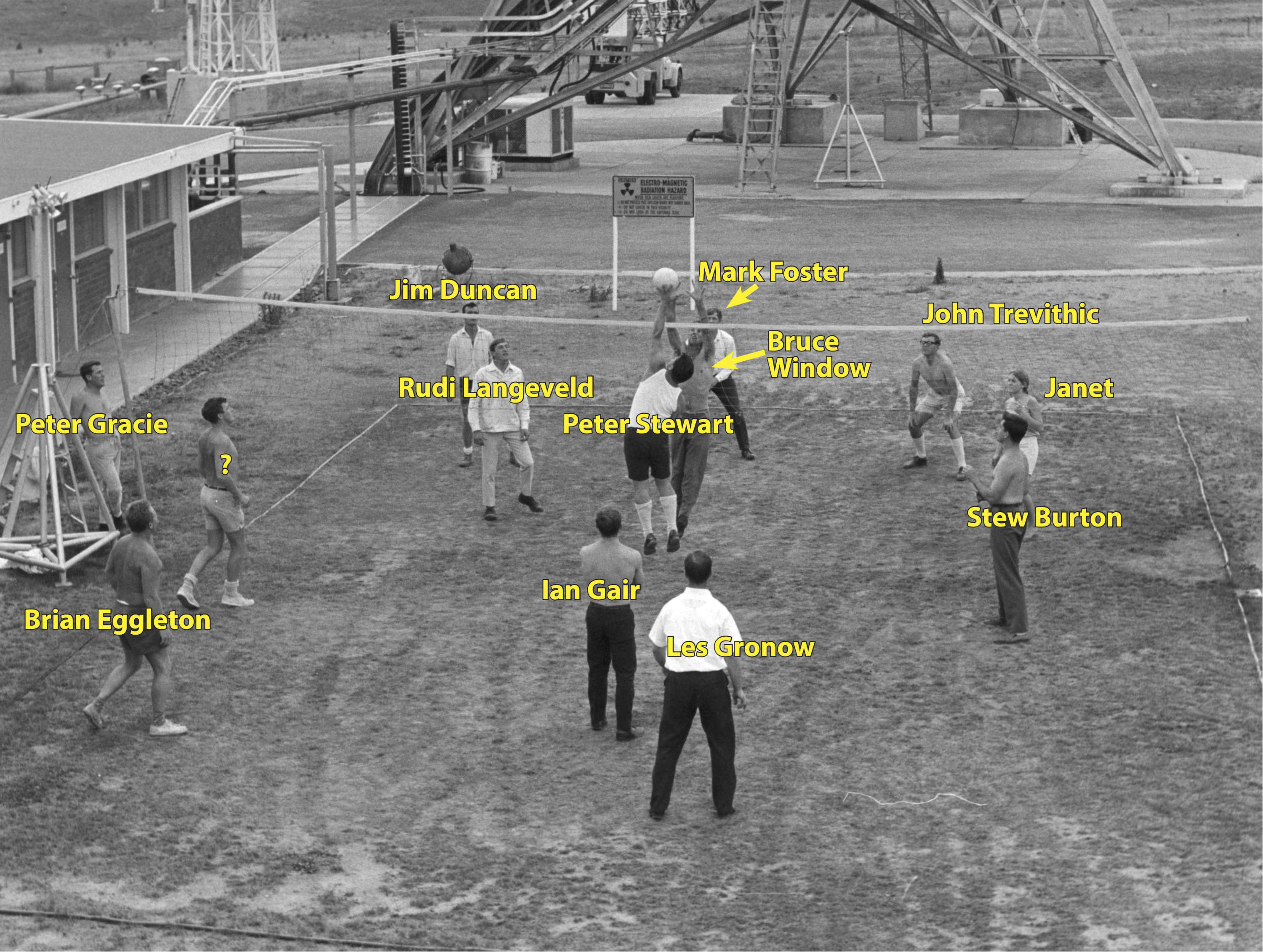 |
Here is a key to the photo. |
In 1970, when I spent 6 months at JPL with the Design Engineers on DSS43, I renewed and strengthened my friendship with Dave and his family. We became close friends and our families celebrated card nights, birthdays and National events.
In later years after I had left Tidbinbilla, we stayed at his house at La Crescenta several times while travelling to Alaska and to Europe. We holidayed with Dave and his wife Lois as they explored Darwin and Kakadu. They visited us in Brisbane several times, the last being in August 2017.
Dave was a dear friend, highly committed to his job at JPL, and a good soft-ball player into his later years.
 |
Written around 1993 or 1994, this paper gives a good idea of the formidable challenges facing the Deep Space Network during planetary encounters, and the amazing success achieved. (This copy does not include the pictures which are referenced.) Click the image for a 3.7MB PDF file. |
_______________
and from this online tribute:
“Born in Fresno, California, into a farming family in one of the Central Valley’s most productive agricultural communities, David grew up in Clovis. He graduated from Clovis High School in 1955, where he was an active member of the band and the California Scholarship Federation (CSF).
David pursued his passion for innovation at Stanford University, earning a Bachelor of Science in Electrical Engineering (BSEE) in 1959. During his time there, he joined the Phi Sigma Kappa fraternity and played saxophone in the Stanford Band. He later earned a Master of Science in Electrical Engineering (MSEE) from the University of Southern California in 1968.
David’s exciting career at NASA’s Jet Propulsion Laboratory (JPL) in La Cañada Flintridge spanned 44 years, from 1959 to 2003. As a key contributor to the Deep Space Network (DSN)—NASA’s global system for communicating with distant spacecraft—he dedicated his professional life to enabling groundbreaking missions that expanded humanity's understanding of the universe.
His duties included development, qualification testing, installation, and operator training at field sites across the globe, such as Goldstone (California), Johannesburg (South Africa), Canberra (Australia), Madrid (Spain), and Woomera (Australia). David always stressed the importance of teamwork in all endeavors. While the space exploration itself was thrilling, the international travel created unique opportunities for lifelong friendships with colleagues and partners—relationships he cherished to the very end.
A lifelong member of the IEEE, David’s expertise in radio frequency subsystems, telecommunications, and radar systems supported historic endeavors. These included Mariner 9, the first spacecraft to orbit Mars; the Viking orbiters; and the Voyager 1 and 2 probes, which continue to transmit data from interstellar space as of 2025, over 15 billion miles from Earth. His roles ranged from technical oversight to deputy systems engineering, leaving an indelible mark on missions such as SEASAT, Magellan, Galileo, Cassini, and Juno.”
– Source: Dignity Memorial and Boice Funeral Home in Clovis, California.