
Pat Delgado in 2008.
Pat Delgado
1919–2009
Island
Lagoon
|
Pat Delgado in 2008. |
In 1961 I transferred from the Woomera Missile Range to DSIF 41 and was there until 1966.
During that time I operated and maintained equipment in the servo section of the dish.
The work called for a great variety of shift times, sometimes extending up to 28 hours non-stop if there was an equipment or a dish drive crisis. It was a case of becoming thoroughly familiar with every part of the system I was responsible for. Any malfunction of the system when tracking a spacecraft called for almost instantaneous recognition and correction of the fault. Any loss of tracking time was considered a disaster. You should have seen me going up those dish ladders sometimes. I considered sliding down the ladder handrails for quickness but the joins in them would make your eyes water!
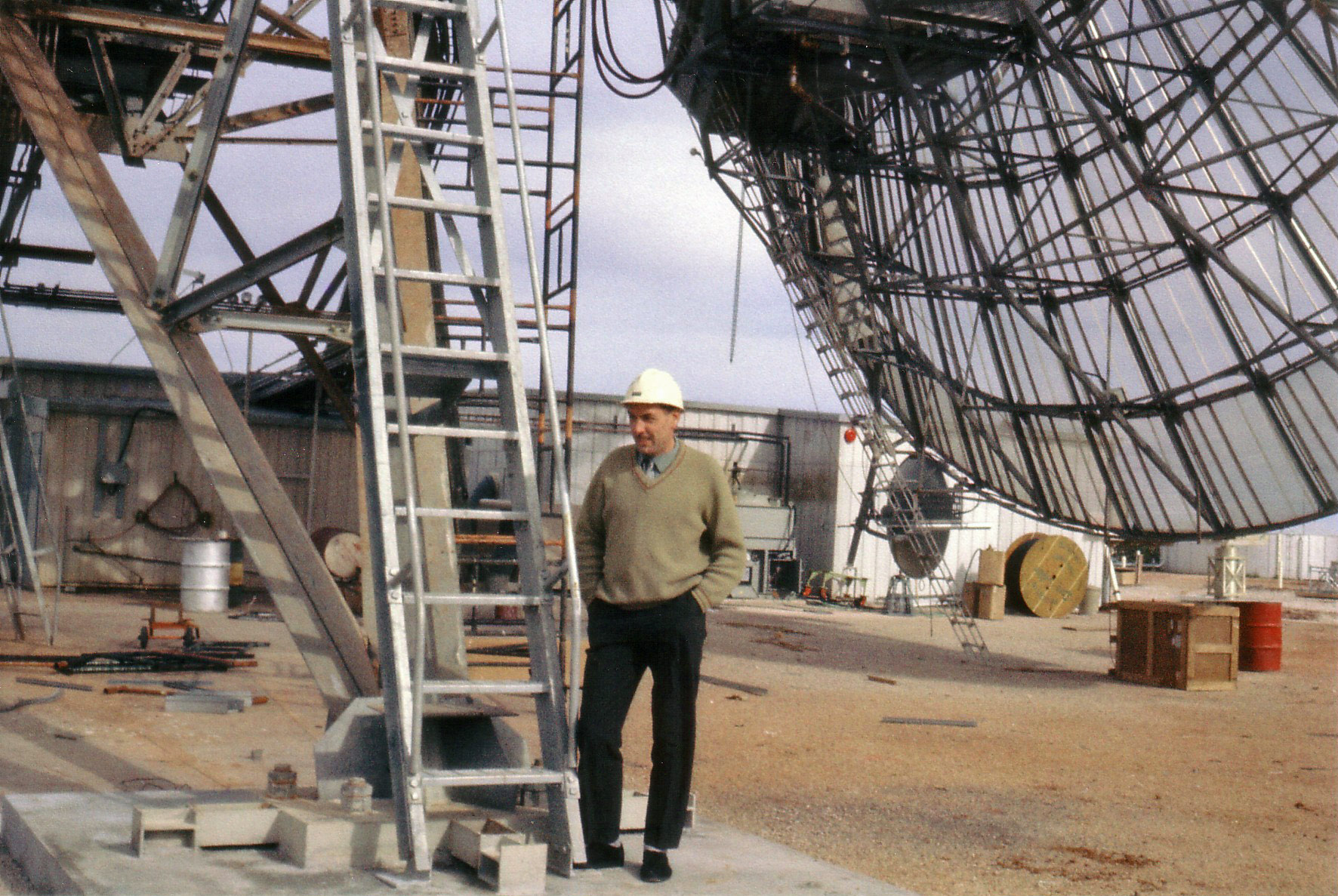 |
Pat Delgado at DSIF 41 in 1963. Scan: Jan Delgado. |
On some lengthy tracking sessions meals were supplied in the HQ building and it was an in-joke at the time that some of the operations teams were gaining a yellow pallor through devouring such huge quantities of scrambled eggs!
There was a short period when I was transferred to Minitrack while parts of the dish system were being serviced. I operated the tracking equipment there and the large Baker Nunn camera. The most difficult part of the latter was developing the films in total darkness doing everything by feel.
Strangely, after I left Island Lagoon and tracking spacecraft, my next job was installing and testing analytical instruments in Polaris nuclear submarines under the Atlantic.
I will never forget the time I spent at Island Lagoon. It was the early years of space exploration and working on such state of the art equipment and being on the leading edge of space technology created a great team spirit and was both exciting and very rewarding.
_________
Not long before he left Island Lagoon, Pat received a personal reference from Minitrack’s Station Director Eric Hird.
While Pat would doubtless be embarrassed by the glowing description, this reference also gives a feel for space tracking at Woomera in the mid-1960s, and for that reason we include it here:
Reference from Minitrack’s Station Director Eric Hird –
|
Pat Delgado doing some system checks in the control room in 1962.
Photo: Pat Delgado.
Back in England, Pat, and a friend, Colin Andrews, carried out a great deal of research into crop circles in the UK.
Colin Andrews created this tribute to Pat.
______________
Twenty-one years before joining the team at Island Lagoon, Pat was among the 338,000 Allied soldiers evacuated from Dunkirk, in the north of France, between 26 May and 4 June 1940.
His account of being evacuated from Dunkirk is harrowing reading–
Pat Delgado’s experience at Dunkirk – May/June 1940
Our RAOC [Royal Army Ordnance Corps] workshop unit stationed in Loos had to get to Dunkirk, fifty miles away to the north.
We boarded our machine lorries but soon abandoned them as the roads were too dangerous with advancing German troops. We smashed our vehicle engines and workshop machinery so they could not be used before continuing the remaining forty miles to the coast on foot.
We were ambushed a few times on the way by motorcycle machine gun units and our members began to dwindle. During this retreat and being a Lance Corporal I was ordered to take four men back to the last crossroads we had passed and hold back any German tanks with a Boyes anti-tank rifle. We stuck this for about half a day managing to reduce the German army by about five men in a scout car. We retired and caught up with the remainder of our unit until reaching Dunkirk railway station. It was here we witnessed a long Red Cross train being strafed and bombed, bodies everywhere.
As we had not slept for three days we dragged ourselves up into a warehouse on the docks but were awakened a few hours later to find two outside walls of the building were missing through being bombed.
I was then ordered to take eight men and unload landmines from a ship at the docks. While doing this bombs were falling all around us. We decided to leap over the side of the ship to avoid a potential vast explosion but were shot at by a Naval officer and told to come back. We did not and five minutes later the ship was hit and practically disappeared.
Scrambling along among rubble on the road through an area of shops, I passed a jewellers with its goods spilled out on to the path but this meant nothing to me. A few doors along was a house with its front wall missing but in the room was an old lady still sitting in her rocking chair. She was dead but the chair was still slightly rocking.
I do not remember much more other than falling on to some kind of old boat where I passed out but came to outside the harbour with the whine of aircraft bullets ricocheting off metalwork all around me.
I “came to” again at Peacehaven and was having a mug of tea given to me. My battledress was in shreds and with three or four of my unit friends we were sent to Southsea Barracks where we were given a complete new kit and Army number.
I had originally been called up at the age of 20 for six months militia training on July 15th 1939. Two weeks after war was declared I was in France never having fired a rifle.
As a point of interest and as a comparison to present conditions I was married in December 1941 and was sent overseas a couple of weeks later and never saw my wife again for five years. I still have occasional nightmares about Dunkirk.
Pat Delgado
Alresford
Hampshire2004.
 |
Pat Delgado on the dish – the camera is looking towards the power house. 1962. |
 |
Pat Delgado with Goldstone’s helicopter, during their visit for the L to S-band conversion. Larger version. Largest version. |
 |
The Holiday Inn at Barstow, where the Island Lagoon team stayed during their visit for the L to S-band conversion. Larger version. Largest version. Scan: Jan Delgado. |
Pat enjoyed painting local scenes. These below are from 1966.
 |
Pimba, 1966. Painting by Pat Delgado. Photo: Jan Delgado. |
 |
Island Lagoon, 1966. Painting by Pat Delgado. Photo: Jan Delgado. |
 |
Island Lagoon with the dish in the middle, behind it the HQ buildings, to the right the Baker Nunn camera and on the very edge of the right hand side that must be Minitrack. Probably from the col tower area. 1966. Painting by Pat Delgado. Photo and notes: Jan Delgado. |
 |
Girawheen Avenue, from the north west corner of Woomera village looking east, 1966. Painting by Pat Delgado. Photo: Jan Delgado. |
 |
Sunset from Girawheen Avenue, 1966. Painting by Pat Delgado. Photo: Jan Delgado. |
 |
Lake Richardson, 1966. Painting by Pat Delgado. Photo: Jan Delgado. |

