1928 – 2012
JPL, Deep Space Network
|
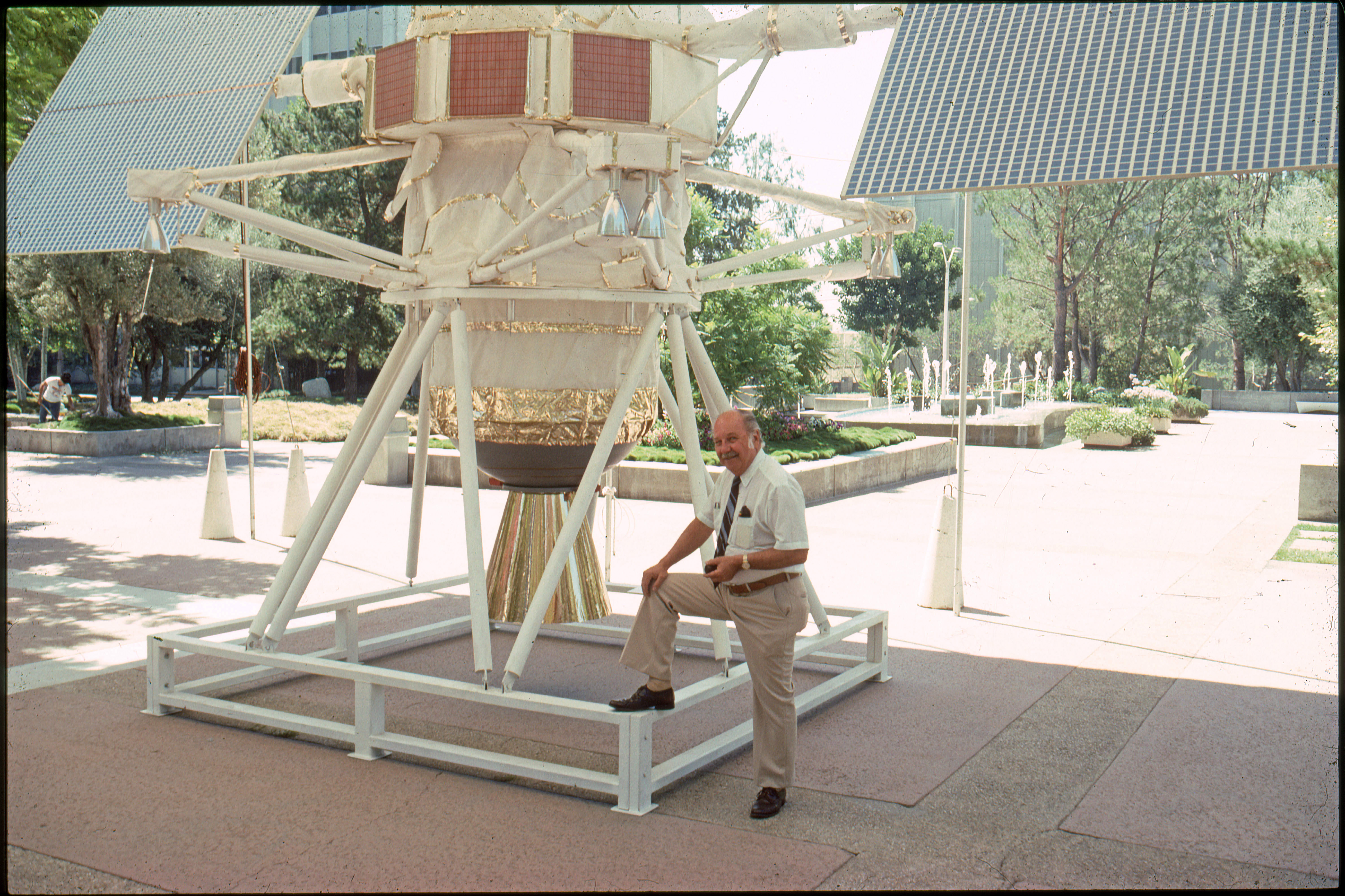
Bob Latham at the Jet Propulsion Laboratory, Pasadena, California, probably in the late 1980s.
John Saxon recognises this was taken at a place “called ‘The Mall’ … between the Admin Building 180 and the Cafeteria Building 167. A nice place on a warm sunny day to meet people or demonstrate your latest Mars rover etc.”
Transparency by Hamish Lindsay. Scan by Colin Mackellar. |
Robert Silvester Latham was one of the much loved characters of the Deep Space Network, from its very earliest days.
After serving in the US Navy towards the end of World War II, finally as a Motor Machinist’s Mate 3rd Class Petty Officer (MOMM3) [1.], his interests turned to electronics.
|
In this undated photo, Bob Latham is at left in US Navy uniform.
From the Tidbinbilla archives. Scan by Colin Mackellar. |
Latham began his career at the Jet Propulsion Laboratory in Pasadena in about 1955 when he was hired by Richard K. Mallis, who had recently started at the Lab.
Mallis was tasked with modifying a surplus US Army Az/El Nike antenna pedestal as part of a research project (known as CODORAC) to demonstrate the transmission and reception of encoded telemetry. To aid in this work, Mallis was authorised to hire a technician to assist him.
Mallis recalled,
“I was intrigued by the resume submitted by a person who had run a television repair business which had terminated for some reason.
The person was Robert S. Latham who gave as his personal reference a Walter E. Brown who was his partner and who was recently hired by JPL. I made some enquiries and was told that Walt Brown was doing an exceptional job. So I called Bob in for an interview and discovered he was well versed in electronics. As I was a mechanical engineer and the antenna pedestal was both mechanical and electrical, it seemed to me that we would make a good pair. So I discussed this selection with John Scull and he agreed. So I hired Bob Latham as my technician on this antenna pedestal project. …
We also had to modify the drive system as we were to auto track a transmitted signal from the instrument package which was mounted on a helicopter. This is where Latham’s experience proved to be very valuable. He and John Scull worked together on the design and fabrication of the electronic circuits.” [2.]
|
The antenna pedestal project was for the CODORAC antenna, the forerunner of key JPL tracking systems.
Richard K. Mallis spoke about the project in this video interview recorded in 2009.
The prototype CODORAC antenna, mounted on a Nike pedestal, was tested at White Sands. [3.] |
|
The CODORAC antenna, mounted on a Nike pedestal, was installed in Puerto Rico. 1955 photo from JPL’s bi-monthly “Laboratory” magazine, page 7, Jan-Feb 1973.
Preserved by Walt Larkin. Scan by Colin Mackellar, with thanks to Maureen Hay. |
In the early days of the Deep Space Network, Bob Latham spent much time at the first 85-foot DSN station, Pioneer, at Goldstone. He was there for Mariner 2, the first flyby of Venus.
|
December 1962, during the first flyby of Venus with Mariner 2 –
“In Goldstone control room, DSIF personnel await confirmation that spacecraft has begun to scan the planet Venus.”
Apparently at the Pioneer station (later known as DSS-11).
1. Howard Olsen – Goldstone Senior RF man (and, later, the Director of the Pioneer station).
2. Dr. Eberhardt Rechtin, Program Director of the Deep Space Instrumentation Facility – and known as “Father of the Deep Space Network”.
3. Bob Latham.
4. Nick Renzetti – Manager, DSIF Communications and Operations.
5. Walt Larkin – Goldstone Complex Director.
From a JPL book on Mariner 2 [4.] With thanks to Herb Younger for help with names. |
Bob participated in experiments with Closed-Cycle Refrigerators to cryogenically cool masers. These were first implemented on the 64 metre Mars dish, DSS-14, at Goldstone, in 1966.
|
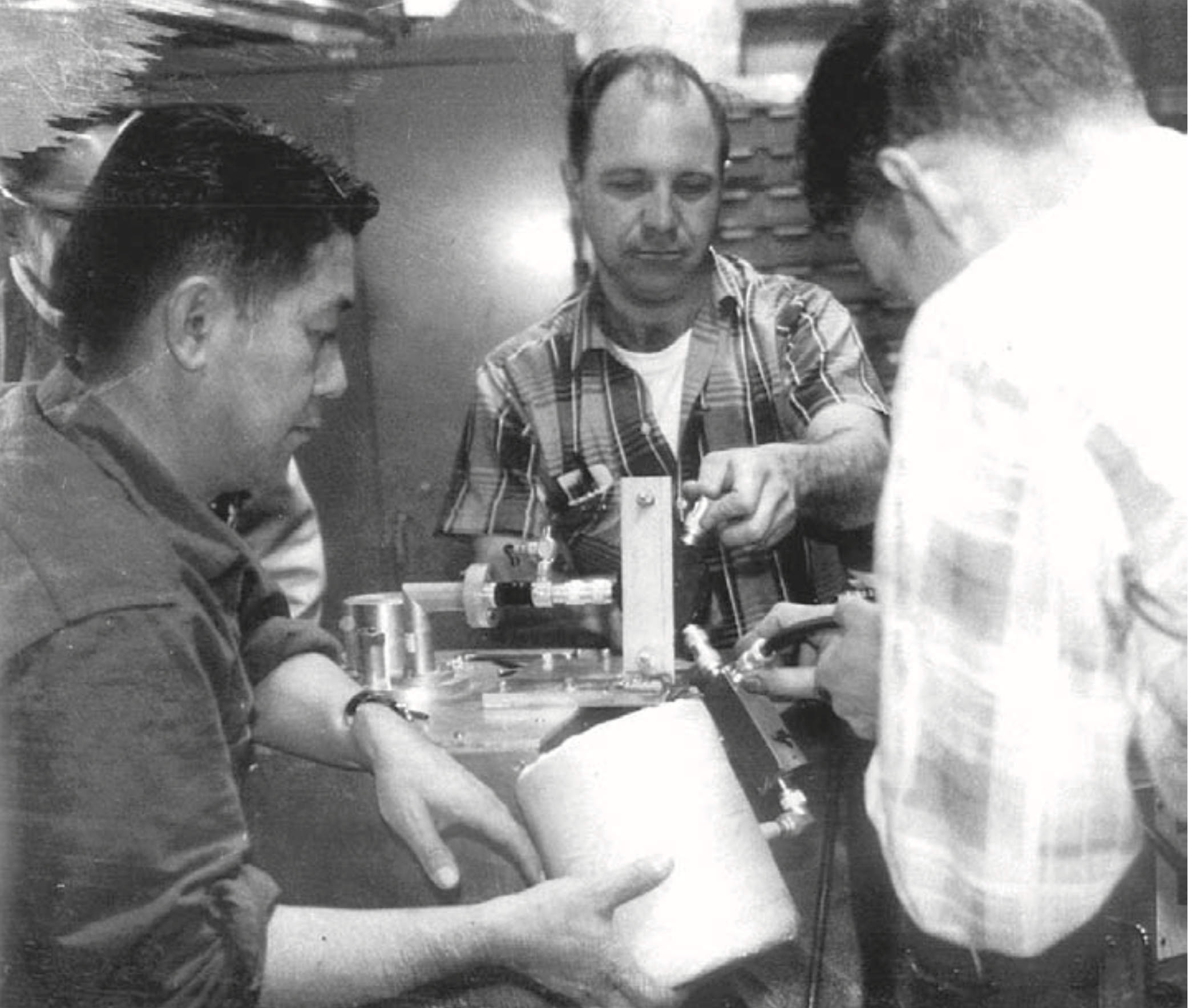
Bob Latham, centre, with Walt Higa, left, and
Robert Clauss, working on the cryogenic cooling of masers, apparently at Goldstone in this circa 1966 photo.
“Bob’s guidance in dealing with operational situations was most valuable.” [5.] |
Mike Dinn remembers that, in the earliest days of the Deep Space Network, there were Liaison Engineers at JPL assigned to look after the needs of the stations around the world. At one point, there were Liaison Engineers the stations in Australia, South Africa and Spain.
“Bob was a great character. Helped me find our accommodation in 1972 for instance.” (Mike spent a year at JPL working on integration of the new 64 metre DSS43 at Tidbinbilla.)
Bruce Window recalls,
“Bob was a big help to me in 1970 arranging accommodation for me and my family when I went to JPL for 6 months with Bill Merrick’s engineers designing equipment for DSS43.”
|
Mike Dinn says that Bob had a permanent spot reserved for him for lunch at a bar/restaurant in La Cañada (near JPL). This undated photo may well have been taken there.
From the Tidbinbilla archives. Scan by Colin Mackellar. |
In his 2001 book NASA STATIONS near MADRID: forty-five years of history (1963-2008), José Manuel Urech Ribera, former Director of the DSN’s Cebreros complex (1970 – 1981), and Robledo DSN (1981 – 1999), recalls Bob Latham and his indispensible role –
“Robert Latham, for his special charisma and personality had been a key man for the DSN, with Stations and personnel from different countries, to be an organization that got on very well with each other, almost a ‘big family’.
In his job as Liaison Engineer he was the link with Stations and communicated by telephone at least once a week with all the directors to inform them about interesting occurrences in the great JPL. Also he found out what was happening and felt at the Stations, in order to represent their interests in the many local meetings.
Besides he was the perfect organizer of the various joint meetings (Station Directors, Operations & Engineering and others), arranging the location, the formal agenda of presentations, and even organized the leisure time.
He was also responsible for all travelers visiting JPL for courses or meetings, and for all he was a good friend and help in whatever conflict, large or small, that might arise.” [6.]
|
Bob Latham at the Jet Propulsion Laboratory, Pasadena, California.
Transparency by Hamish Lindsay. Scan by Colin Mackellar. |
Mike Dinn:
“Bob called me on the black phone most mornings whilst I was Director. He was at Tidbinbilla for [US Vice President Dan] Quayle’s visit and I fixed a unique meeting for them in our briefing room.” He also volunteers that Bob was, “very pleasant to work with”.
|
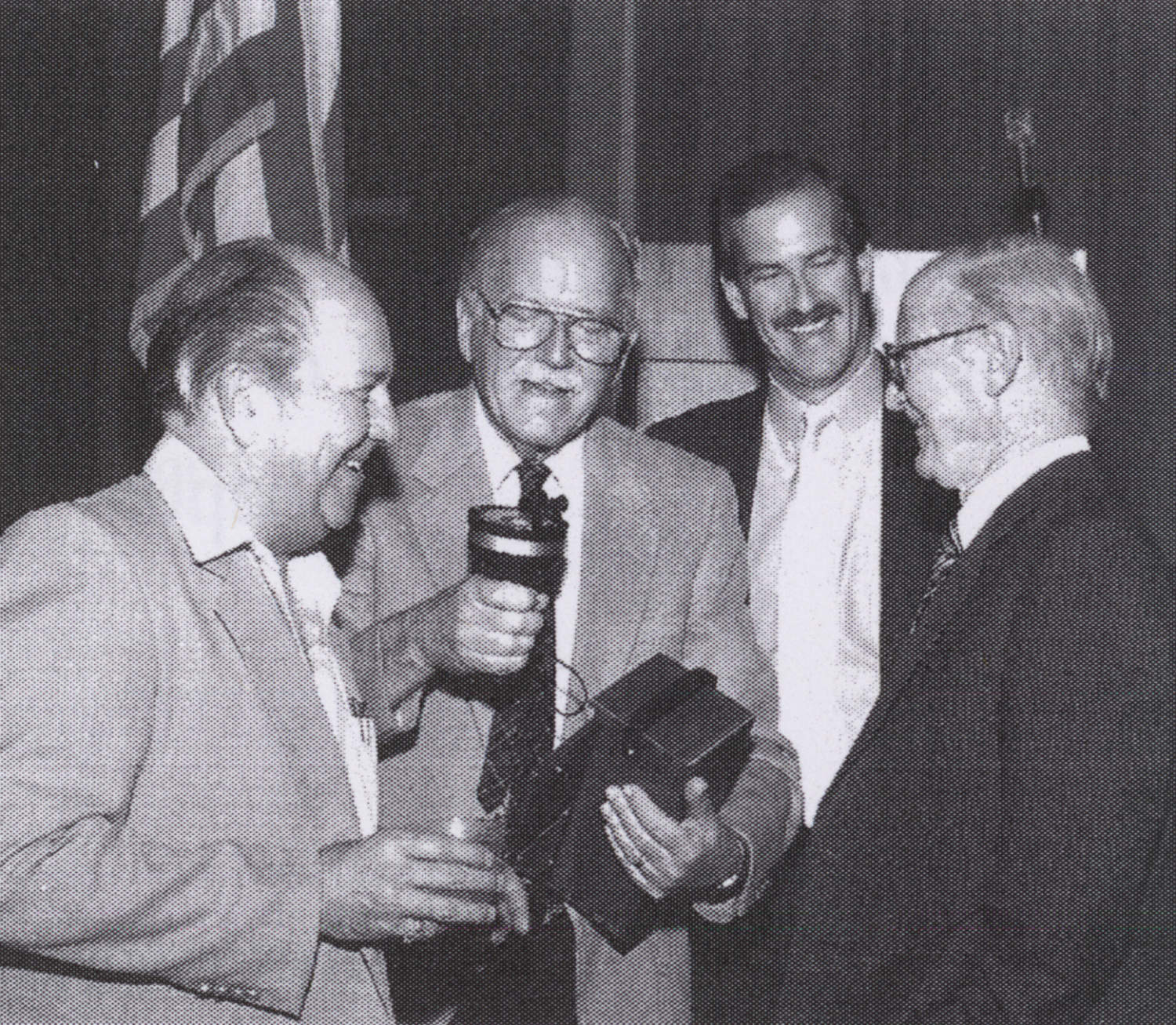
At Tidbinbilla on 27 April 1989, Bob Latham (at centre in light blue suit) watches as US Vice President Dan Quayle is introduced to Bruce Middleton of the Australian Space Office.
Photo from the Tidbinbilla archives. Scan by Glen Nagle. More on Quayle’s visit here. |
|
Detail from the above photo. |
|
Bob travelled to key meetings involving the DSN, including this Joint Management Meeting at Canberra’s Hotel Ainslie in 1992.
Click the image for a larger picture.
Or see the key – jpg version, or PDF version. Bob is number 26 (centre of back row)
With thanks to Glen Nagle, Mike Dinn, James Costrell, Ray Amorose, Peter Churchill, Ray Lloyd, Tony Carro, Jose Urech and NASA Madrid DSN for the names. Key assembled by Colin Mackellar. |
|
Bob Latham (left) is pictured here at the retirement party at JPL for Walt Larkin in 1987.
L to R: Bob Latham, Walt and Blake Larkin and Dr William Pickering. Photo courtesy Kathleen Larkin du Plessis. |
|
A humourous poster at JPL advertising Latham’s retirement party. [6.] |
|
Bob Latham receiving a Galileo DSN Planning and Operations certificate on behalf of the Goldstone complex.
Cropped from this photo preserved by Mike Dinn.
Scan by Colin Mackellar. |
In his retirement, Bob lived in Palm Desert, not far from Palm Springs, California.
He is remembered as one of the stalwarts of the Deep Space Network.
References:
1. Inscription, Riverside National Cemetery, California.
2. Memoir by Richard K. Mallis (to be published on this website).
3. A History of the Deep Space Network by William R. Corliss, May 1, 1976. NASA CR-151915, page 4.
4. JPL book on Mariner 2, Mariner: Mission to Venus, “By the staff, Jet Propulsion Laboratory”, published by McGraw-Hill Paperbacks, 1963. Library of Congress Catalog Card 63-17489, page 77. This copy preserved by Rudi Langeveld.
5. Photo from Cryogenic Refrigeration Systems by Robert C. Clauss – a chapter in the book Low-Noise Systems in the Deep Space Network, Edited by Macgregor S. Reid, JPL, 2008, page 204.
6. NASA STATIONS near MADRID: forty-five years of history (1963-2008), José Manuel Urech Ribera, page 101.