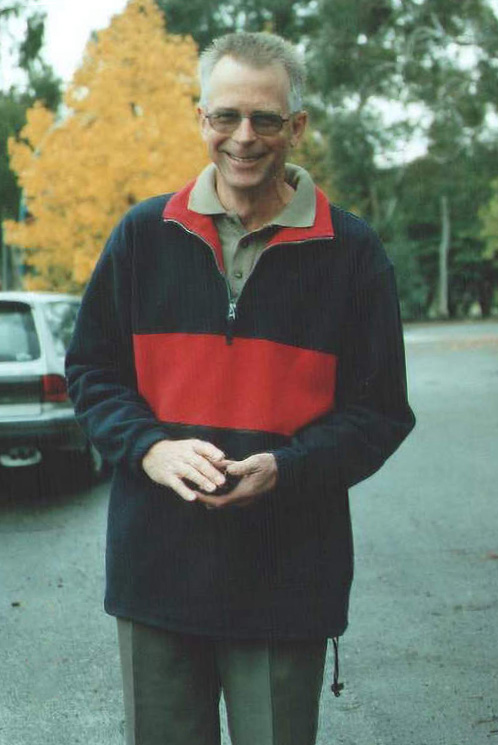
Geoff Seymour
Island Lagoon, Honeysuckle Creek
|
Geoff Seymour. |
During his career Geoff Seymour had a range of jobs but, excepting for the first, they all involved computers in one way or another.
The first job began in 1962 soon after graduating from Sheffield University in the United Kingdom. Geoff joined a company called Cable and Wireless and was seconded to the British Post Office Research Station in London to join a team investigating the reasons why the most-recently-laid telephone cable across the Atlantic Ocean required more amplifiers inserted in the cable than had been forecast.
This work was successfully completed by mid-1964 and he began searching for new work.
DSS41 Island Lagoon
An advertised vacancy for a position at Island Lagoon, Woomera grabbed his attention.
The work would involve looking after a low noise maser amplifier at a tracking station used to track unmanned American spacecraft travelling to the Moon and other planets.
The lengthy recruitment process by the Australian Department of Supply was completed towards the end of 1964 and, on Boxing Day, Geoff and his wife Patricia set off for Australia, expecting to return after three years.
On arrival at Deep Space Instrumentation Facility 41 (DSIF 41), Island Lagoon, in January 1965, Geoff was advised that the job he had applied for was no longer vacant. However, the good news was that there were several positions vacant at his level of employment and he should spend a month in each one and come back at the end and say which one he preferred to do. And so a life-long career involving computers began.
 |
The 26 meter (85 foot) antenna of DSIF-41, Island Lagoon, Woomera, circa 1967. Photo by Ed von Renouard. |
Towards the end of 1965, Geoff spent three months at the Jet Propulsion Laboratory (JPL) in Los Angeles where he attended a course at Scientific Data Systems on the SDS 910 and 920 computers that were soon to be installed at DSIF 41.
At the completion of the course Geoff undertook on-site training on the system at DSIF 11 located at Goldstone in the Mojave desert. Geoff returned to Woomera in early 1966.
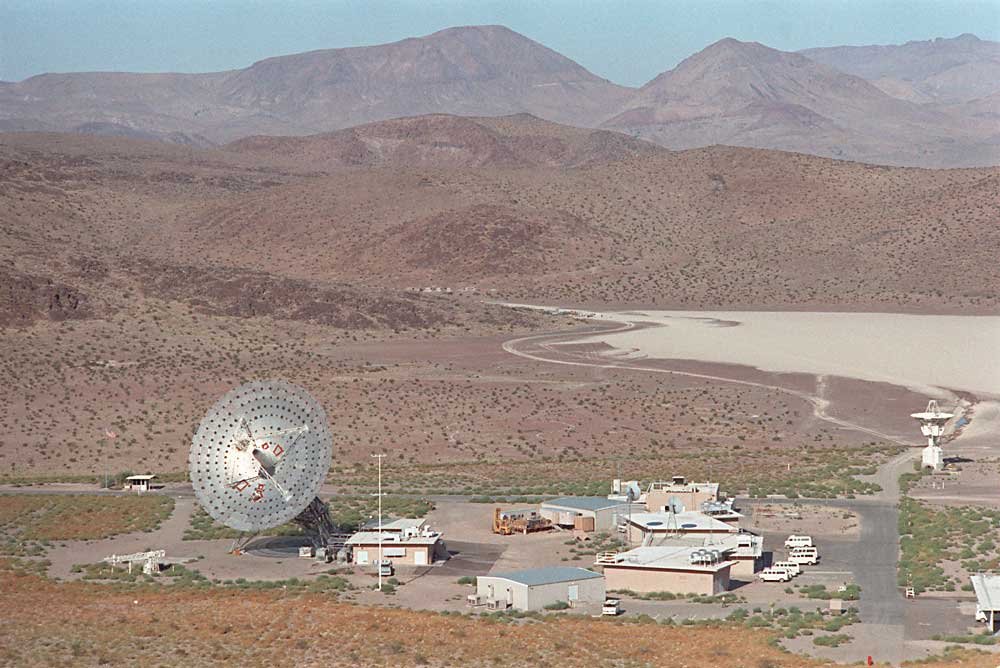 |
The Pioneer station, Goldstone’s ‘Wing’, DSIF-11. Photo: Bill Wood. |
Over the next three years the station was involved in a number of projects including Ranger and Lunar Orbiter missions.
Each Ranger spacecraft was launched on a specific trajectory aimed at a selected moon location considered as a possible future manned moon landing site. As the spacecraft approached the moon, on board equipment photographed the lunar surface and transmitted photographs back to JPL via the tracking station network. Each spacecraft continued to transmit photographs until it crashed into the lunar surface.
In contrast the Lunar Orbiter spacecraft went into orbit around the moon and photographed potential landing sites as they passed overhead.
Honeysuckle Creek
As the completion of their three-year assignment approached, Geoff and Patricia decided to stay in Australia rather than return to England. Whilst they had very much enjoyed their time in Woomera they decided to move on and after another lengthy recruitment process Geoff accepted an offer to work at the Honeysuckle Creek tracking station located near Canberra, ACT. The job was head of the Computing Section and the station was dedicated to the Apollo Lunar Landing program.
Very soon after joining Honeysuckle, Geoff and two of the senior Section staff spent a month at the Goddard Space Flight Center in Maryland, USA undergoing training on the Univac 642B computers used for processing spacecraft telemetry and sending commands to the spacecraft. On their return to Honeysuckle they joined in the station preparations for the Apollo 8 mission.
 |
The Network Test and Training Facility – Building 25 at the Goddard Space Flight Center, Greenbelt, Maryland. The NTTF was the centralised training location for selected members of the Manned Space Flight Network (MSFN) and the Spacecraft Tracking and Data Acquisition Network (STADAN). |
The Apollo 9 and 10 missions followed in quick succession. At the completion of Apollo 10, station management decided that the Telemetry and Computer sections should be combined into a single Group and Geoff was appointed as its head.
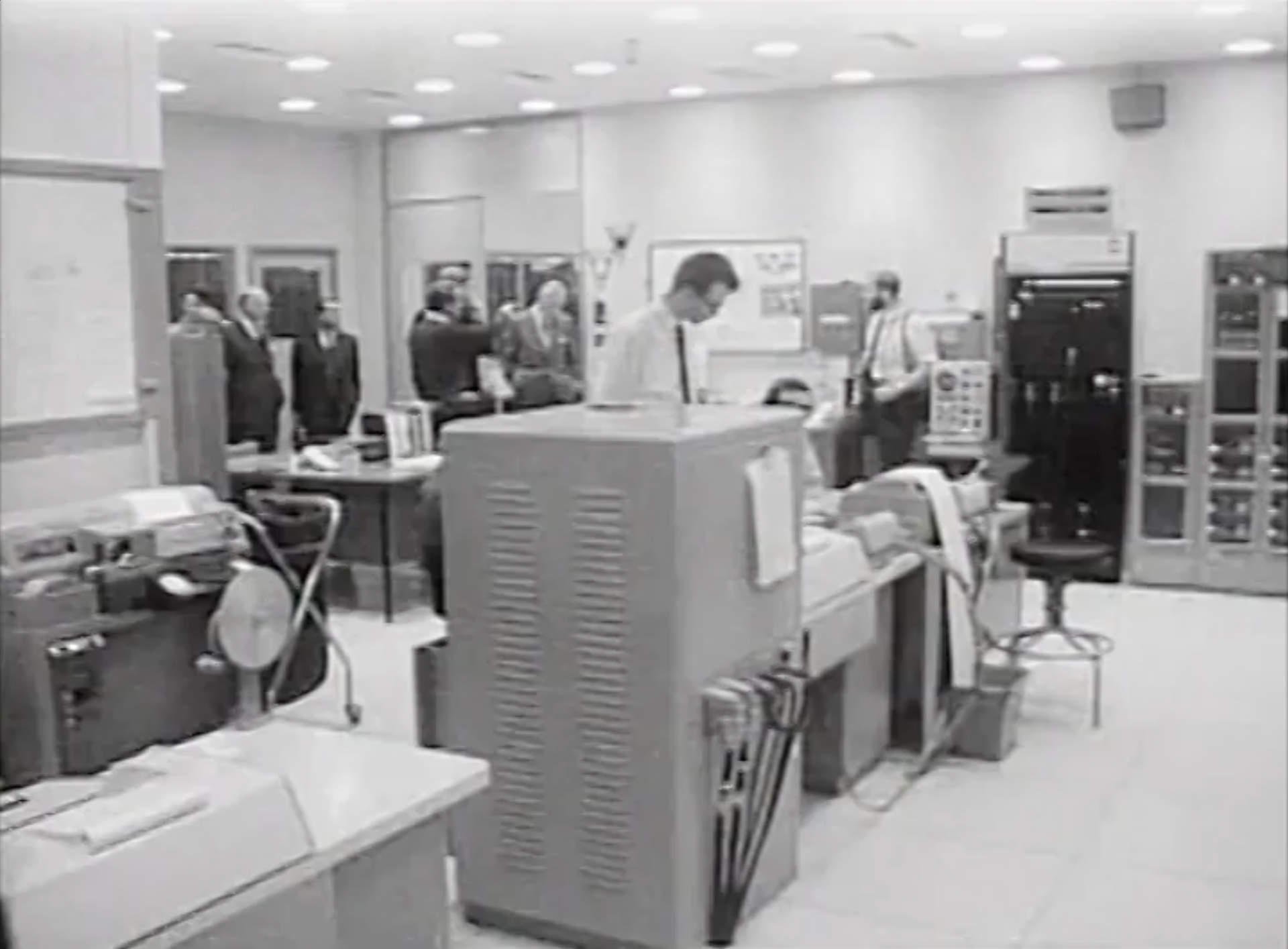 |
Geoff Seymour, standing at centre, speaks with Bryan Sullivan in the Computing area at Honeysuckle Creek on the day of the Moon landing, 21 July 1969. Prime Minister John Gorton, partly hidden by Station Director Tom Reid, is touring the station. Hamish Lindsay waits on the right with his camera. Frame from ABC TV footage of the visit, courtesy Geoff Crane and ABC Stateline ACT edition. |
 |
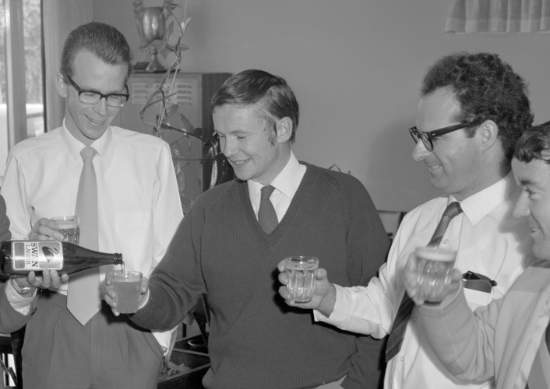
After the Apollo 16 mission there was time to enjoy some Swan Lager, supplied by the Western Australian brewery. From left: Jerry Bissicks (USB), Don Gray (Station Director) replenishing Saxon’s glass, Geoff Seymour (Computer/Telemetry Engineer), John Saxon (Ops Supervisor), Ian Grant (Deputy Station Director), and Milton Turner (Departmental Admin Officer). Photo: Hamish Lindsay. |
Geoff thoroughly enjoyed working on the Apollo and subsequent Skylab project. Whilst each mission was exciting in its own right, the period between missions was exciting in a different way. During these time periods staff worked to modify existing and install new equipment required to support the forthcoming mission. Excellent team work was crucial and on-time completion of tasks for these new capabilities was essential.
As the Skylab project drew to a close, the future of Honeysuckle was about to undergo significant change – it would join the Deep Space Network taking over the role previously performed by Island Lagoon, Woomera. Geoff spent time at JPL working with their staff on a high level plan for the transition from Manned Space Flight to Deep Space Tracking.
Changes
By this time Geoff had spent ten and a half years in the space tracking industry and decided that another career change was due. He joined the Australian Public Service at the Department of Defence in August 1975 where he provided real time support for the Royal Australian Navy’s communication network. This network was relatively new, being essentially the automation of the prior teletype message network.
After several years providing this support Geoff then carried out a range of other tasks within the Department before assisting a working group to develop a plan for the future of administrative computing in the Department. Following approval for this plan, Geoff was appointed as head of the team charged with its implementation.
In early 1984 Geoff was promoted to the position of Head of Computing at the Department of Education and Training and after a further twelve months to the position of head of Information Technology at the Australian Taxation Office (ATO).
At the ATO, Geoff led the organization’s IT work supporting both its current business activities and the IT Group’s contribution to a project charged with turning the ATO from a paper-based organisation into a modern one using currently available technology. This significant project called the ATO Modernisation Project required Federal Government approval and funding over a period of eight years. During this time the total computing infrastructure of hardware and application systems was completely replaced. Two large mainframe computers hosting the ATO’s application systems were accessible to each staff member whose job required their access. To meet this requirement approximately 17,000 networked personal computers were installed around the country.
The Modernisation Project came in on time and on budget.
In 1996 Geoff was awarded the Public Service Medal in the Queen’s Birthday Honours “For outstanding public service, particularly in the area of providing information technology solutions within the Australian Taxation Office”.
In 1997 Geoff took early retirement from the Public Service when the government of the day directed that large components of IT work were to be outsourced to private industry.
In the ensuing ten years Geoff carried out thirty short-term consultancy assignments for the International Monetary Fund and the World Bank. He visited thirteen countries across the globe including ten visits to China.
 |
In November 1970, Geoff Seymour, John Saxon and Ian Grant authored a paper entitled “Computers and Apollo”. It was presented at a meeting of the Australian Computer Society in Melbourne. It gives a wonderful insight into the vital role played in Apollo by computers. As the conclusion states, “without the modern high speed digital computer, the Apollo project would have been impossible”. |
With much thanks to Geoff for sharing his story.