25th
November 1966
Links to related pages at the bottom of this page. |
Among the many ‘firsts’ for Carnarvon township was the first ever satellite television broadcast to originate in Australia.
On 26 October 1966, a new communications satellite, the first of a new series, was launched from Cape Canaveral Launch complex 17B onboard a Delta rocket.
Intelsat II F-1 (sometimes called “Lani Bird” or “Early Bird 2”) was intended for geostationary orbit above the Pacific Ocean.
In this orbital slot, it would provide reliable communications between NASA’s Carnarvon Tracking Station and the USA, using the new OTC Australia 42-foot casshorn antenna, 4.4km north of the NASA station. Such communications would be needed for the Apollo missions, with the first manned Apollo flight planned for early 1967.
On the other side of Australia, NASA’s Cooby Creek transportable ground station had been officially opened just four days earlier. It would be operated on behalf of NASA by the Australia Department of Supply and would conduct satellite communications experiments using the Application Technology Satellite series.
|
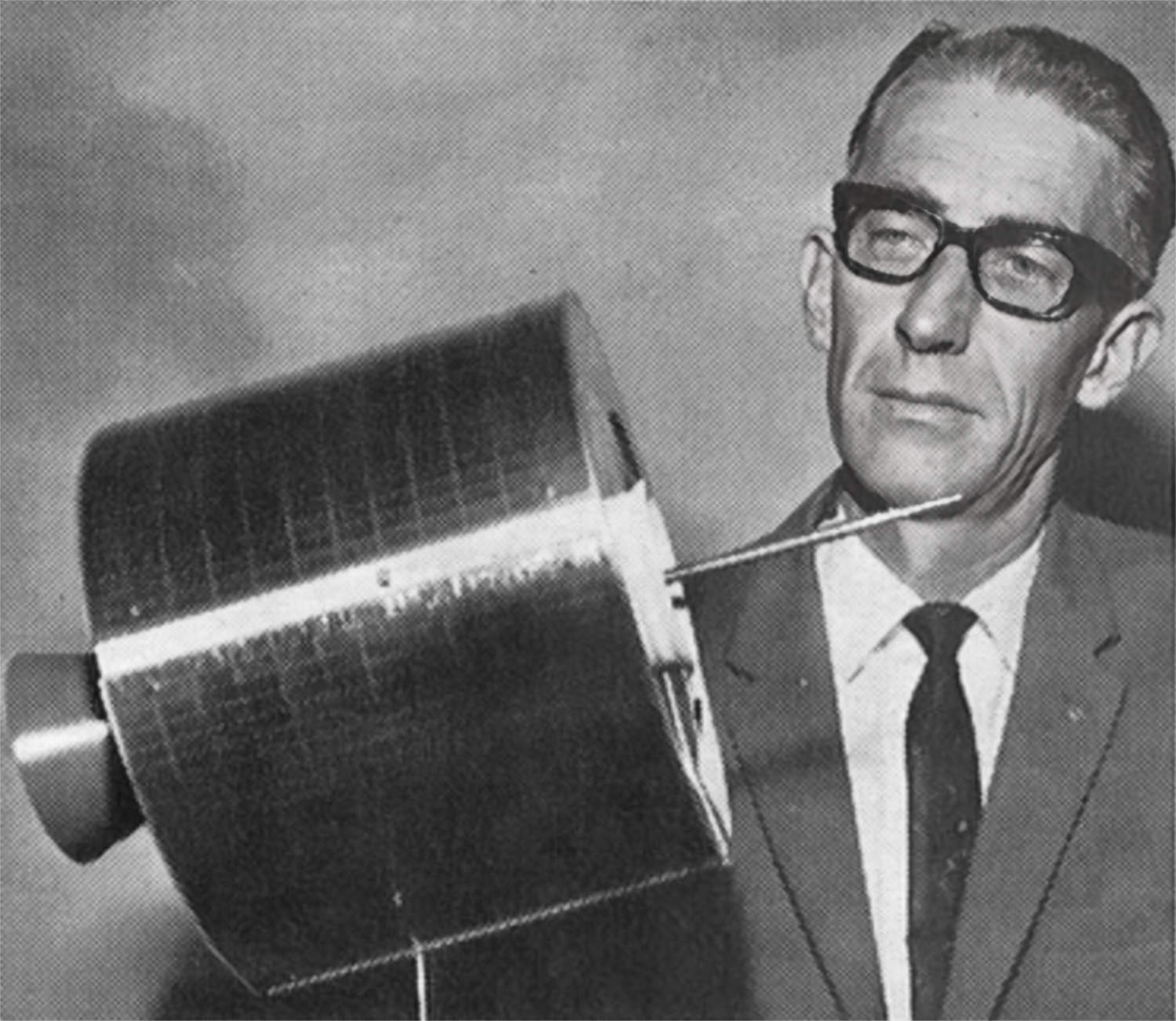
OTC (A) Carnarvon Satellite Earth Station Manager Leo Mahony with a small model of the Intelsat II spacecraft.
OTC photo thanks to Jim Simpson, from the First quarter, 1968, issue of Contact, the OTC staff magazine, page 48. |
The Original Plan
As the OTC Carnarvon Satelite Earth Station was nearing completion, the OTC, as Australia’s offical overseas telecoms carrier, was keen to be the first to demonstrate a satellite television link.
OTC’s Cyril Vahtrick recalled,
“We had learned that the Department of Supply and NASA were planning to use the NASA station at Cooby Creek in Queensland for an international television hookup within a few months, so this provided an incentive to get there first.”
Negotiations between the BBC and the ABC (Australian Broadcasting Corporation) led to plans for a satellite TV link-up.
Carnarvon had no domestic television (until July 1972) and there
was no capability to send TV from elsewhere in Australia to Carnarvon for transmission
to the satellite. All material would need to be produced locally. The ABC team (and their outside broadcast equipment) which would travel the 900km from Perth to Carnarvon. ABC presenters Peter Pockley and Kim Corcoran would come from Sydney.
The broadcast was to be a relatively low-key family reunion –
with three British families in Carnarvon being linked with their families back
in the UK.
The three families were –
Frank and Pauline Vinton and their
baby son Ian,
Alan and Jean
Gilham and their sons Steven and Andrew,
and Les and
Laura Brightwell.
Frank Vinton and Alan Gilham were in Carnarvon to work
at the NASA tracking station. Les Brightwell had come to Carnarvon some years
earlier and had married a local girl.
NASA Carnarvon engineer Paul Dench recalled,
“We were one of the families interviewed and remember the criteria for selection very well –
1) British migrant family
2) Relatives living in or very close to Central London for a short notice call to the TV studio.
3) An Australian wife (spouse?) and/or an Australian-born baby.
We failed on the second criterion. George Alan would have been a good choice with a new Australian wife of migrant Yugoslav parents except you could hardly understand his thick Scottish brogue and his family were many many hours journey away.”
In addition to the British families, the local publican and Mayor, Wilson Tuckey,
local sheep farmer Clarrie Lewington and ‘flying padre’ Rev. John McCahon from the Australian Inland Mission were featured.
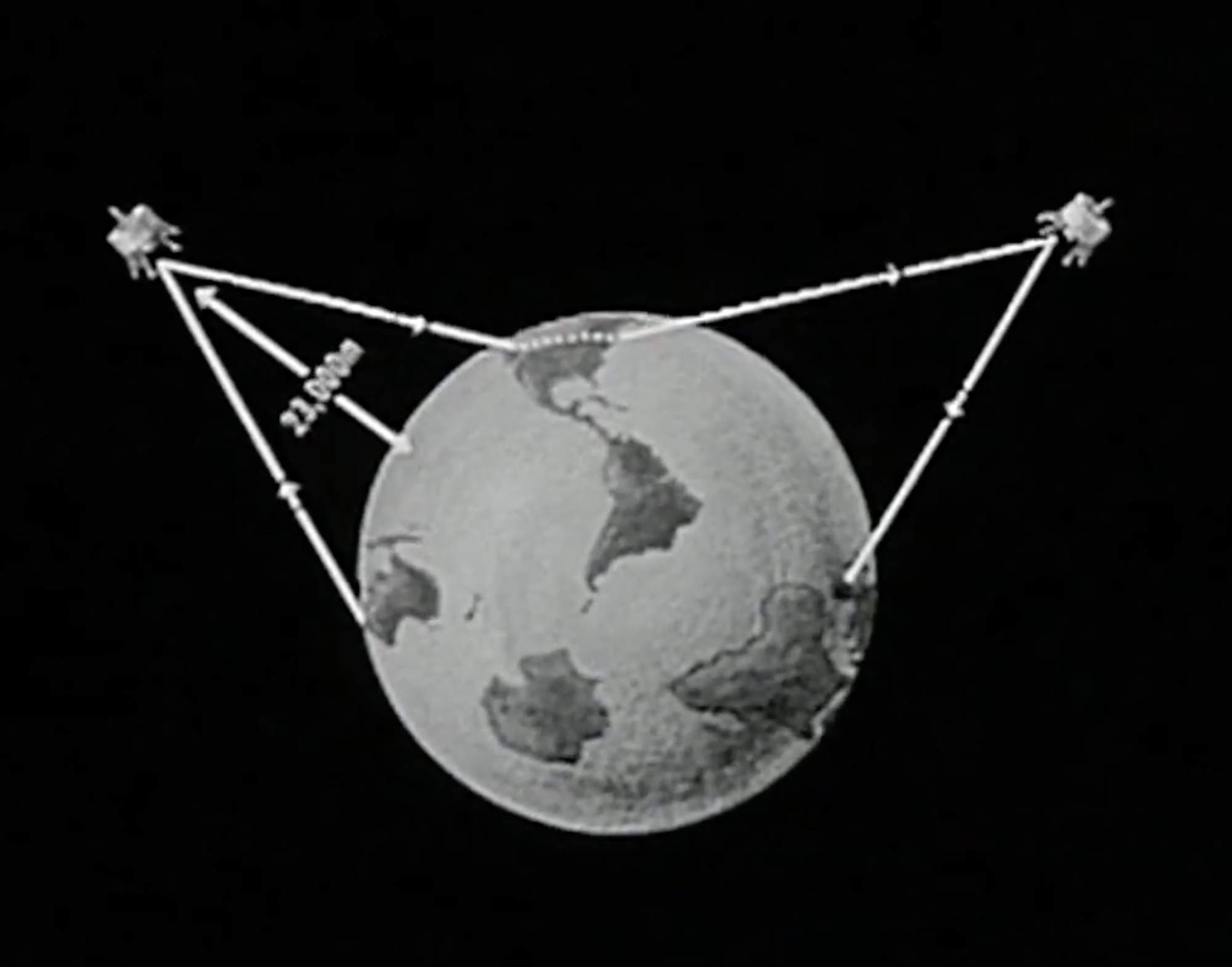
The plans assumed that the Intelsat II F-1 satellite would be in a geostationary position over the Pacific Ocean.
In that scenario, the television signal would be relayed over the Pacific and received on the west coast of the USA, at the COMSAT station at Brewster Flat, travel across the country via microwave links, and then be relayed over the Atlantic Ocean from Andover in Maine to Goonhilly Down via the Intelsat I (Early Bird) satellite.
Audio would travel via undersea cable and be synchronised (using delay lines) with the video signal in London.
|
The original plan. Frame from an ABC report, thanks to Derrick Wright. |
On this basis, plans were made for the broadcast.
Both Australia and the United Kingdom used the 625-line / 50Hz field rate television standard. However, the United States used 525-line / 60 fields per second, and their equipment would be unable to handle the 625-line pictures. Consequently, the ABC equipment taken to Carnarvon would need to generate 525-line video.
(Note: At this time the BBC was using two television standards – the old 405-line and the new 625-line standard. Newer U.K. television receivers were switchable to either. Production had shifted to 625-lines.)
Perth-based ABC technician Warren Jacobs had the task of changing the ABC’s three EMI cameras from 625-line to 525-line so that the ABC Outside Broadcast van driven to Carnarvon could supply 525-line TV to the OTC Earth Station. The BBC would need to convert the 525-line picture coming from the Atlantic satellite to their 625-line standard.
Before the broadcast took place, Warren Jacobs had to restore the cameras to their normal 625-lines. This is why –
Plan B – a satellite in the wrong orbit – but the broadcast goes ahead
Shortly after launch, Intelsat II F-1 failed to achieve
the desired geostationary orbit, rendering the satellite useless as it slowly drifted westwards in a highly elliptical orbit.
Even though its original purpose as a Pacific Ocean relay was no longer possible, it could be used for brief periods (up to around twenty minutes during passes over the Indian Ocean), to link the Carnarvon OTC Satellite Earth Station
and the Goonhilly Down Earth Station in the UK.
On this basis, the decision was made to go ahead with the planned broadcast, though the programme would have to fit inside this shorter window, and the timing of the broadcast would be determined by orbital mechanics.
It also meant that there would be no double-hop (via the Atlantic as well), and no need for standards conversion, hence the three ABC cameras were re-set to 625-lines.
The PMG’s John Lambie recalls:
“I remember that event very well. I had several meetings with Dr Peter Pockley and actually set up the audio outside broadcast link. These details never get mentioned but the audio was a terrestrial link via PMG and OTC. Yes I have heard the comment that the vision was so-so but the audio was excellent!”
|
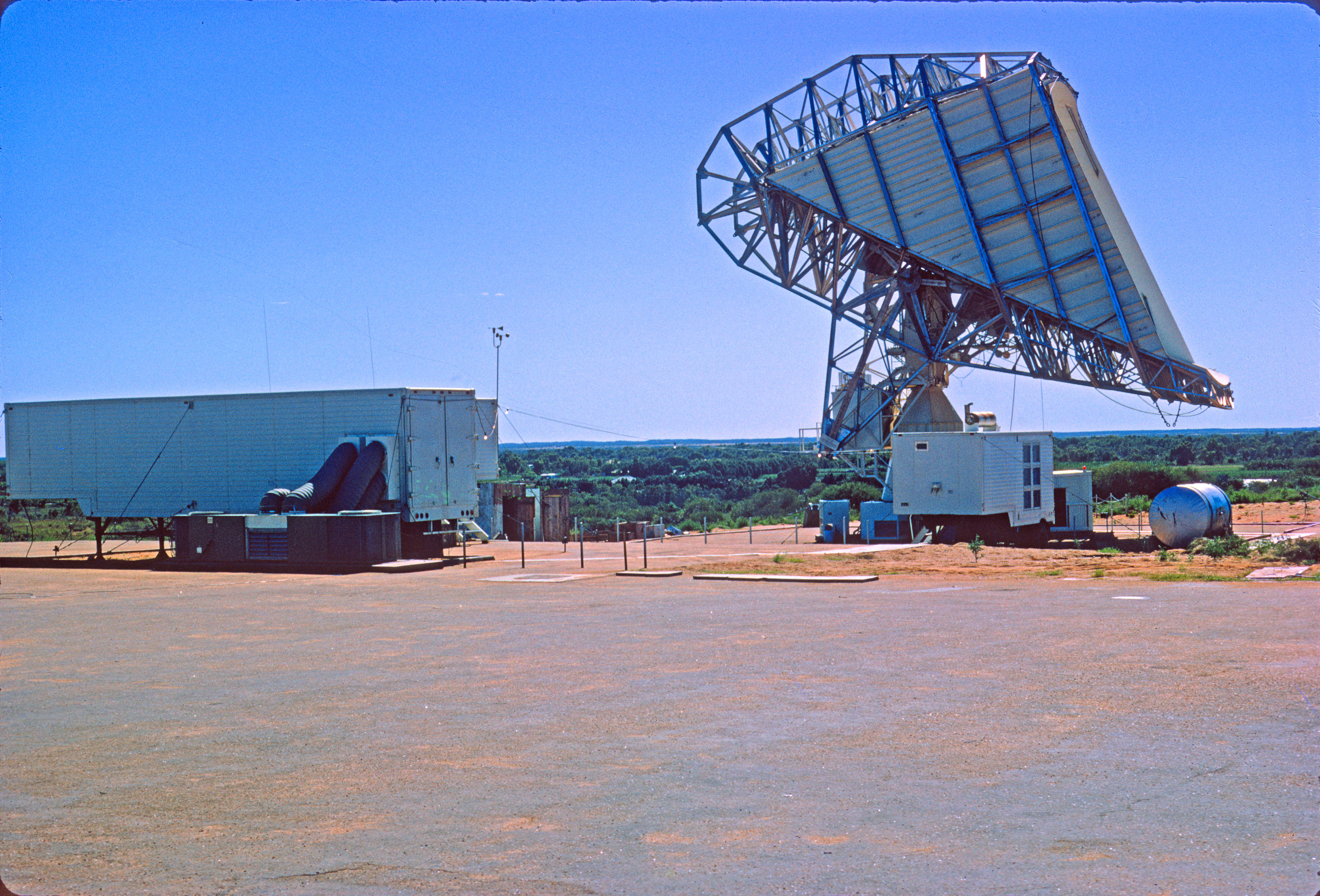
The OTC 42-foot Casshorn in 1967.
Transparency: John Lambie. Scan: Colin Mackellar. |
 Listen to a 4 minute interview (1.4MB mp3 file) with ABC-TV Perth Senior Engineer Allan Hullett.
Photo: University of Western Australia. |
 |
|
After the ABC / BBC link, commercial station TVW-7 in Perth exchanged programming with ITV in the UK. They had a more modest set-up, with a one-camera outisde broadcast.
|
Australian Broadcasting Commission (ABW2) links van is visible behind the TVW Channel 7 one-camera outside broadcast van at the OTC(A) earth station.
The dishes are for the temporary microwave link set up by the ABC to connect the ABW2 multi-camera outside broadcast van in Carnarvon with the earth station.
Photo: Guntis Berzins. More photos here. |
WA TV History’s Ken McKay recalls,
“The TVW team included John Quicke [TVW Chief Engineer], Peter Hobson and Gordon McColl as the OB crew. The late Eric Walters fronted the TVW component with journalist Michael Gale.”
(We hope to add more on the TVW programme.)
Reciprocal programmes were received from London (from the BBC to the ABC, and from ITV to TVW.)
|
Sir Bernard Lovell featured in the broadcast sent by the BBC to the ABC. Sir Bernard talked about the future potential for space exploration and use of space.
Photo: Guntis Berzins. |
|
The ITV picture from London for TVW.
In both cases, the picture from London was degraded, partly due to the smaller dish size at Carnarvon. The pictures from Carnarvon, seen at Goonhilly, were very good.
Photo: Guntis Berzins. |
Because
there were no television links from Carnarvon to Perth, a copies of the UK broadcast
were flown to Australia.
The ABC / BBC “Down Under Comes Up Live” Broadcast
The broadcast began just after 6:25am London time (2:25pm West
Australian time) on Friday November 25th 1966. It was seen live in the UK.
Despite
dropouts in the signal, more than twelve minutes of usable television was received in the UK.
|
|
|
Clipping from a Department of Supply newsletter.
Scan: Alan Gilham. |
The Television Broadcast
With thanks to Alan Gilham for providing a copy
of the broadcast.
Thanks also to ABC TV via Derrick Wright and Ken McKay, and to Bill Woods (OTC).
Screenshots and image enhancement by Colin Mackellar.
All rights are fully acknowledged.
This is how the complete broadcast unfolded –
|
|
|
It is 6:25am in London on Friday November 25, 1966.
On the BBC, the opening title of “Down Under Comes Up Live”
is accompanied by the strains of Frank Ifield singing “Walzing Matilda”. |
|
In London, BBC Presenter Raymond Baxter introduces the
broadcast as “another step forward in television history”.
He
has with him a globe of the Earth, complete with a model showing the position
of the Intelsat II (also known as the Early Bird II) satellite. |
|
Raymond Baxter explains that after an early rocket shutoff four weeks
earlier, the Early Bird II satellite is now “wandering its errant
way round the Earth in an elongated orbit” – thus providing
a brief window of opportunity for the television linkup. |
|
Paddy Feeny (seated facing audience) in the London TV studio as live television from Carnarvon flashes on their screens. |
|
|
|
Relatives of three British families in
Carnarvon wait in the London TV studio. |
|
As the BBC crosses live to executive producer Kim Corcoran in
Carnarvon, viewers see him standing (front and just right of centre) with
a crowd in front of the war memorial in Robinson Street.
From an 8mm recording made in London by Bill Woods. |
|
|
|
The camera pans up and to the south west to show traffic in Robinson
Street. Camel Lane is off to the right. |
|
|
|
On the balcony of the Port Hotel across the street, ABC Science Presenter
Peter Pockley interviews the 30 year old publican and Mayor of
Carnarvon, Wilson Tuckey.
(Wilson Tuckey went on to become a long-serving and colourful
member of the House of Representatives in the Australian Parliament.)
Local farmer Clarrie Lewington is on the right. |
|
|
|
Kim Corcoran begins interviewing three of the British families in Carnarvon.
Front row L–R:
Laura & Les Brightwell, Jean &
Alan Gilham (with their sons Steven and Andrew in front
of them), Kim Corcoran (holding microphone), Pauline Vinton
(holding 4 month old Ian), Frank Vinton (holding Sussan)
and Joanne (standing in front of Frank). |
|
Kim Corcoran listens to questions coming back from the UK. Andrew Gilham is in the foreground. |
|
|
|
Pauline and Frank Vinton send greetings to their family in the UK. Frank
works at the NASA tracking station. |
|
|
|
Pauline Vinton holds baby Ian for the family to see. |
|
Kim Corcoran speaks with Jean &
Alan Gilham (with their sons Steven and Andrew in front
of them). |
|
|
|
Jean Gilham speaks – her husband Alan is on the right in white shirt.
(The satellite video link was temporarily lost just
as Alan spoke. The audio to and from London was transmitted independently
by cable via the Pacific and Atlantic Oceans.) |
|
|
|
Andrew Gilham – just after the picture is restored. |
|
|
|
Steven Gilham smiles for his unseen grandparents. |
|
|
|
Mr & Mrs E.J. Gilham – Alan’s parents – in
London are enthralled as they watch the live picture from half a world
away. Mrs Florence Brightwell is at top right. |
|
Mr E.J. Gilham – Alan’s father. |
|
|
|
Laura & Les Brightwell speak with Les’ family in the
UK. |
|
Laura Brightwell hears Les’ family through Kim Corcoran’s headset. |
|
|
|
‘Flying padre’, Presbyterian minister the Rev. John McCahon from the Australian
Inland Mission, is introduced by Peter Pockley. |
|
Part way through the interview, the satellite link is lost and Raymond
Baxter in London concludes a memorable and historic programme.
The plan had been for a Royal Flying Doctor Service aircraft to fly above Robinson Street for the final shot, but apparently, the signal to the pilot to take off from Carnarvon airport was not sent at the right time and the satellite link was lost before he could move into position. (Source: Phone conversation, Colin Mackellar with Dr. Peter Pockley, January 2013.)
|
|
The Goonhilly Downs Earth Station ident card briefly displays as the satellite link is lost. From an 8mm recording made in London by Bill Woods. |
|
From the closing credits.
From an 8mm movie made in London by Bill Woods. |
With grateful thanks to Alan Gilham, Paul Dench, Suzi Vinton, Donna Vinton,
Bill Woods (OTC), Derrick Wright (ABC) and Ken McKay (WA TV History).
See also:
(Would any of the other OTC or ABC people who helped make the
broadcast possible like to share their
experiences?)