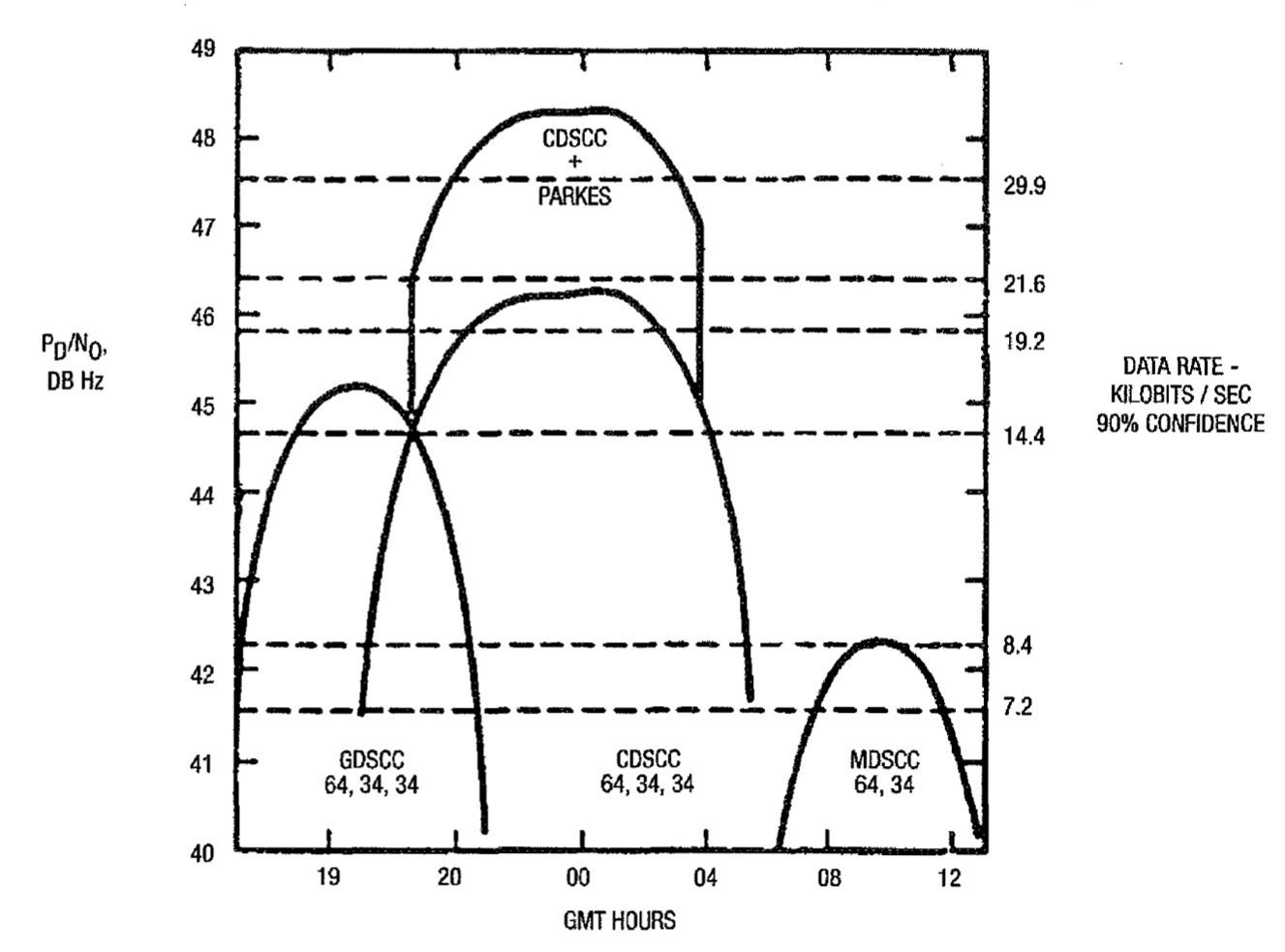
I started on Voyager with the launches in 1977 which we supported at Honeysuckle Creek station (which became DSS44 after the end of NASA's Manned space missions). We also supported the Viking Landers on Mars, the Helios spacecraft around the sun, the Pioneers launches and encounters with the outer planets, and many other projects. Later when Honeysuckle closed in 1981 many of us moved to what is now CDSCC (the Canberra Deep Space Communications Centre).
But the Voyager missions were gifts that just kept on giving!
For the first time those distant points of light orbiting the outer planets became separate new worlds, each with their own unique terrain and characteristics. Io, Europa, Ganymede and more at Jupiter, Google now tells me that the total number of Jovian satellites is now 67!. Then the (very) close up views of the rings of Saturn, with the rotating and woven patterns. Then the strangely tilted Uranus with its very faint ring system. Finally Neptune and the incredible finale of the Ice fountains on Triton... Today I read that Voyager one may have finally reached Interstellar space. A 33 hour round trip light time – the mind boggles!
As one of the primary ground stations, the planetary encounter periods were always busy, but by far the most labour intensive activity was keeping the Radio Science equipment fed with the massive glass reels of 1" magnetic tape. It always amazed me that so much information could be gained from the minute changes in the received spacecraft frequencies as the signal passed through the atmosphere of the body we were flying past.
This chart shows the variability of the received X Band signal as Voyager 2 was occulted by Uranus, and also by the planet’s (then recently discoevered) ring system.