
 |
|
The
Apollo 8 crew: NASA image 68-HC-731, courtesy Kipp Teague’s Apollo Image Gallery. |
Apollo 8
21 – 28 December 1968
Updated for the 55th anniversary.
|
|
|
The
Apollo 8 crew: NASA image 68-HC-731, courtesy Kipp Teague’s Apollo Image Gallery. |
| AS-503/CSM-103 |
MISSION C-1 |
NCG 735 |
|
Commander : Frank Borman Back-up Crew: |
Mission Fact Box: Launch from Pad 39A, Cape Kennedy 0751:00 US EST, 1251:00 UT, Earth to Moon elapsed time 66 hours 16 minutes 22 seconds. Enter Lunar Orbit 69:08:20 GET, 0959:20 UT, 1959:20 AEST, 24 December. Lunar orbits 10 orbits in 20 hours 10 minutes 13 seconds. Left Lunar Orbit 89:19:16.6 GET, 1610:16 AEST, 25 December. Moon to Earth elapsed time 57 hours 23 minutes 32 seconds. Splashdown 147:00:42 GET, 1551:42 UT, Friday 27 December 1968, 0151:42 AEST Saturday 28 December 1968. Total mission elapsed time 6 days 3 hours 0 minutes 42 seconds. Total distance travelled in space 933,419.1 kilometres. |
Apollo 8 marked the beginning of a new era in man’s exploration of space and, indeed, in the history of mankind, grabbing a swag of space firsts:
The first time humans had left the planet Earth.
The first time a human saw the whole planet Earth from space.
The first time humans had not experienced a night, with sunrises and sunsets.
The first time humans were exposed to raw solar radiation beyond the Earth’s magnetic field.
The first time astronauts had experienced the full 3.4 million kilogram thrust of the big Saturn V rocket.
The first time humans had entered another gravitational field.
The first time humans orbited the Moon.
The first time humans had been occulted by the Moon.
The first to see the back side of the Moon.
The first to see Earthrise at the Moon.
The first to reenter into the Earth’s atmosphere from the Moon.
The first to travel so far and so fast.
Apollo 8 also ended the American’s race with the Russians. The Russians had been leading the race in the early era of space exploration, and the Americans were constantly looking for ways of catching up. The Russians were pursuing the assembly of an Earth orbital platform from which to launch the lunar landing mission, while by 1962 the Americans had moved on to the lunar orbit rendezvous concept, which is estimated to have sliced a year off their Apollo development program.
In October 1968 the Russians were still trying to perfect
their docking techniques. They launched Soyuz 3 to rendezvous with Soyuz 2 and
transfer crew members between the two spacecraft, but ran into problems and
had to abort the docking exercise. In November an unmanned Zond 6 flew around
the Moon but the cabin depressurised on the way back and the spacecraft slammed
into the Earth at a speed that would have killed a human crew. A Zond 7 flight
with two cosmonauts was planned for December, but due to a number of technical
problems the flight was scrubbed and the Russian cosmonauts had to stand by
and watch Apollo 8 go for the Moon.
Of all the Apollo missions Apollo 8 was the most exciting to me. Most people I have spoken to who were involved in Apollo, including Houston flight controllers, agree. Nobody knew what would happen to humans so far out in space – for the first time we were really going to leave the Earth and head off into the void.
Flight Dynamics Officer Jerry Bostick explained the view from the Trench in Mission Control,
“From a trajectory viewpoint, it meant we had to accelerate some of the software in the Mission Control Center and the spacecraft and the world-wide tracking network. Now management had decided to go into lunar orbit it required very accurate calculations. I have told people that shooting for the Moon is a bit like duck hunting – you don’t shoot at the duck, you shoot at a spot in front of it and let it fly into the shot. So we have to aim at a spot in front of the Moon equivalent to the thickness of a sheet of paper when viewed from Earth.
We had confidence in being able to do this, but were a little nervous about doing it for the first time and much earlier than planned.”
Just the navigation required to accomplish this feat was mind-bending. Every object involved in this voyage was moving and the spacecraft had to arrive exactly 128.7 kilometres ahead of the Moon, itself moving at 3,219 kilometres per hour. Just an error of 1.6 kilometres per hour in the spacecraft’s speed would mean missing the Moon by 1,600 kilometres. As for going into orbit around the Moon – that really grabs one’s stomach.
Put yourself in the crew’s place; how would you feel about going into orbit around the Moon for the first time ever? Locked up in a spacecraft not much bigger than a phone box with two other people? If anything went wrong it was days to get back to the Earth, and there was every chance of being stuck in permanent lunar orbit, or being the first human bodies buried alive in moondust, or shooting off into solar orbit, three sitting skeletons forever circling the sun.
There was only one cheerful option – returning safely
to Earth.
Originally Apollo 8 had been planned as an Earth orbit mission to check out
the spacecraft. Flight Director Chris Kraft felt the CSM was in the best shape
of any spacecraft ever. It was passing all its tough tests with flying colours.
It was the LM development that was lagging with a number of problems still to
be resolved. It didn’t help to receive American CIA reports inferring the
Russians might be working on a lunar flight with a new Soyuz spacecraft.
In early August 1968 George Low, the Apollo Program manager, had this crazy idea of just going to the Moon with no LM on the first manned flight of the mighty Saturn V. The Russians’ spectacular fireballs had shown what it was like when things went wrong during a launch of these big rockets. At this point Low only saw a circumlunar flight. He bounced the idea off Chris Kraft and Bob Gilruth. “His idea was a shocker,” said Kraft, “but if we could pull it off it would be absolutely pivotal to landing men on the Moon,” and proposed they go into lunar orbit as well.
After consulting Deke Slayton and von Braun and getting the go ahead from a surprised NASA hierarchy and President Johnson, NASA decided to officially go for orbits around the Moon with a CSM flight only, subject to a successful Apollo 7 manned flight. It was decided to make the first attempt on 21 December with a liftoff time of 1251 GMT (0751 USEST or 2251 AEST) Choosing this day and time would allow the crew to observe the first planned landing site at the ideal Sun elevation of 6.7°. At least it would make sure of beating the Russians and confirm that a manned lunar flight in orbit was possible.
 |
This dramatic change of flight plan disrupted Deke Slayton’s carefully
planned crew schedules. The original Apollo 8 crew of McDivitt, Scott and Schweickart
had been training hard for an Earth orbit mission to check out the Lunar Module.
Slayton decided to keep them with their LM mission, and to swap McDivitt’s
crew with Borman, Lovell and Anders from Apollo 9, with their backups of Armstrong,
Aldrin and Haise.
Slayton: “I thought that this crew could be ready in four months, no problem,” and on 10 August 1968 called Jim McDivitt into his office to tell him he was rescheduled for Apollo 9. McDivitt could see, “...NASA didn’t want to throw away our training... I think it was that Rusty (Schweickart) and I knew more about this particular lunar module than anybody else,” and agreed to the swap.
Two days later Slayton called Frank Borman and told him Apollo 8 was his if he wanted it. Frank said “yes” without any hesitation and the new crew for 8 was announced on 19 August 1968 – but not the flight plan. These plans were kept secret from the media until Apollo 7 was safely back home. In mid September a news release was issued saying that NASA was looking at options beyond Apollo 7 that included a long duration flight in high orbit, or maybe a circumlunar or lunar orbit flight. Surprisingly the wording fooled the media, who did not pick up the hint of the impending lunar orbit mission.
 |
This TWX was sent Network Controller Ernie Randall to the tracking network at the successful conclusion of Apollo 7. Dated 22nd October 1968, it reads, “The Apollo Network is released from support of Apollo 7. It was a job well done. With any kind of luck, we will spend Christmas around the Moon.” Received at the Guam Tracking Station. Preserved by Brian Riehle. |
By 11 November 1968 all the ground work for a lunar mission was complete and the message officially advising the President was laid on Lyndon Johnson’s desk just as he was handing the Presidency over to Richard Nixon.
The next day NASA’s new Acting Administrator, Thomas Paine, announced, “After a careful and thorough examination of all the systems and risks involved we have concluded that we are now ready to fly the most advanced mission for our Apollo 8 launch in December, the orbit around the Moon.”
President Johnson backed up Paine’s announcement with a message to the astronauts, “I am confident that the world’s finest equipment will strive to match the courage of our astronauts. If it does that, a successful mission is assured.”
With Apollo 8 going into lunar orbit the Service Propulsion System (SPS) motor had to perform flawlessly to put them into orbit and bring them back home. There was some concern about its reliability, so it was planned to give it a trial burn for a few seconds on the way to the Moon. If it worked the mission would proceed as planned; if it had problems the brief burn would still let Apollo 8 loop around the Moon and return back to Earth.
Apollo 8 was the first time the steerable four-dish Unified S-Band High Gain
antenna was used and the three big 26 metre stations of the MSFN were called
on for what they were designed for, tracking manned spacecraft at the Moon.
On Friday 15 November 1968 the Goddard Simulation Team in the Super Constellation NASA 421 flew up from their temporary base in Sydney to put us through a series of lunar passes peppered with typical faults and problems they had dreamed up. Although we were now familiar with their antics, after they left we felt confident we were ready for Apollo 8.
 |
Nevil Eyre took this photo of Super
Constellation NASA 421 |
For this mission we had two 12½ hour shifts from 0600AEST to 1830 throughout
the mission. Apollo 8 was our first experience of tracking a manned (talking)
spacecraft for more than 12 minutes. We had to sit and keep alert and on the
ball for up to 11 hours. With an hour and a half travelling to work and back
home it meant we did little else outside our job while the missions were on.
It was my good fortune to draw the night shift where most of the action was,
because that was daytime in Houston, the time the astronauts used on the spacecraft
for their day. Once on their way to the Moon they had no night and day so could
choose any time zone on Earth for their local spacecraft time.
Day one of the mission for us was Saturday 21 December 1968. From my arrival at the station at 1800 I had to wait 4 hours 15 minutes for the launch and about another 40 minutes before we saw the spacecraft come over the horizon. We began our H-30 countdown to station acquisition shortly after launch. My position was USB Tracking 1, responsible for the Timing, Ranging, Antenna Position Programmer (APP), Tracking Data Processor (TDP) and the System Monitor chart recorder. Frank Campbell was Tracking 1 on the Day Shift. We had parallel positions at the Wing site at Tidbinbilla.
Honeysuckle Creek was the prime two-way station, transmitting to the spacecraft when the mission began, but this was to change for a while, as we shall see.
The day before the Apollo 8 launch the director of the Manned Spacecraft Center in Houston, Dr Robert Gilruth, sent a Christmas greeting to all the staff at the Manned Spacecraft Center in Houston. This is part of that address:
At 0235 USEST on 21 December 1968, Deke Slayton roused up the Apollo 8 crew for their traditional breakfast of steak and scrambled eggs. At 0458 USEST (1958 AEST) the three astronauts eased themselves into their cramped spacecraft, to be their home for the next 6 days. First in, on the left, was Borman. He had the instruments to monitor the Saturn V rocket’s performance. Lovell the last to crawl in, sat in the middle, operated the Command Module’s computer and kept an eye on their trajectory and navigation, while Anders in the right seat was in control of the spacecraft’s electrical and communications systems. Borman and Lovell were Gemini veterans, suffering 14 days together in space with Gemini VII. Lovell then joined Buzz Aldrin for the last Gemini flight, so was the most experienced of the three. Anders was the rookie.
The hatch was closed, sealing the three men from the world, at 0534 USEST, and the count proceeded smoothly.
 |
|
The Apollo 8 astronauts (from left: Anders, Lovell, Borman) walk out to the crew transfer van for the drive to the pad. |
 |
|
Apollo 8 on Pad 39A with the Mobile Service Structure (MSS) preparing the Stack for flight. NASA image S69-15528. |
 |
Countdown status report TWX. “The Pad Countdown is proceeding smoothly. The S/C count is on time and the launch vehicle is approximately 2 hrs ahead of schedule – but rest assured the L/V and S/C will lift off together.” Received at the Guam Tracking Station. Preserved by Brian Riehle. |
| HSK MISSION DAY 1 | Saturday 21 December 1968 |
LAUNCH
The weather on launch day was fine with some feathery cirrus clouds covering
about 40% of the sky while on the ground an 11 knot northerly breeze kept the
temperature down to a cool 15ºC. Relative humidity was 88%.
As recorded at Honeysuckle just before launch. 2.7MB mp3. (Details on this page.) |
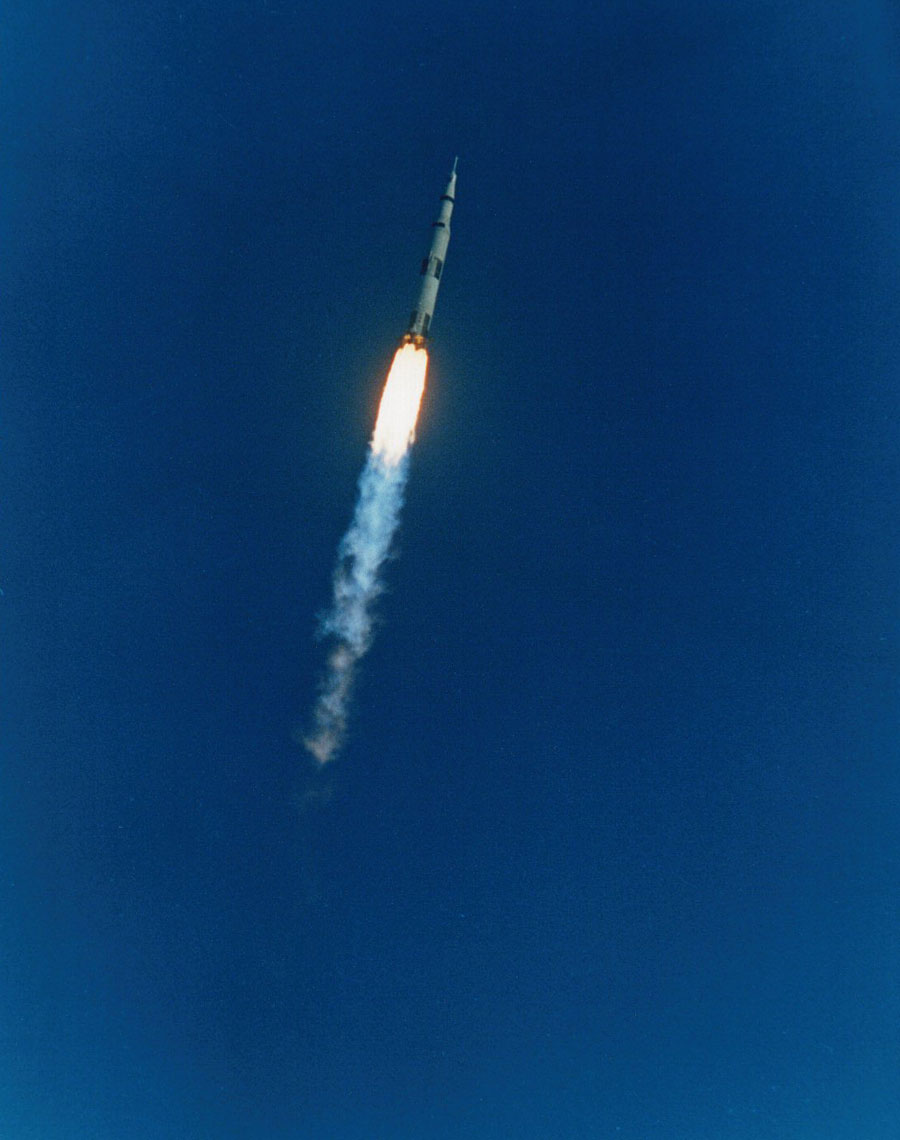
Apollo 8 was launched from Pad 39A at 0751USEST (2251 AEST) on 21 December. Although noisy, Borman and Lovell found the ride much smoother than their Gemini launches, apart from being thrown from side to side as the giant rocket continuously corrected its trajectory.
 |
|
Apollo 8 on its way to the Moon. NASA image S68-56050. Courtesy of the Apollo Image Gallery. |
 |
|
Apollo 8 on its way to the Moon. NASA image ap8-KSC-68PC-315. Courtesy of the Apollo Image Gallery. |
Borman:
Anders:
Public Affairs announced, “We have cleared the tower. Tower clear at 13 seconds.”
Once clear of the tower responsibility of the mission passed over to Mission Control in Houston and the world-wide tracking network, so Borman checked the communications,
At 1 minute 19 seconds, at an altitude of 13.4 kilometres, the rocket experienced the maximum point of dynamic pressure while still in the Earth’s atmosphere.
At 2 minutes 7 seconds they were looking to jettison the big booster rocket, Collins advising, Apollo 8, Houston. You are GO for staging. Over.
Borman, Roger.
After two minutes 34 seconds of powerful acceleration the five main F1 engines cut at an altitude of 66.7 kilometres. The astronauts, locked in their harnesses, were flung forward then thrown violently back when the second S-II stage ignited for 6 minutes 7.85 seconds and increased their speed to over 24,140 kilometres per hour. Rookie Anders felt he was going to be thrown into the instrument panel, but the two Gemini veterans were exhilarated by the ride.
At a height of 173.8 kilometres the third stage, the Saturn IVB, burned for two and a half minutes and pushed them into earth orbit at 00:11:34 GET (2302:35 AEST), so 11 minutes 34 seconds after leaving the launch pad they were travelling at 28,054.2 kilometres per hour in an orbit of 185.2 x 184.4 kilometres with a period of 89.2 minutes.
|
|
Coming up to 25 minutes Lovell announced, Well, how about let’s take off our gloves and helmets, huh?
The three astronauts had been locked up in their suits and helmets since the suiting up room about three hours ago.
AOS on the first pass over Carnarvon was at 00:52:44 GET (2343:44 AEST) where Borman commented on the lights he could see on the ground below. Initial orbital tracking was by Carnarvon, their C-Band FPQ6 radar and S-Band system confirming the spacecraft was in a proper parking orbit for the final checks.
|
As recorded at Honeysuckle. 872kb mp3 runs for 4 minutes 37 seconds. Hear all the Apollo 8 audio recorded at Honeysuckle (49 hours) here. |
Honeysuckle Creek was next. I had a brief tense moment when I had to change to 30 minute APP tapes while the antenna was still in Program Mode, but it all went smoothly and we had no trouble finding the strong signal right on time. Peter Cohn had no trouble locking the ranging system up. By the way, if any crackpot says we never really went to the Moon, we were measuring the distance to the spacecraft the whole time, so we know they went to the Moon.
At Honeysuckle Creek, we had AOS just before midnight at 59:27:00 GET (2350:27 AEST) with Anders calling down, “Hello Houston, how do you read?”, but there was a voice communication hitch as the spacecraft could not hear Houston, though we could hear the spacecraft. The telemetry data was being received at Houston fine. The cause was never located as communication was established 4 minutes 46 seconds after AOS.
|
|
Away round on the other side of Earth at Goldstone, Bill Wood remembers, “An
hour and twenty minutes after launch we tracked the CSM as it made its first
orbit of Earth. Ninety minutes later we tracked it during most of its TLI burn,
which started over the Hawaiian tracking station.”
Everything was looking good.
In Houston the Flight Director called the roll around the consoles for a unanimous ‘Go,’ so Capcom Michael Collins announced the fateful words, Apollo 8 – you’re Go for TLI (Trans Lunar Injection).
After eight years of preparation, at last Apollo 8 was on its
way to the Moon.
|
|
|
|
|
 |
|
At Honeysuckle Creek, from left, Jim (Dutchy) Holland, Ron Hicks and Clive Cross mark the first time humans have ventured beyond Earth orbit. |
| HSK MISSION - DAY 2 | Sunday 22 December 1968 | |
| TLC DAY - 1 |
Track Duration |
|
| AOS : 1034:00 AEST | LOS : 2133:00 |
10h 59m |
 |
 |
|
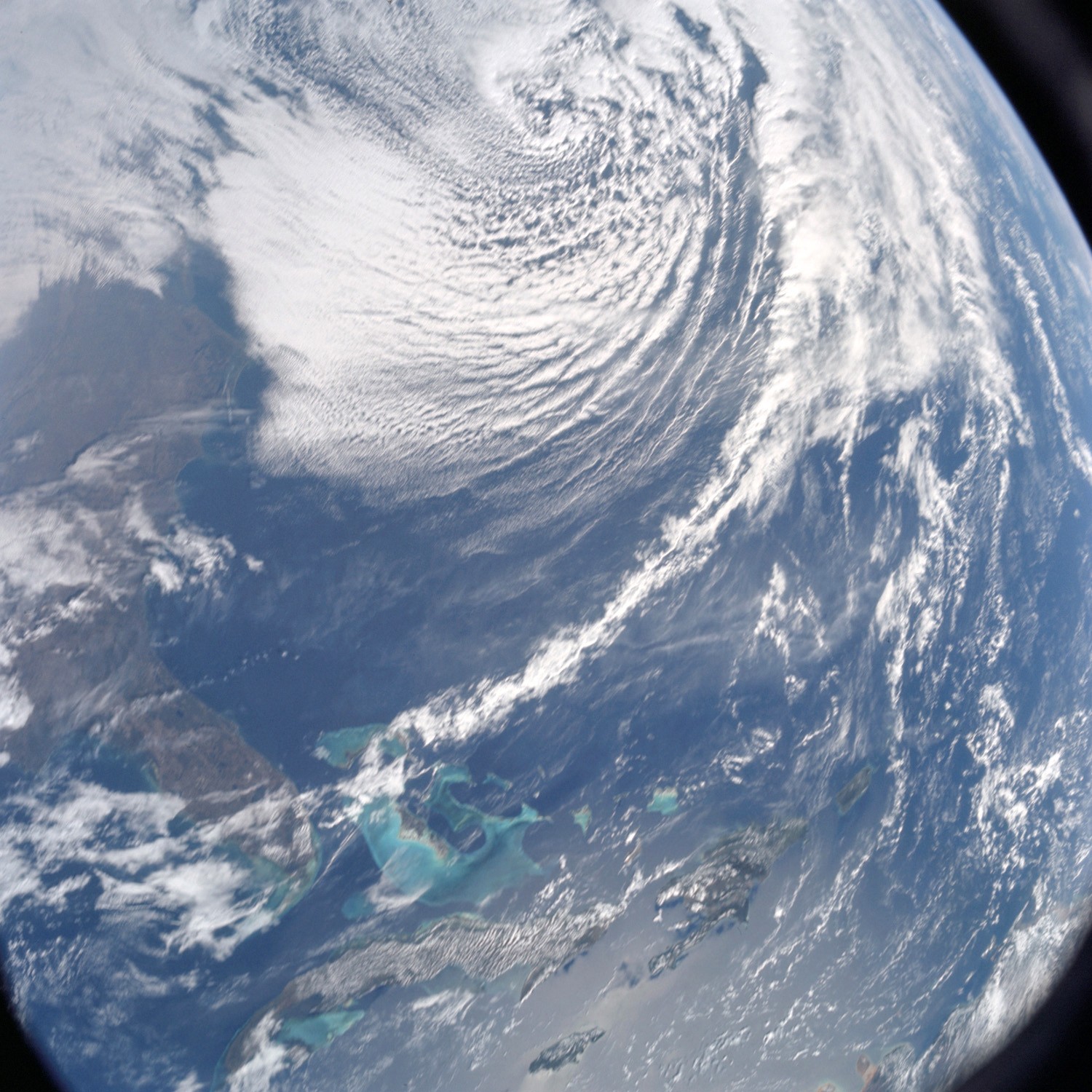
Looking back to the Earth as they begin the journey to the Moon. The Florida Peninsula and Cape Canaveral are in the lower left. The Caribbean chain of islands can be seen. Below is a computer-generated (from Google Earth) of approximately the same view, for orientation. Upper: NASA image AS08-16-2581. |
TRANS-LUNAR COAST (TLC).
At 1:25:00 GET (0024:16 AEST) they plunged back into daylight with sunrise as they approached America. Lovell commented, “Here comes the Sun – take a look. It crept up on us.”
At 2:50:37.79 GET (0141:37 AEST), the S-IVB stage burned for 5 minutes 17.7 seconds to boost the spacecraft’s velocity by 7,451.2 kilometres per hour, and Apollo 8 left Earth orbit and headed for the Moon at 38,959.4 kilometres per hour.
At Honeysuckle Creek we were out of range for the second orbit so didn’t see the burn, but the tracking station at Hawaii reported it had no trouble seeing the red glow of the S-IVB.
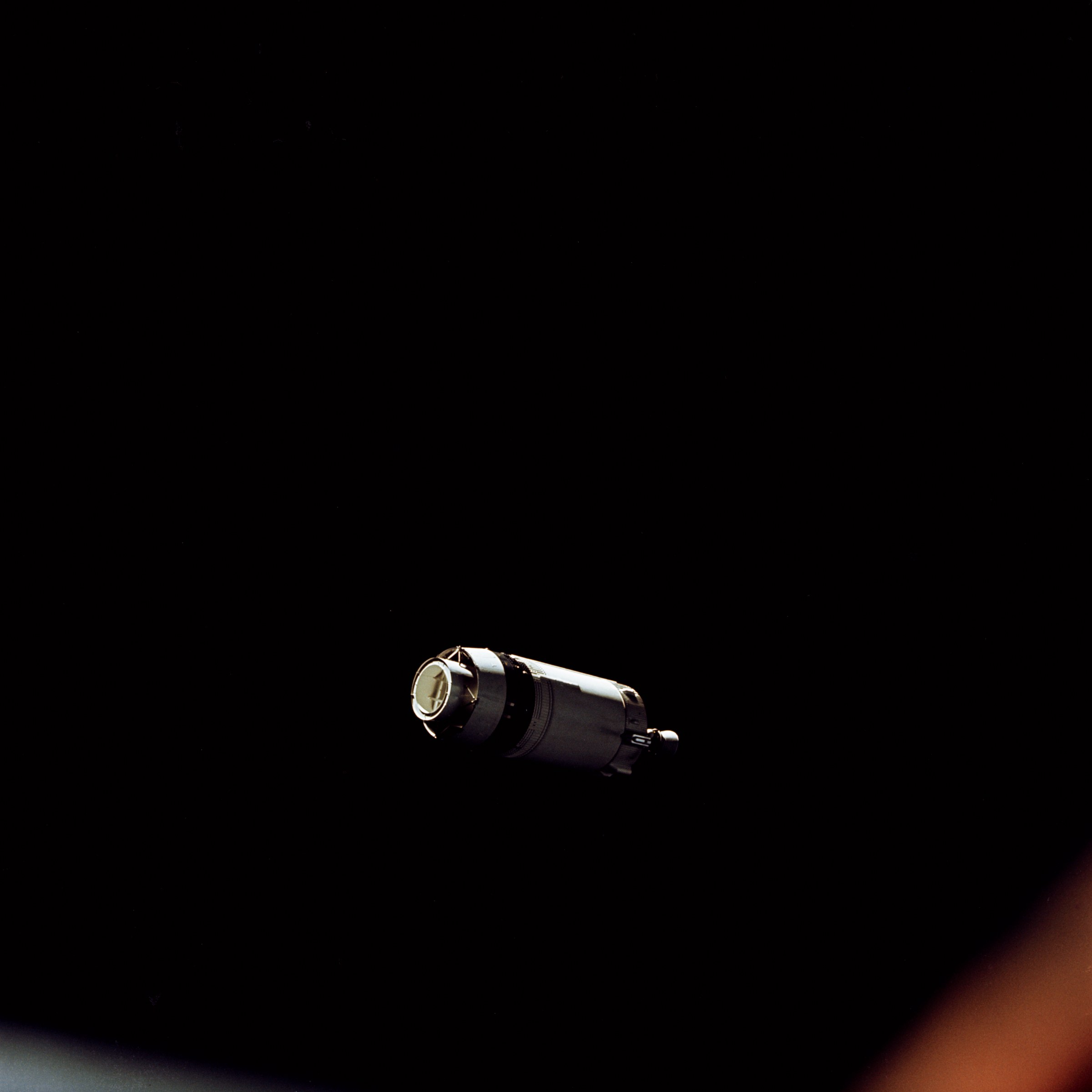
Thirty minutes after the TLI burn, at 3:20:59.3 GET (211:59 AEST) the S-IVB separated from the CSM with a bone-jarring shock, and Borman aligned the CSM to look back at it, now following them about 150 metres behind.
The Apollo 8 S-IVB was sent off into solar orbit, where it will orbit the Sun forever. Later missions smacked the S-IVB into the lunar surface for the ALSEP seismometers to record the impact.
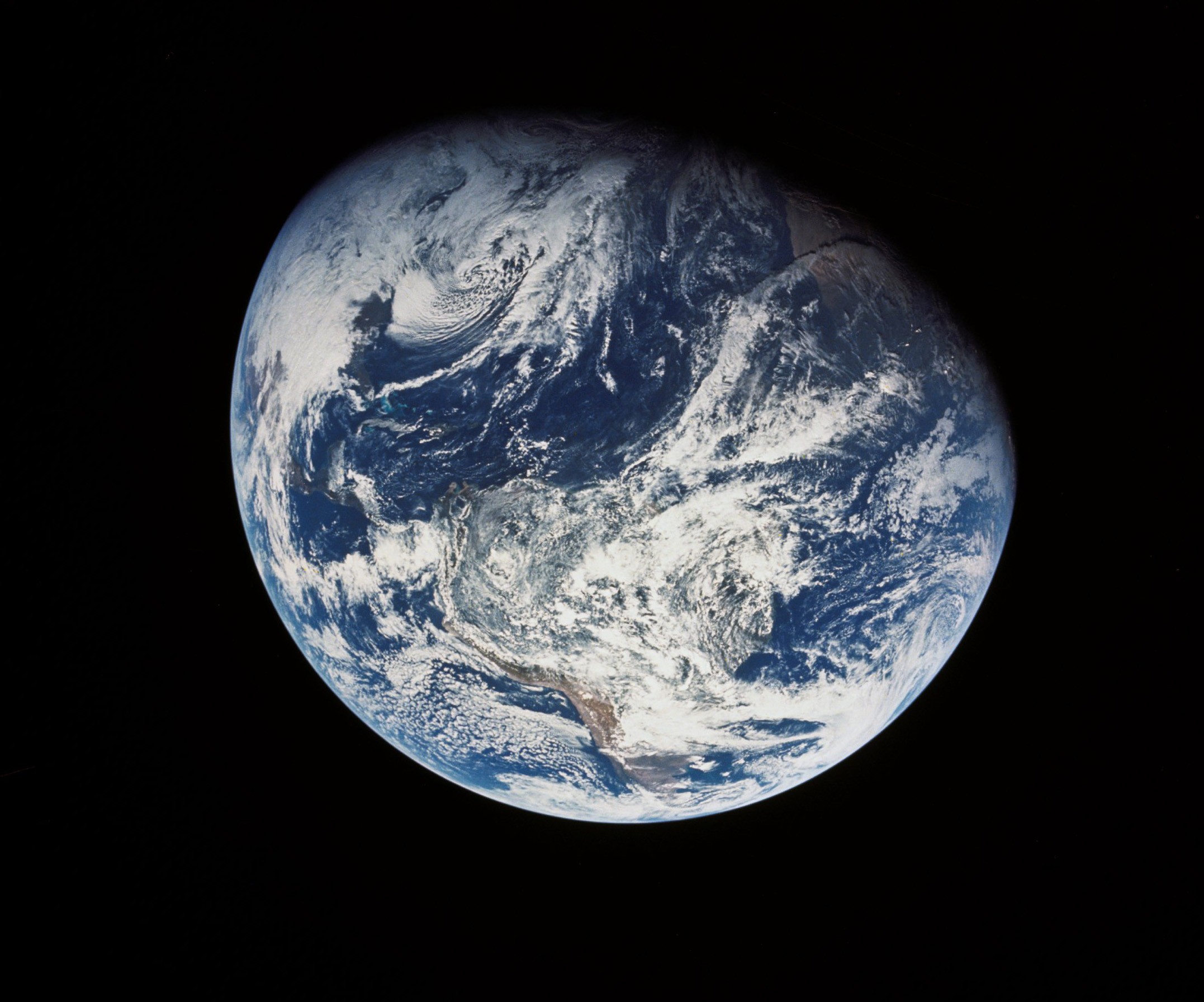
This was the first time anybody had spanned the whole Earth at a glance. They were 12,038 kilometres from Earth, staring in awe at the sight of the whole Earth shrinking into the distance behind the third stage. Lovell felt he was driving a car into a dark tunnel and was watching the entrance dwindle into a distant speck. Borman thought this must be how God sees the Earth.
Bill Anders tried to put it into words: “How finite
the Earth looks. Unlike photographs people see there’s no frame around
it. It’s hanging there, the only colour in the black vastness of space,
like a dustmote in infinity.” They were the first living creatures in the
history of the planet to have ever seen the whole Earth at a glance. It was
a really awesome thought at the time, though we are used to seeing pictures
of it now.
 |
|
The first time humans saw their whole planet at a glance. Taken not long after the previous picture, Florida and the Bahamas can still be seen at upper left, but now all of South America has come into view with Chile and the Cape Horn area pointing off the Earth’s bottom edge. Africa is on the upper right. AS08-16-2593 |
 |
|
The third stage following Apollo 8. JSC scan courtesy of apolloarchive.com |
 |
|
The third stage as Apollo 8 backs away. JSC scan courtesy of apolloarchive.com |
I can still remember listening to Net 1 (the astronauts’
communication channel) in my headset with the astronauts describing the weather
around Tierra del Fuego, sounding as though they were discussing a tourist’s
view of the Florida Everglades.
By the time we next picked up the signal from the spacecraft at Honeysuckle Creek it was already on its way to the Moon.
|
|
 |
|
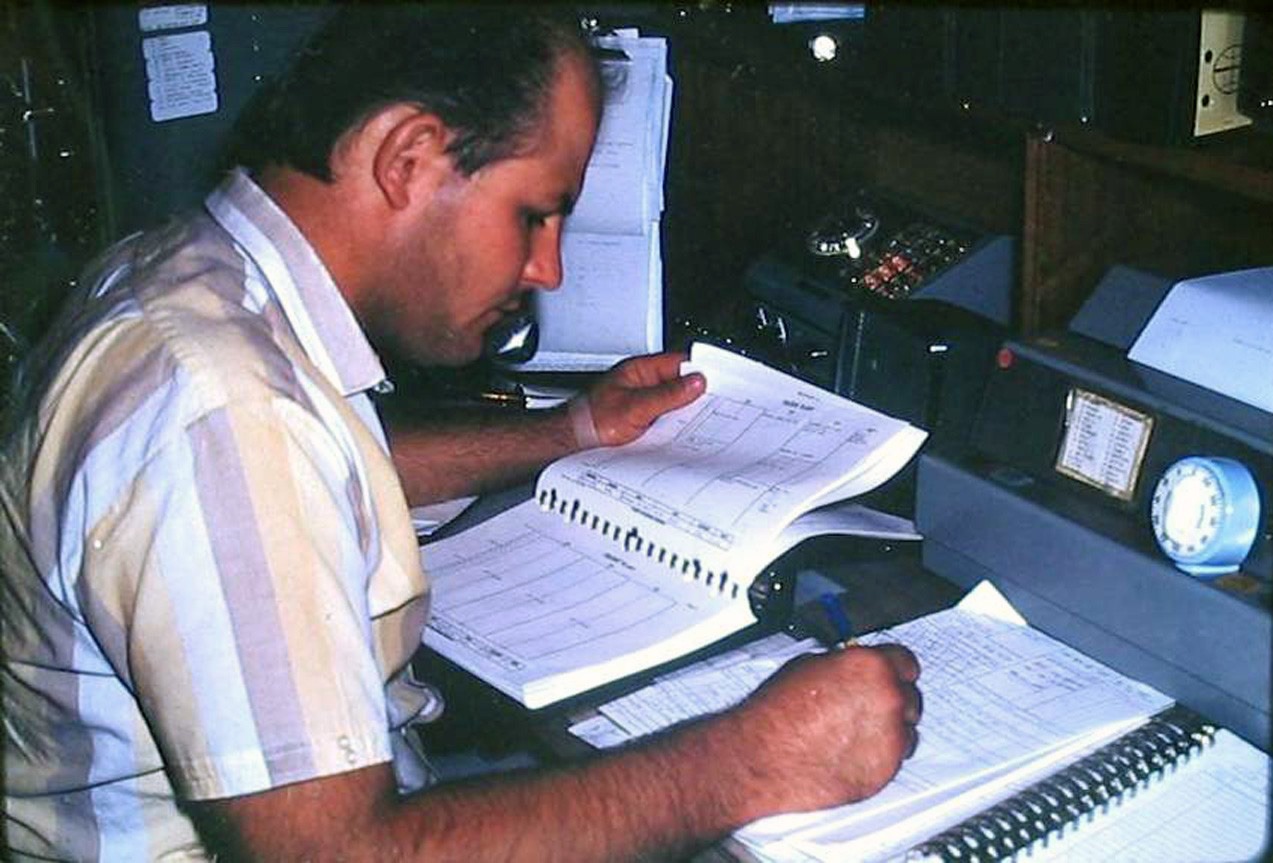
Ron Hicks in the Honeysuckle Computer area |
As the Earth turned we would pick up the spacecraft signal with Goldstone in California transmitting to the spacecraft, then as it set over the horizon at Goldstone we would take over transmitting the signal from the ground. The Deep Space 26 metre dish at Tidbinbilla, DSS42, and the 9 metre dish at Carnarvon were backing us up, receiving one way only, that is, they were not transmitting a signal to the spacecraft. The 64 metre dish at Tidbinbilla had yet to be built, and the 64 metre dish at Parkes wasn’t called up for this mission.
This did not last long. At Honeysuckle Creek we had been suffering a problem in the antenna
feedcone that we called the ‘Search for the Spurs.’ Bill Kempees,
the Chief Engineer, and Jim Kirkpatrick, the Facilities Engineer, and their
teams were trying to track down random bursts of noise, or spurs, appearing
on each side of the uplink when the transmitter was on. It was visible on a
spectrum analyser we had sitting in the USB area. Although we could see it,
there wasn’t a simple explanation for its source.
The theory was it was arcing in the flanges of the waveguide
– but how do you find it and stop it? Nobody could be observing in the
feedcone when the transmitter was on. Before the mission they had asked me to
try and photograph any arcing inside the feedcone, so one night I slung a Polaroid
camera over the window looking down straight into the guts of the feedcone.
A moonless night was chosen and all the floodlights were turned off and the
camera was set with the shutter open all through the night so if an arc occurred
it should cause a spark, be recorded on the film, confirm it was arcing and
identify where the fault was located. Unfortunately the film didn’t like
the transmitter’s 20 kilowatt signal beamed straight at it, just showing
a mysterious white circle, so the idea had to be abandoned.
As soon as Apollo 8 was on its way the spurs were back so there was a high level
decision to pull the feedcone apart and smooth and coat all the flanges, as
we didn’t want to compromise the mission, so this day, Sunday, Honeysuckle
USB went “Red cannot support” for a couple of days. Technical specialist
Dick Albert was flown out from Goddard to help with the exercise.
 |
|
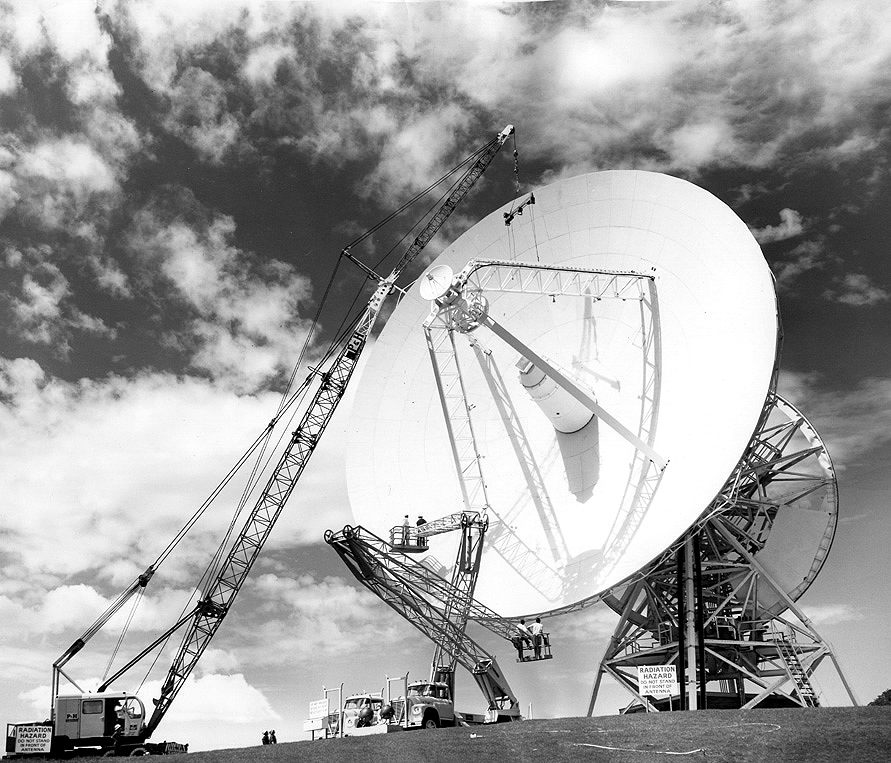
About to remove the feed cone on the antenna. |
 |
 |
 |
|
John Saxon writes, “One Cherry picker occupant was probably Jim Kirkpatrick and the other Ted Burt.” |
First Midcourse Correction.
The second of the two manoeuvres that separated the CSM from the Saturn IVB rocket altered the spacecraft’s trajectory so that a correction was needed at 10:59:59 GET.
So for the first of two mid-course corrections the Flight Plan called for the use of the SPS engine, but some of the flight controllers wanted to use Apollo 8’s smaller thrusters in case the big SPS engine might disrupt the free-return trajectory and make it difficult to return to Earth in an emergency, but Director of Flight Operations Chris Kraft told them, “We need that SPS engine to get into lunar orbit and I want to see it work before they go behind the Moon. Stick to the plan.”
At 10:59:59 GET (0950:59 AEST), 97,730 kilometres from Earth, the SPS motor was fired for the first time for 2.4 seconds for a slight course correction to reduce the closest approach to the Moon from 848 kilometres to 122.8 kilometres, and to check the motor was functioning properly. If there had been any problems with it, the spacecraft wouldn’t go into lunar orbit, but loop around the Moon to return back to Earth.
The SPS engine did not work quite as planned; the thrust had been less than expected. Experts gathered to analyse the data from the spacecraft, and decided that some Helium must have become trapped in the fuel lines before launch; If true, it probably meant the bubble had been purged – but no one was sure. Kraft decided to go ahead and take a chance their diagnosis was correct. The next time the engine was to be fired was the crucial burn to put them into orbit around the Moon, and it had to work perfectly.
At 11:32:44 GET (1023:44 AEST) Borman began a planned 7 hour rest/sleep period while Lovell and Anders continued with mission activities such as communications tests. He had trouble getting to sleep, taking Seconal sleeping pills. After about 5 hours of restless, interrupted sleep Borman took over while Lovell and Anders had their rest period.
At 22:41:24 GET (2132:24 AEST) Borman decided to call Houston, Houston, how do you read?
| HSK MISSION – DAY 3 | Monday 23 December 1968 |
TLC DAY - 2 |
No tracking by Honeysuckle USB today, the Wing at Tidbinbilla carried the day, going two-way with Apollo 8. However all their data was being sent to us over the microwave link to be processed and sent to Houston. Luckily there was no LM to need two stations for a simultaneous track.
Our feedcone was taken off using a crane and two cherry pickers and the waveguide flanges were honed and filled with very expensive silver-filled epoxy, and after purging the nitrogen for the maser we were operational again before Apollo 8 reached the Moon. After the feedcone was reassembled the spurs were still there, though not as bad. As they didn’t seem to degrade our signal to noise ratio we decided to live with them.
At 31:10:36 GET (0601:36 AEST) the first television pictures were received through Goldstone in California from a distance of 223,393.8 kilometres. Those were the days when television was poor quality by later standards, with a tendency for the white areas to smear when the camera was moved.
The first scenes were inside the spacecraft and showed Lovell upside down in the lower equipment bay. He spoke, “This is known as preparing lunch and doing P3 at the same time.”
This was an attempt at humour as the REFSMMAT is a reference to which way is ‘up’ in the spacecraft, and Borman was inferring that Mission Control did not know which way was ‘up’.
 |
Slow Scan TV picture: Bill Anders twirls a toothbrush in zero G for the camera during the first television broadcast, at 31:20 GET. Frank Borman announces: Photo taken by Goldstone Telemetry Supervisor Don Johnson using a Polaroid camera mounted on the Fairchild Slow Scan monitor. Photo ID by Colin Mackellar. |
 |
“Happy birthday Mother!” – Jim Lovell sends birthday greetings to his mother, during the first TV transmission, at 031:23:28 GET. Video excerpt available here. |
They changed the lens from wide angle to telephoto to show the Earth through the window but, as there was no television monitor in the spacecraft, it was very difficult for the astronauts to see what they were photographing. They had to give up on the shots of Earth and finished with more interior scenes.
On the way to the Moon the spacecraft was set up for the PTC (Passive Thermal Control) mode, also known as barbecue mode, slowly turning to keep temperatures evenly distributed over the surface. In this mode the glowing blue and white Earth would pass by their windows every so often, and they were aware it was getting steadily smaller, until eventually they could cover the whole planet with a thumb.
 |
During the three day TLC, Borman, and to a lesser extent Lovell and Anders, went down with motion sickness (technically called SAS, or space adaption syndrome) but we never heard this on the loop as it was passed down through one of the tracking stations (it could have been us) on a voice tape dump to be heard in private in Houston.
We were advised down Net 2 (the tracking station’s communication line from Houston) that Borman had a stomach upset and Lovell was feeling a bit sick too – and it was a mild threat to the mission for a while when Dr Charles Berry thought Borman might have a virus. The astronauts’ description of the gut-wrenching smells and errant pulsing balls of vomit floating around the cabin sounded revolting, but after taking the prescribed medication everything settled down before reaching the Moon.
| HSK MISSION – DAY 4 | Tuesday 24 December 1968 | |
| TLC DAY – 3 and Lunar Orbit Insertion. |
Track Duration |
|
| AOS : 1112:00 AEST | LOS : 1948:16 AEST |
8h 36m 16s |
The astronauts were disappointed to find their view of the approaching Moon was washed out by the Sun’s powerful glare. It should have been a spectacular sight to see the huge bulk of the Moon getting bigger and bigger as they closed in, but they never really saw the Moon on the way out.
 |
The Earth, as seen during the second TV transmission. Video excerpt available here. |
 |
Capcom Mike Collins watches the second television transmission at his console in Mission Control. Frame grabbed by Colin Mackellar from a transfer of the 16mm footage cortesy of Stephen Slater. |
 |
Capcom Mike Collins watches the second television transmission at his console in Mission Control. Behind him, (left to right) astronauts Ken Mattingly, Harrison Schmitt, Buzz Aldrin (standing) and Neil Armstrong also focus their gaze on the TV monitor built into the Capcom console. Frame grabbed by Colin Mackellar from a transfer of the 16mm footage courtesy of Stephen Slater. |
This was part of the conversation during a second TV broadcast of 25 minutes at 55:02:45 GET (0553:45 AEST) as they tried to keep the Earth’s image in the middle of the screen. This time they managed to get an image of the Earth on the screens in Mission Control.
EQUIGRAVISPHERE
Borman, Lovell and Anders were the first humans to leave the Earth’s gravity. They also never felt any physical change when the spacecraft slowed down to 3,578 kilometres per hour relative to Earth and crossed over into the Moon’s gravity field at 55:38:40 GET (0629:40 AEST). They were 326,415 kilometres from Earth and 62,598 kilometres from the Moon.
Jack Garman, in the Guidance Support Room in Mission Control, remembered that moment,
Meanwhile in one of the back rooms at Mission Control Director of Flight Crew Operations, Deke Slayton, cornered Neil Armstrong and told him that Mike Collins was back on flight status and would he mind Collins joining his crew in place of Fred Haise for Apollo 11?
“No problem,” replied Armstrong, thinking back that he had worked well with Aldrin in their training for Apollo 8, and he was quite confident in Collins’ abilities. They thought it over and both agreed that Armstrong as Commander, Collins as Command Module Pilot and Aldrin as Lunar Module Pilot would be the crew for Apollo 11.
 |
|
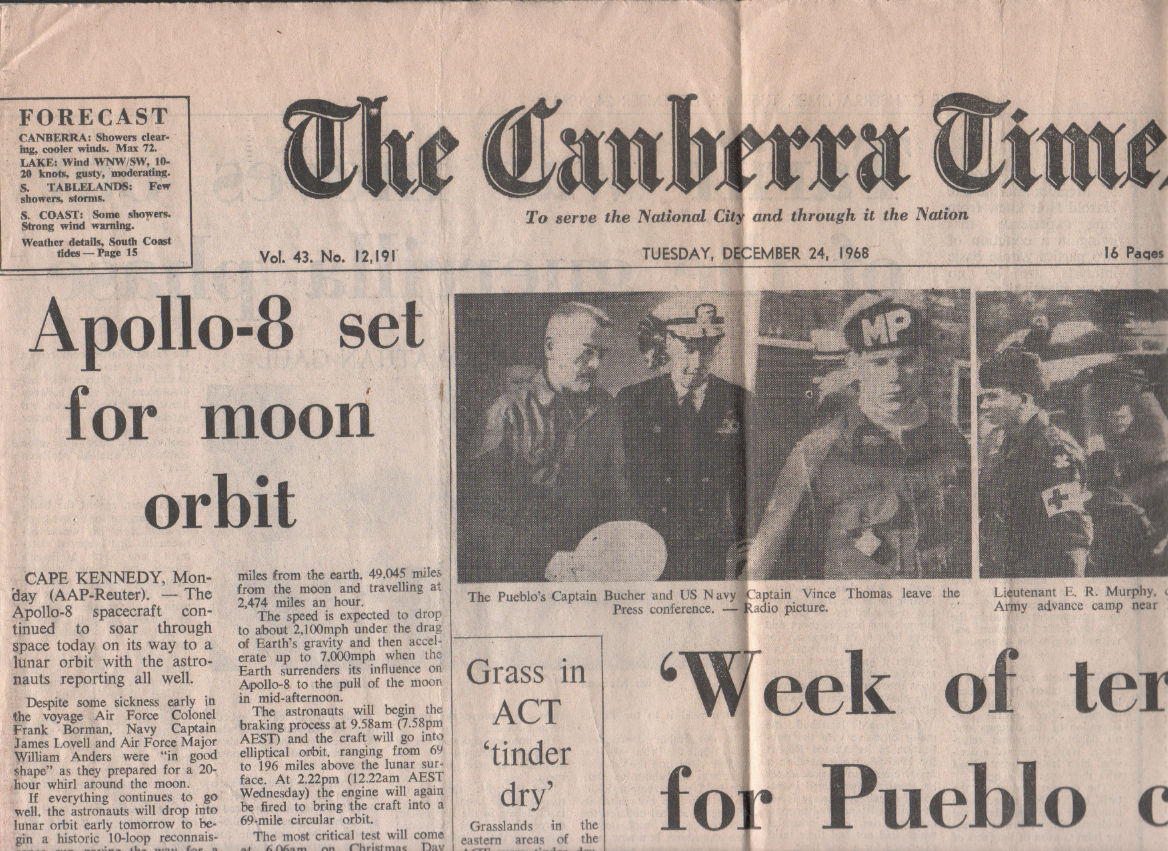
This is how Canberra residents read about the Apollo 8 Mission on the morning of Christmas Eve 1968. An optimistic end to what had been a tumultuous year. |
 |
|
The Canberra Times’ front page also reported Mike Dinn’s brief conversation with the Apollo 8 astronauts when there was a comms problem between Houston and Honeysuckle. Scan and notes: Colin Mackellar. |
 |
|
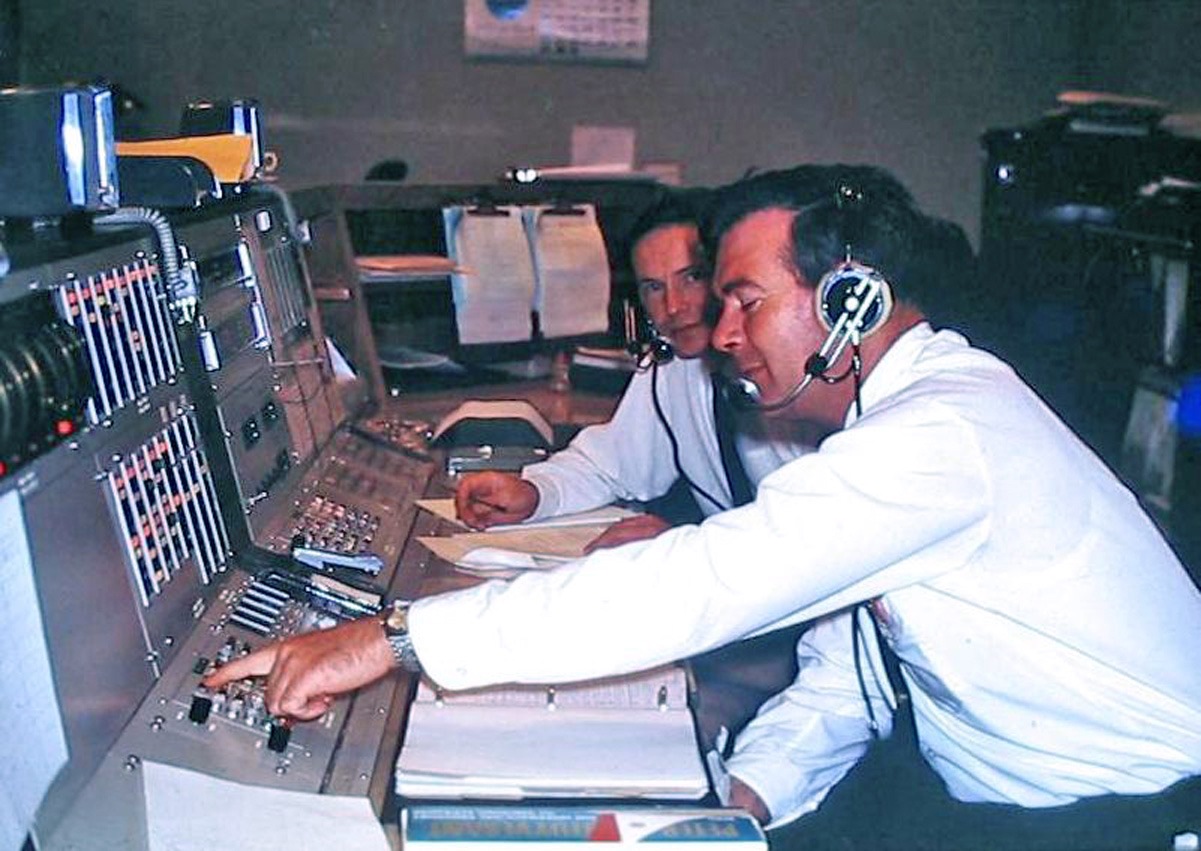
John Saxon (background) and Mike Dinn at the Ops Console, December 1968 (from the calendar), and almost certainly during Apollo 8. Photo: Ron Hicks. |
At 61:58:06 GET (1249 AEST), about 1 hour 37 minutes after our AOS, Honeysuckle Creek had a rare mention on Net 1, the astronaut’s communications loop with Mission Control.
Borman wanted to do a urine dump but checked with Houston, as even such a minor liquid ejection caused the spacecraft to change its trajectory slightly, so Houston advised Borman to go ahead, but it would be the last “gas station stop,” or urine dump, before going into lunar orbit so as to minimise any trajectory perturbations.
GOING BEHIND THE MOON AND INTO LUNAR ORBIT
Then came the moment to go behind the Moon – and the decision to loop around the back and return, or to go into orbit around the Moon.
“Apollo 8 this is Houston,” Capcom Jerry Carr called at 68:04:07 GET (1855 :07 AEST) “at 68 hours 4 minutes you are Go for LOI.”
“Okay,” replied Borman, “Apollo 8 is Go.”
Carr, “Apollo 8 Houston, you’re riding the best one we can find around.”
Borman, “Say again.”
Carr, “You’re riding the best bird we can find. Over.”
Borman, “Roger. It’s a good one.”
At 68:57:16 GET (19:48:16 AEST), just as they were going behind the Moon’s rim Carr called, “Apollo 8 Houston. One minute to LOS. All systems go. Safe journey, guys.”
“Thanks a lot, troops,” Anders responded.
“We’ll see you on the other side,” Lovell added.
“Apollo 8, ten seconds to go. You’re go all the way,” Carr finished the conversation.
|
140kb mp3. 1' 08". Starting at 068:57:06 GET. Honeysuckle was prime at this point. |
1.2 MB mp3. 1' 36". Starting at 068:57:52 GET. Details and more onboard audio on the Onboard Audio page. |
At 68:58:45 GET (0349:20 Houston USCST) time (early, early morning for the Americans, but 1949:20 AEST on Christmas Eve for us), Apollo 8 slipped behind the Moon’s rim and all our signals dropped out. It was now a wait and hope and pray all went well with the burn to put them into lunar orbit.
Borman was so impressed with the exact predicted timing of LOS he wondered, “That was great, wasn’t it? I wonder if they turned the transmitter off?”, but we hadn’t.
Anders laughed, “Chris (Kraft) probably said, ‘No matter what happens, turn it off.’ ”
Borman: “The greatest tension in the spacecraft was when we fired the rocket to slow us up, and when we fired the rockets to get us out of there.”
Subconsciously I felt they would be all right, but was there something unexpected behind the Moon that was a threat to the astronauts or the spacecraft? Someone jokingly said, what about the mountain we didn’t know about that was higher than the spacecraft they would smash into? What was certain was the whole fate of the mission and the astronauts now hung on the SPS motor.
Nobody had ever seen behind the Moon; up to this point we had only sent satellites round. So we all waited, and waited for what seemed hours, but was really only 32 minutes. Behind the Moon the astronauts suddenly felt alone. The radio was quiet; there was no Houston, no Goldstone, Madrid or Honeysuckle to talk to; in fact there was nobody to talk to – they were the first people in history to be completely isolated from Earth, unable to even see it. Lovell decided he felt no different – he was weightless before, he was weightless now – there was blackness outside the window before, there was the same blackness now. The black bulk of the Moon beside them was blotting out the Earth and stars on that side. Only now the radio was silent.
The astronauts looked at each other. Borman then broke into their thoughts with,
Up to now the crew couldn’t see anything out of the windows, as Borman said,
1.1 MB mp3. 1' 18". Starting at 069:05:05 GET. Details and more onboard audio on the Onboard Audio page. |
Flying along with their heads down, the three astronauts were looking out the windows at shafts of bright sunlight splayed across the cratered lunar surface.
Lovell typed the instructions into the computer and looked for the response. The code to say everything was Go, “99:40” appeared in the readout. Lovell took a deep breath and pressed the “Proceed” button.
At 69:08:20 GET (1959:20 AEST), 1,400 kilometres above the Moon, they felt the pressure on their backs as the spacecraft slowed in response to the 4 minute 6.9 second burn that put them into a 312.1 by 111.1 kilometre orbit around the Moon.
“Longest four minutes I’ve ever spent,” murmured Lovell, and stuck his thumbs in the air at Borman.
They were now in lunar orbit after a Trans-Lunar Coast
of 66 hours 16 minutes and 22 seconds.
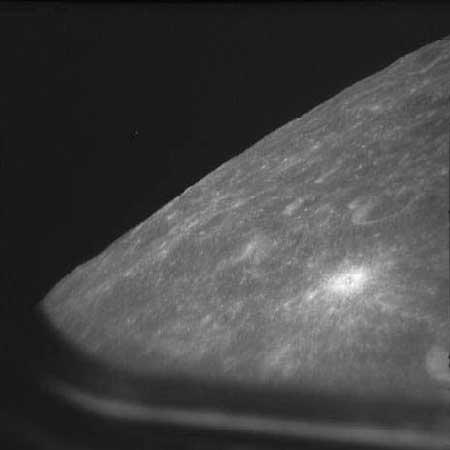
Borman swung the spacecraft around to view the lunar surface and the three astronauts
were gob smacked to see the crater-pitted moonscape gliding past beneath. As
far as the eye could see it was a plaster-like black and white lunarscape of
countless thousands of all types of craters, a tortured terrain of craters on
craters on craters, craters obliterating craters, rising mountains of craters,
deep valleys of craters, plus rilles, rifts, landslides and mares. For a brief
moment the mission was forgotten as the men pressed their faces against the
windows to soak up the sight.
 |
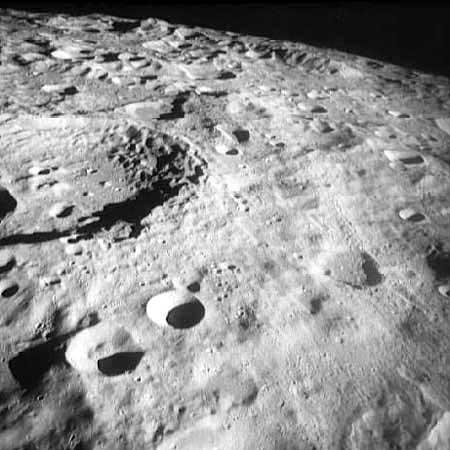
When back in sight of the Earth the astronauts were hardly
poetic in their descriptions. Borman described the scene as: “It looked
like the burned-out ashes of a barbecue,” Lovell: “It’s like
a sand pile my kids have been playing in for a long time. It’s all beat
up with no definition. Just a lot of bumps and holes,” and Anders: “It
looks whitish-grey, like dirty beach sand with lots of footprints in it.”
 |
|
The kids’ sand pile. |
IN LUNAR ORBIT
We had been given the exact time they should appear from behind the Moon for the first time, calculated by those brilliant boffins and their computers in the Trench at Mission Control. At Honeysucklecreek, we were carrying the responsibility of being the Prime Station for this part of the mission.
In the USB area I could see our antenna focussed on the
trailing edge of the crescent Moon on our boresight television, the crosshair
sitting steadily on the rim – waiting. My APP (Antenna Position Programmer)
steadily nudged the antenna along to keep pace with the Moon. Just above the
television screen was one of my large digital clock displays, silently flicking
the seconds away, counting down to a monumental success or a tragic failure.
Had they aborted the burn to give us an early acquisition and a direct ride
home? If not, had the burn gone to plan and put them in the planned lunar orbit?
Or had it failed?
 |
|
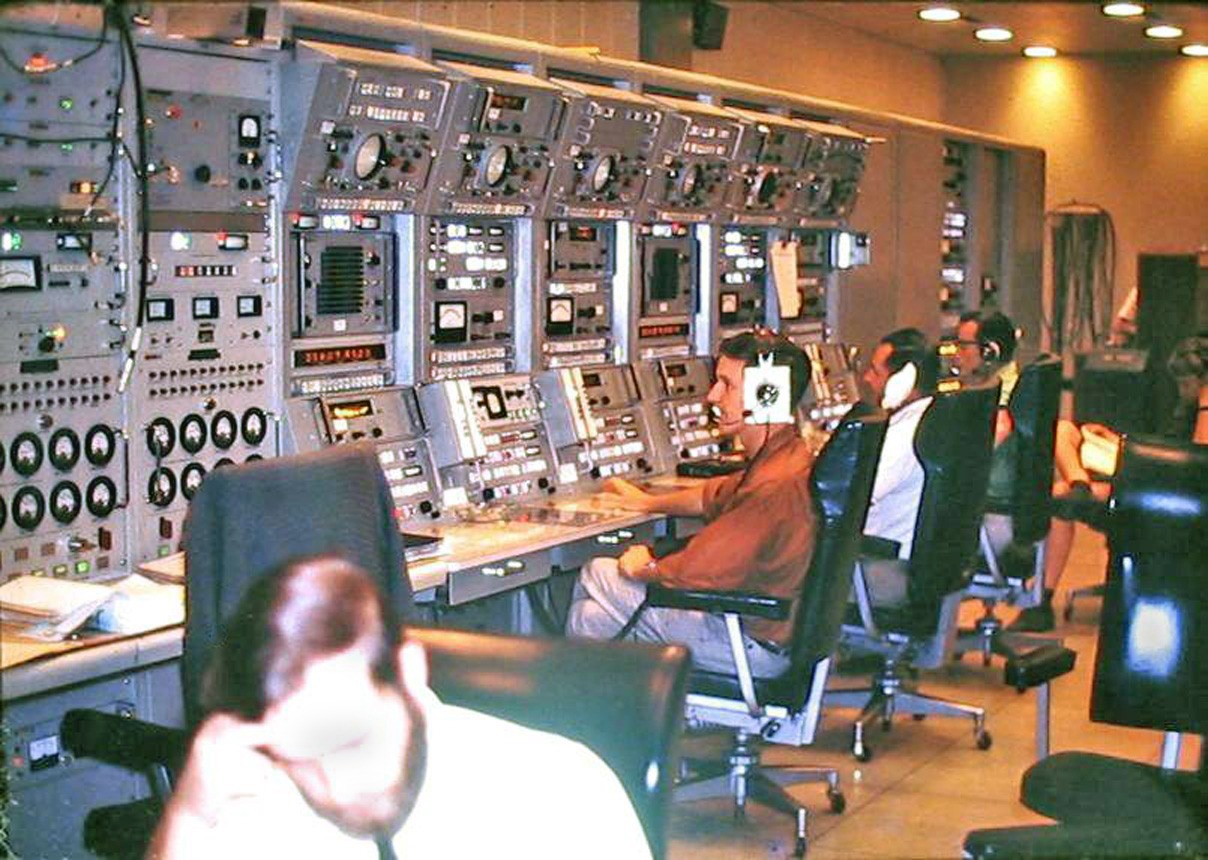
The Honeysuckle Creek USB area during Apollo 8. |
 |
|
Alan Foster – Receivers |
I had a quick look around – everyone one was quiet, Alan Foster and the receiver operators were glued to their consoles, spring-loaded to grab the first signs of any signal from the spacecraft. When the AOS time of 69:32:35 GET Ground Elapsed Time, the time we always used, or 2024 AEST, appeared on our station clock displays we held our breath, but at that exact moment the signal hit our antenna and flooded through the station, kicking all the meters up (analog meters in those days) and filled all our equipment with information about the spacecraft and what had happened while they were out of contact behind the Moon.
On the receivers Alan Foster remembered,
“I just made a normal acquisition as they came over the lunar horizon – it was a good signal, clean and sharp, no fading at all – one of the easiest acquisitions I had ever done because there was no antenna searching around as we could see the crescent Moon on the boresight TV.
I was relieved, I can tell you. I have always remembered Network saying on the loop, ‘That was a beautiful acquisition, Honeysuckle’.”
Once the receivers were locked up we had no trouble acquiring the range, but down at the back of the station there was a lot of tension as there was telemetry data but no voice.
 |
Operations Supervisor John Saxon:
“Because we weren’t tracking the LM we had all our equipment configured onto the CM. There was a planned mode and an unplanned, or back-up mode. We decided we should cover the back-up mode just as carefully as the prime mode. Unfortunately there were so many ways to configure this – we ended up locking up all the telemetry and sending it back to Houston all right – but there was a degree of confusion about where the voice was actually coming from.
I remember hearing the Public Affairs loop saying we have data but no voice, and here I was frantically pushing buttons trying to find where they had put this voice, and Kevin Gallegos (on SDDS, Demodulator) was pushing buttons as well – and no doubt Houston was also pushing buttons. I had my fingers poised ready to call the astronauts and tell them that we did have communications with Houston, but somehow we can’t get you through.
We managed to sort it out in the end – I was very close to being the first guy to speak to someone in Lunar orbit.
Our problems with voice during that first Lunar AOS had worried me for almost 50 years. But recently (August 2018) we gained access to the CSM on-board voice recorder tapes. And it’s now apparent that the CSM HGA was not properly locked on to our signals so the ground signal level (and in particularly the voice sub-carrier levels) were really low, making it almost impossible for Kevin Gallegos to establish if the voice was on a sub-carrier or not. I feel better now!”
Meanwhile on board the spacecraft at 69:33:56 GET (2024:56 AEST) the astronauts were getting ready to receive Honeysuckle Creek’s signal.
| Lunar Orbit 1. | Track Duration |
|
| AOS : 2023:35 AEST | LOS : 2147:39 | 1h 24m 00s |
The public affairs commentator in Houston, John McLeaish, announced with suppressed excitement, “We’ve got it! We’ve got it!! Apollo 8 now in lunar orbit.”
There was a relieved cheer from the Flight Controllers
in Mission Control while Bob Gilruth and Chris Kraft, the two leaders, were
choked up with emotion as they shook hands.
|
180kb mp3 file. At around 069:33:46 GET. |
|
228kb mp3 file. Starts at 069:33:19 GET. Recorded at Honeysuckle. |
Capcom Carr began repeatedly calling the spacecraft with no answer, “Apollo 8, Houston.”
With clear communications established, a discussion began on the status of the cooling radiator as the temperatures were higher than expected. As its evaporator had dried out they switched to the secondary system.
When we heard astronaut Lovell’s prosaic voice answering Mission Control in Houston, “Go ahead Houston, this is Apollo 8.” we all knew everything was all right. They were safely in a 312 x 111.1 kilometre Lunar orbit – at least for the moment.
 |
“Apollo 8 is in Lunar Orbit. 169.1 by 60.5. All is well.” TWX Received at Guam. Preserved and scanned by Brian Riehle. |
|
344kb mp3. Starting at 069:51:04 GET. Recorded at Honeysuckle. |
At 70:03:31 GET (2054:31 AEST) the astronauts were still mulling over the accurate predicted time of the signal LOS.
|
Starting at 070:03:17 GET. Recorded at Honeysuckle. |
Just before eating breakfast they flew into darkness in the shadow of the Moon and Jerry Carr asked the astronauts if they could see Earthshine, that is, the light reflecting from Earth shining on the dark face of the Moon.
84kb mp3. Recorded at Honeysuckle. Starting six minutes later at 070:09:13 GET. |
 |
Hamish Lindsay writes: “Back on Earth, in the darkness of the Australian bush at Honeysuckle Creek, I felt I should get a photograph of this historic moment of us tracking Apollo 8 in lunar orbit, and set up my Linhof camera to record the moment. I had to wait for a gap as some clouds drifted across the face of the Moon. As it was night and there were only the antenna floodlights, it had to be a long tripod exposure for the 100 ASA Kodacolor 4 x 5 inch sheet film, but the result, shown here, was successful, and recorded the historic moment.” |
|
Listen to the entire pass on Lunar Revolution 1
18.4MB mp3 file. Starting at about 069:32:10 GET. |
Just before eating breakfast they flew into darkness in the shadow of the Moon and Jerry Carr asked the astronauts if they could see Earthshine, that is, the light reflecting from Earth shining on the dark face of the Moon.
In Houston excitement spread through the computer centre as the realtime measurements they were getting from our ranging systems at the tracking stations gave them the precise, accurate measurements of the spacecraft’s real orbit around the Moon they needed for all the upcoming Apollo missions – their maths models were now corrected with live data.
Also, for the first time, the crater-scarred surface of the Moon appeared on the 3 by 6 metre screen stretched across the front of the control room. Up to then it had always been the lands and seas of the Earth as the spacecraft orbited the planet.
| Lunar Orbit 2. | MSFN Track Duration |
|
| Madrid AOS : 2230:00 AEST | Madrid LOS : 2355:08 | 1h 25m 08s |
The first pass in lunar orbit ended with LOS at 70:56:35 GET (2147:35 AEST) as they went behind the Moon for the second time, and after 42 minutes they reappeared at 71:39:00 GET (2230:00 AEST) in orbit 2, busy transmitting television pictures of the lunar surface passing below the spacecraft. This was their third television broadcast. Madrid was the prime station tracking now.
After 12 minutes of television transmission, mainly showing and discussing various craters passing by below Borman terminated the transmission with,
Just before our midnight, at 73:04:08 GET (2355:08 AEST) the spacecraft disappeared behind the Moon again, though we weren’t tracking it.
| HSK MISSION DAY – 5 | Wednesday 25 December 1968 | |
| Lunar Orbits 3-10 and TEC Day – 1 | Overall Track Duration |
|
| HSK AOS : 1231:30 AEST | HSK LOS : 2206:45 | 9h 35m 15s |
At 73:35:06.6 GET (0026:06 AEST) there was a second SPS engine burn of 9.6 seconds to circularise the orbit to 112.4 by 110.6 kilometres.
| Lunar Orbit 3. | MSFN Track Duration |
|
| MSFN AOS : 00:40:25 AEST | MSFN LOS : 01:52:23 AEST | 1h 11m 58s |
At 73:49:25 GET (0040:25 AEST), the Manned Space Flight Network saw Apollo 8’s signal again in their third orbit.
At 74:44:51 (0135:51 AEST) Borman checked to see if Rod Rose was in Mission Control. Rose was Chairman of the Planning and Analysis Division of Flight Operations, responsible for producing the Mission Flight Plans.
Experiment P-1 was a code for a planned Bible reading arranged with Borman’s St. Christopher’s Episcopal Church near Seabrook, Texas, Rose being a fellow member, and in on the secret.
The third orbit ended at 75:01:23 GET (0152:23 AEST) with LOS behind the Moon’s rim, heading around to begin their fourth orbit.
 |
As most Australians slept, awaiting the dawn of Christmas Day, NASA Public Affairs Officer Don Witten took this photo of Station Director Tom Reid at the Operations Console. Ops Supervisor Ken Lee is partially visible. |
 |
This photo, taken at the same time, gives a slightly different view of the Operations Console. |
| Lunar Orbit 4. | MSFN Track Duration |
|
| MSFN AOS : 0238:18 AEST | MSFN LOS : 0350:59 AEST | 1h 12m 41s |
AOS in the fourth orbit was at 75:47:18 GET (0238:18 AEST)
One of the mission’s sublime moments was the sight of the Earth rising above the lunar horizon – Earthrise!
Although the vista of the Earth rising over the lunar horizon had been experienced in the first three orbits, the astronauts were too busy with the lunar surface to see it with their windows looking down. This time Borman had been keeping the spacecraft pointing down to look at the Moon’s surface, but had to roll it around for a navigation sighting by Lovell. As the lunar horizon hove into view, Anders was startled to see a glowing blue and white ball swim into view – the Earth.
At 75:47:30 GET (0238:30 AEST) an astonished Anders blurted out , “Oh, my God – look at that picture over there; here’s the Earth coming up... wow, is that pretty.”
While waiting, Anders took a black and white photograph at 75:47:44 GET (0238:44 AEST) showing the Earth just appearing from behind the Moon.
 |
The first black and white picture of the famous Earthrise scene. |
As the spacecraft was rolling, the Earth disappeared from window #5 and now could be seen in windows #4 and #3.
The first colour frame was taken at 75:48:39 GET (0239:39 AEST).
The second frame, with a minor exposure change, was taken 30 seconds later.
As the Earth climbed above the horizon into the jet black sky they gazed in
silence, spellbound at the wondrous sight. The resulting colour picture, to
become one of the most famous images ever recorded, was the first time the people
of Earth really became aware of how fragile and insignificant our planet suddenly
looked in the infinite cosmos.
 |
|
Bill Anders took this colour picture of the Earth rising above the lunar surface a few moments later. |
I used to wonder which way was ‘up’ in the spacecraft. Pictures usually show the
lunar horizon across the bottom of the frame, but actually the lunar horizon
should be on the right side to me, lunar north being ‘up.’ One day
I asked Dave Scott (Apollo 15) which way was up to the astronauts in the spacecraft,
and his answer was it was always straight above their instrument panel, whatever
was happening outside. I feel that the pictures of the Earth with the lunar
surface should have the horizon on the right side if they are orbiting clockwise
around the Moon’s equator to give a more natural alignment to the scene.
Looking from the moon back to the Earth suspended in the
absolute black, infinite void of space, the astronauts now saw the whole planet
Earth as “home”. In fact, a running joke among the Apollo 8 crew was
that looking at the Earth from space the question arises, “Is it inhabited?
Is there life on Earth?”
This acquisition through Madrid while the astronauts were taking their historic pictures had some spacecraft omni antenna problems and the lines were very noisy, so they handed the uplink over to Goldstone.
So on the ground at Honeysuckle Creek we did not share those exciting moments of Earthrise as it happened.
LOS for the fourth orbit was at 76:59:59 GET (0350:59 AEST) with Anders frantically busy taking endless photographs, Lovell at the navigation station and Borman keeping an eye on the spacecraft and eating his lunch.
Collins: Have a good back side. See you next time around.
| Lunar Orbit 5. | MSFN Track Duration |
|
| MSFN AOS : 0437:02 AEST | MSFN LOS : 0549:56 AEST | 1h 12m 54s |
AOS from behind the Moon was at 77:45:50 GET (0437:02 AEST), the topics under discussion during the pass were navigational, engineering and the lunar surface features, and some general news items were read to them.
Just before LOS the crew reflected on what they had seen (onboard conversation):
MSFN LOS was at 78:58:44 GET (05:49:56 AEST) with a weary Borman already asleep.
| Lunar Orbit 6. | MSFN Track Duration |
|
| MSFN AOS : 0632:12 AEST | MSFN LOS : 0748:36 AEST | 1h 11m 24s |
AOS was at 79:46:00 GET (0637:12 AEST) for their sixth orbit, but communications were poor due to relying on the omni antennas, and it was a few minutes before dialog was established.
During the sixth orbit, before rounding the corner to see Earth, they saw another sunrise at 79:09:22 GET (0600:34 AEST). (Onboard.)
Borman woke up at around 80:12:00 GET, just before they went behind the Moon again at 80:57:24 GET (0748:36 (AEST)
| Lunar Orbit 7. | MSFN Track Duration |
|
| MSFN AOS : 0834:17 AEST | MSFN LOS : 0947:06 AEST | 1h 12m 49s |
At 81:43:05 GET (0834:17 AEST) the MSFN had AOS with Capcom Collins greeting the boys with, Roger, Frank. Good morning. Welcome back.
In a comfortable cabin temperature of 25°C Borman was flying the spacecraft, Lovell was conducting auto optic exercises and Anders was trying to eat between identifying landmarks and more photography.
By now Lovell and Anders were getting very tired and at 82:42:01 GET (0933:13 AEST) Borman announced he was terminating all experiments,
LOS was at 82:55:54 GET (0947:06 AEST) and, after they were out of contact with Earth, Borman had to urge Anders to go to sleep, “I want you to go to bed. Come on now. You’ve been up all the time – it’s in the Flight Plan, God dammit. Go to bed. To hell with the other stuff! We’ll bust our ass for it.”
| Lunar Orbit 8. | MSFN Track Duration |
|
| MSFN AOS : 1033:17 AEST | HSK LOS : 1145:12 AEST | 1h 11m 22s |
[Honeysuckle Creek begins tracking once the Moon rises above the surrounding hills – some minutes after nominal Moonrise at 10:34am AEST, and tracks through to LOS at 11:45am.]
OS was at 83:42:05 GET (1033:17 AEST) with Lovell and Anders asleep, while Borman was keeping watch and speaking to Houston, “Well, Jim and Bill are both resting now. I had about 3 or 4 hours earlier today.”
With a shift change in Mission Control, Collins handed over the Capcom position to Ken Mattingly, “Okay we have finished looking at all your systems and you have a GO for another rev.”
They ducked behind the Moon again at 84:54:00 GET (1145:12 AEST) and as they sailed along the back of it the crew began to think about the big television show they were going to set up for, as Borman said, “We’ve got to do it up right, because there will be more people listening to this than ever listened to any other single person in history.”
They were also thinking about the SPS burn and coming home during the tenth orbit. Borman again, “And we’ll put it all in one place and get the whole damn thing shipshape, because now she’s going to take us home.… let’s only have the stuff out we’re going to need to operate for the burn. Here’s some stuff stuck up here. There’s cameras floating about all over the place. Jim, fix me one of those.”
The crew began stowing their equipment away, with the recorder recording comments like, “Jim, where did you get this camera bracket out of?” and “Huh! Where does that go?” and “I don’t know, how does this store, Bill? Together or separately?”
| Lunar Orbit 9. | Track Duration |
|
| HSK AOS : 1231:30 AEST | HSK LOS : 1344:00 AEST | 1h 12m 30s |
On Christmas morning, an Australian News Press Release was sent to the media proudly announcing that television pictures of the Moon had just been received at Honeysuckle Creek and Tidbinbilla tracking stations as the spacecraft was passing over the Sea of Crises as it began its ninth orbit.
At 85:40:30 GET (1231:30 AEST) the Moon had risen above our horizon at Honeysuckle Creek, and we had our AOS as the spacecraft came around the Moon’s rim. With Goldstone in California, the prime station, we were ready for the big television moment.
The fourth television transmission began at 85:42:51 GET (1233:51 AEST), with Anders querying, “How’s the picture look, Houston?”, hoping he had set up a good picture.
 |
Mike Dinn preserved this Polaroid of the slow scan TV monitor at Honeysuckle during the 4th TV transmission on lunar revolution 9. This was taken a few seconds before Anders began reading from Genesis. Scan: Colin Mackellar. |
As Apollo 8 approached lunar sunrise, passing over endless mares and craters, the shadows on the moon beneath shortened, the astronauts celebrated Christmas by taking turns reading from the Bible at 86:06:56 GET (1257:56 AEST, during our lunch time). Anders opened the Bible reading sequence with,
 |
This Polaroid of the slow scan TV monitor was taken as Jim Lovell began his portion of the reading. Preserved by Mike Dinn. Scan: Colin Mackellar. |
Television screens around the world blacked out when Anders switched the camera off at 86:09:46 GET (1300:46 AEST), ending a 26 minute 55 second broadcast.
An estimated one billion people in 64 countries heard the live reading, and delayed broadcasts reached another 30 countries.
|
Outside, darkness enveloped the spacecraft as it rushed on into the lunar night. On Eart,h millions had gathered around their Christmas trees and listened to this ethereal reading from above the forbidding lunar surface.
We lost the spacecraft’s signal at 86:53:00 GET (1344:00 AEST) as it went behind the Moon for the second last time.
Tom Sheehan, Head of Mission Control’s Track group we knew as ‘Houston Track’, said, “Hardly anyone left Mission Control for the very long lunar orbits. There was a universal feeling of awe and fulfilment. All too soon it was time for TEI and the trip home.”
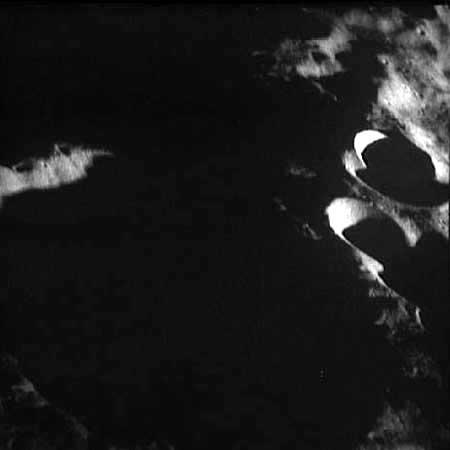 |
 |
NASA Public Affairs Officer Don Witten with a special Slow Scan Television monitor set up in Station Director Tom Reid’s office. He is examining some of his Polaroids showing the slow scan TV picture. More on his visit to HSK here. Photo: Don Wittten, Image restoration: Colin Mackellar. |
| Lunar Orbit 10. | Track Duration |
|
| AOS : 1429:15 AEST | HSK LOS : 1542:00 AEST | 1h 12m 45s |
Honeysuckle Creek tracking.
AOS for Orbit 10 at Honeysuckle Creek was at 87:38:15 GET (1429:15 AEST).
This being the last pass before they went behind the Moon for the TEI burn, everybody was busy checking and double checking all the figures and equipment status. Mattingly read up all the final information for the burn. Lovell swung himself from the lower equipment bay where he had been checking out navigation figures and settled in his couch. The other two were already seated. They began going through the checklist.
At 88:51:00 GET (1542:00 AEST), just as they went around the corner for the last time, there was a conversation about Australia on the spacecraft recorder:
THE TEI BURN AND THEY WERE COMING HOME.
Honeysuckle Creek tracking.
As the crew prepared for the burn behind the Moon, Anders commented, “Boy – it’s blacker than pitch out there.”
The mission critical SPS motor burn to bring them home was fired at 89:19:16.6 GET (1610:16 AEST) with a TEI burn time of 3 minutes 23.7 seconds at an altitude of 111.5 kilometres above the Moon. Their speed increased by 4,435.5 kilometres per hour to 9,702 kilometres per hour.
The clock in Mission Control counted down to the burn while another clock was showing 9 minutes 23 seconds to reacquisition of the spacecraft signal.
In all the tracking stations and Mission Control everyone went quiet. This was
the last unknown. “Swallow the frights one at a time as they appear in
the Flight Plan,” astronaut Michael Collins once said.
George Low, the man responsible for this crazy trip to the Moon, sat hunched in the VIP lounge in Mission Control. He admitted this was his most feared moment.
Chris Kraft, the Director of Flight Operations in Mission Control in Houston, who knew more than anybody about the missions, said to me later, “If you weren’t shaking at that point you didn’t understand the problems.”
So again Honeysuckle Creek was the action station as we hung in suspense waiting for them to come from behind the Moon. If the SPS engine hadn’t fired, or fired incorrectly, they would be doomed to die when their consumables would run out within a week. They would then be condemned to circle the lonely reaches of the Moon. There was no rescue mission standing by, or anybody around to help them.
LAST LUNAR AOS.
Aware this was another big Apollo 8 moment, I had set the computer controlling the Honeysuckle Creek antenna so the dish pointed steadily at the Moon’s rim where the spacecraft was expected to appear.
And, right on time at 89:28:39 GET (16:19:39 AEST) the signal from Apollo 8 arrived at our antenna and the station came alive with operators calling out their readings.
Apollo 8 ....... Houston, called Capcom Ken Mattingly into the ether.
Apollo 8 ....... Houston, he called again, listening to the hash coming down the line.
Apollo 8 ....... Houston. Everyone on the loops around the world were straining to hear a voice. Nearly a hundred seconds of hash had ticked by, then...Roger. Please be informed there is a Santa Claus, we heard Lovell’s voice say and knew they were heading safely for home.
The voice circuit was a bit noisy, and there was no telemetry data, but that was soon corrected when the spacecraft aligned its High Gain antenna and our signal strength increased.
TRANS EARTH COAST (TEC)
Twenty hours, ten minutes and thirteen seconds after entering lunar orbit and 10 times around the Moon, it was Christmas day and it was all on again for the ride home – they had to have a rocket burn to bring them back to Earth, and it had to happen out of contact behind the Moon.
It was 1625 in the afternoon on Christmas Day at Honeysuckle Creek. Apollo 8 was a success and our Moon landing missions could go ahead – well, that was providing they re-entered safely, but there were no unknowns there. We could now enjoy a late but happy Christmas.
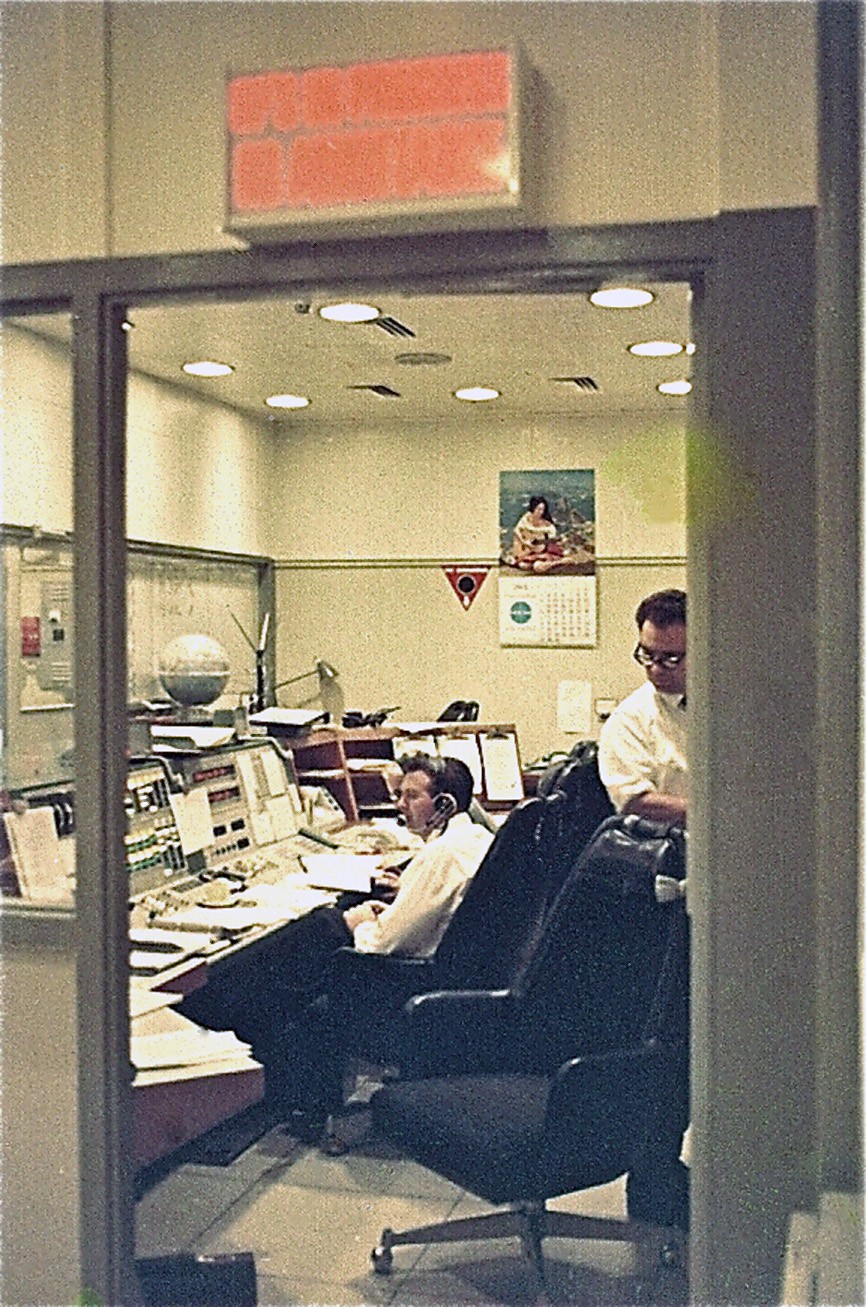 |
The Honeysuckle Operations Console during Apollo 8. Mike Dinn (seated) and Ian Grant appear in this photo by NASA PAO Don Witten. |
Australian Prime Minister John Gorton called the station requesting to speak to the astronauts, but was politely declined. Then he wanted to send a message, but that was also turned down.
At 89:54:06 GET (1645:06 AEST) the Chief of Flight Crew Operations, Deke Slayton, came on the loop,
In Mission Control the big display maps showed the Earth again and a 1.8 metre high, cheerfully decorated Christmas tree was brought into the front of the Control Center.
 |
The Christmas greeting to Cliff Charlesworth’s Maroon Team of Flight Controllers was displayed on one of the screens at the front of the MOCR. Image from 16mm NASA footage supplied by Stephen Slater. Enhancement by Colin Mackellar. |
 |
The Christmas tree is decorated. Image from 16mm NASA footage supplied by Stephen Slater. Enhancement of very dark footage by Colin Mackellar. |
 |
The Christmas tree stands between the consoles and the display screens at the front of the MOCR. Image from 16mm NASA footage supplied by Stephen Slater. Enhancement of very dark footage by Colin Mackellar. |
At 89:59:18 GET (1650:18 AEST) Mattingly called,
|
T’was the night before Christmas, and way out
in space When out of the DSKY there arose such a clatter, But Frank was no fool, he knew pretty quick They spoke not a word, but grinning like elves, Great job, Gang! |
|
|
(DSKY is the computer keyboard and REFSMMAT is Reference to Stable Member Matrix or a mathematical means of determining angles using the stars as a reference.)
Here is the same audio synchronised with the short segments of 16mm which were taken as the poem was read. (External link to Vimeo.) |
With the spacecraft cruising quietly back to Earth, the crew were very tired and at 91:11:59 GET (1802:59 AEST) Borman called down,
Once, for a moment there was a flurry of excitement when the spacecraft signal dropped out, and Houston switched antennas but there was still no voice from Apollo 8. Then it was discovered Anders had inadvertently unplugged his headset.
With Apollo 8 on its way home, and Borman and Lovell asleep, so ended our Christmas Day at work for 1968.
 |
 |
|
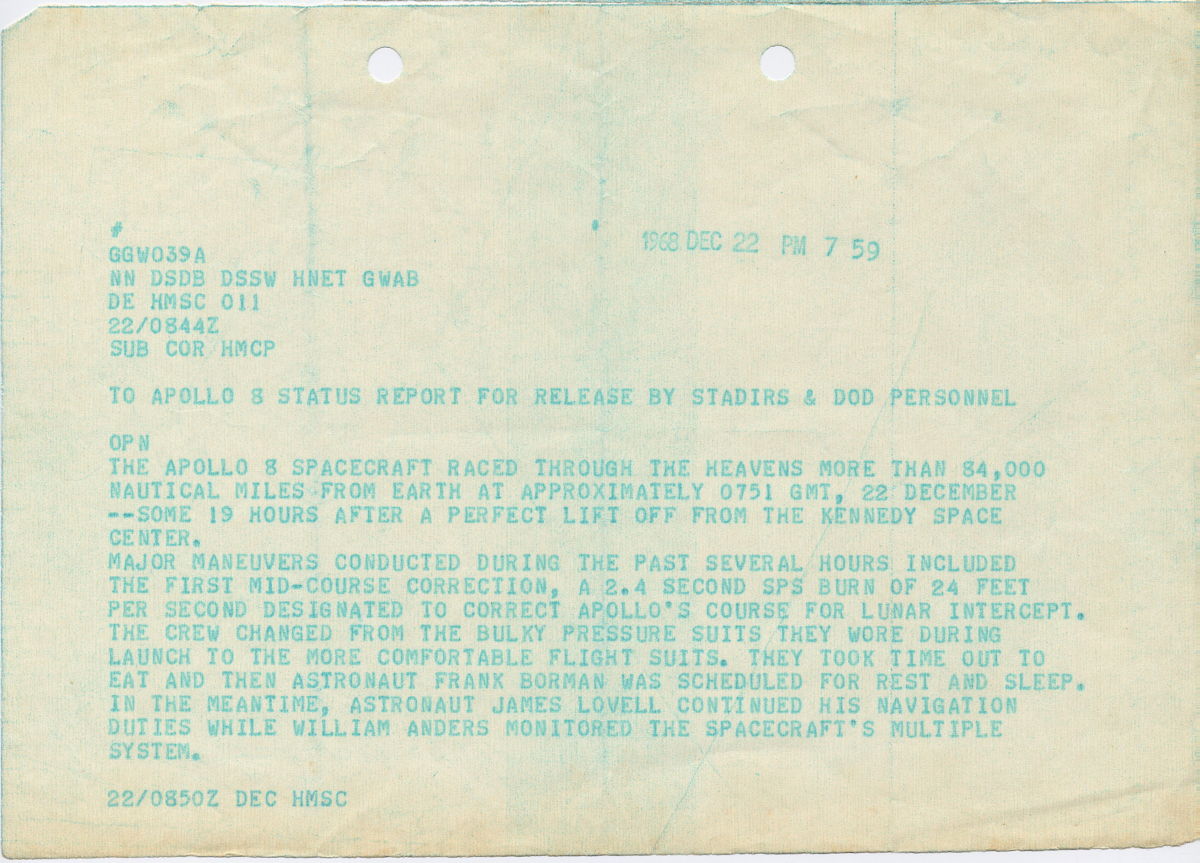
This TWX (Network message) was sent from HMSC (Houston Manned Spacecraft Center) to the Network on Christmas Day at 0845GMT. |
| HSK MISSION - DAY 6 | Thursday 26 December 1968 | |
| TEC Day – 2 |
Track duration |
|
| AOS : 1210:35 AEST | LOS : 2221:09 |
10h 10m 34s |
 |
The Apollo 8 photograph the Earth during Trans Earth Coast. |
At 98:05:28 GET (0056:28 AEST) there was a short discussion about Santa Claus:
While most of us were resting, at 100:47:47 GET (0338:47 AEST) Apollo 8 cruised quietly back through the eqigravisphere, where the Moon’s and Earth’s gravity zero out and the spacecraft slowed up before gaining velocity to plunge back to Earth. At that point the spacecraft’s velocity was 5,309.7 kilometres per hour relative to the Moon, and 4,505.4 kilometres per hour relative to the Earth.
A fifth television broadcast began at 104:24:04 GET ((0715:04 AEST) with Borman calling, Mike, we’e ready when you are.
The return journey was quiet except for one moment. At 105:58:19 GET (0917 AEST on 26 December) Michael Collins was sitting relaxed in the Capcom’s chair in Mission Control when he heard Lovell call, “Whoa, whoa, whoa!”
“Okay, whoa, whoa. Standing by,” he replied, wondering what was coming next.
Lovell had accidentally erased all the navigational data from their computer. The IMU (Inertial Measuring Unit) which Borman had insisted they leave running the whole trip so they would not have to do a tedious manual realignment, suddenly did not know which way was up. It reconfigured back to the beginning of the mission and thought it was back on the launch pad, so the attitude computer began firing the thrusters to realign the spacecraft to the new ‘up.’ Anders noticed with alarm that the eight ball indicator was moving more than it should and tried to counteract the movement, but the spacecraft only corrected his instruction. He wondered if they had a stuck thruster. When he figured the thrusters were okay, he let the spacecraft stabilise to what it thought was ‘up’ on the launch pad. This condition couldn’t continue because during reentry the spacecraft’s heatshield wouldn’t be properly aligned to face the direction of travel.
Lovell had to reset the IMU manually by aligning the spacecraft to the stars Rigel and Sirius and transfer the settings to the computer.
During the quiet periods Houston played a lot of Herb Alpert’s
Tijuana Brass on the uplink from Honeysuckle Creek to the astronauts.
 |
Apollo 8 Television This photo of the slow scan TV monitor, just over six minutes into Apollo 8’s 5th television broadcast, shows how good the slow scan picture was. Kept and preserved by Don Witten. See the corresponding frame of the converted NTSC format TV. |
 |
0359Z 26 December 1968. Report of a TV show on the way home. |
| HSK MISSION - DAY 7 | Friday 27 December 1968 | |
| TEC Day – 3 |
|
|
When we picked up Apollo 8 for the last time there
was a peculiar twist due to the Earth turning under the slowing spacecraft.
We lost Apollo 8 in the west with a handover to Carnarvon who then handed over to Madrid who handed over to Guam for the final minutes of flight and the fall to Earth.
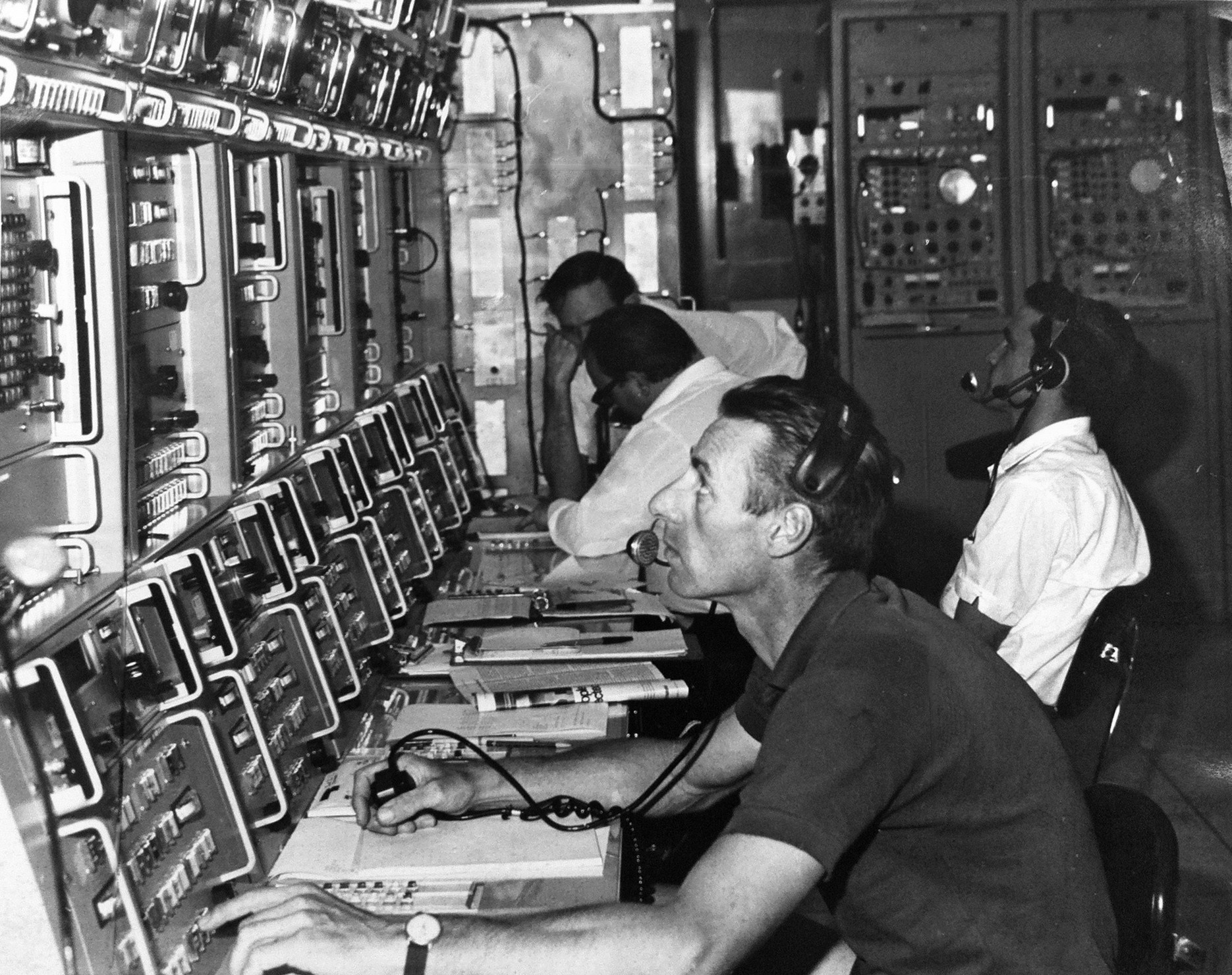 |
AWA Technician Tom Lysaght at the Receiver/Exciters at Carnarvon USB during Apollo 8.
Photo 8526 from the Tidbinbilla archives. Scan by Colin Mackellar. |
The final television show began with a rehearsal at 127:45:33 GET (0636:33 AEST) with the Earth 182,164.6 kilometres away. By now they were speeding up and were travelling at a speed exceeding 6,583 kilometres per hour.
The show began at 128:00:00 GET (0651:00 AEST) with the Earth showing South America:
Borman ended the six minute show with,
Shortly after the television broadcast Borman announced, I say we are starting to stow the spacecraft and get all squared away and then be eating and sleeping. We’ll all be thinking about entry from now on.
| HSK MISSION - DAY 8 | Saturday 28 December 1968 | |
| SPLASHDOWN |
|
|
While the tracking stations were busy following the spacecraft in the darkness below, the astronauts were getting ready for their spectacular reentry. They had cast off the Service Module (SM) at 46:28:48 GET (0119:48 AEST) and were settling in their couches preparing for a rough ride.
“It’s getting a little hazy out there,” Anders spoke thoughtfully as he saw a strange glow outside the window, “Every time you fire a thruster.”
Their first thought was sunrise, but it was the spacecraft entering the initial wisps of the Earth’s atmosphere at 39,744.7 kilometres per hour and a glowing ionised plasma began to wrap itself around the Command Module as it dipped into the thickening air at 146:46:13 GET (0137:13 AEST).
Moments later the
communications blackout began. The spacecraft then skimmed out of the atmosphere
to cool off for a few moments, before plunging back for the final descent to
the ocean below. They were still weightless.
Borman was watching his instrument panel, “Got it – O five G –
Hang on.”
They were now biting into the atmosphere and the G forces
were climbing rapidly until they were groaning with the unaccustomed weight
of 6.8 g’s feeling like a ton of bricks pressing on them. A white neon-like
light filled the cabin, bathing them in an eerie glow. Outside the window they
could see small flaming objects whipping past, mixed with some quite large chunks
of burning material. Hurtling through the air at 1,098 kilometres per hour, the
heat shield was shedding its honeycombed epoxy at a temperature of 5,000 degrees
C, while inside the cabin the astronauts were feeling a comfortable room temperature.
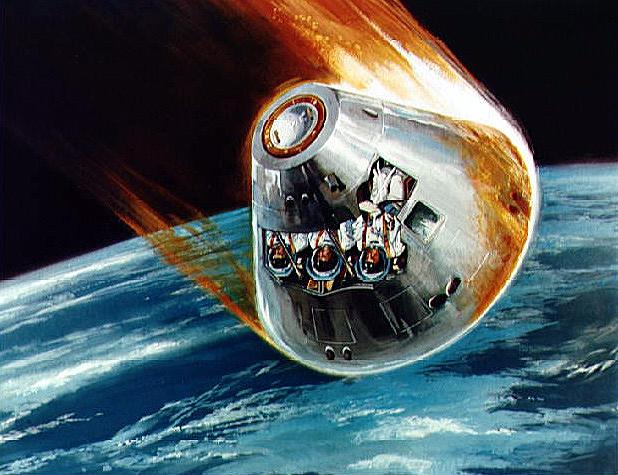 |
|
North American Rockwell Artist’s impression of the CM during reentry. Travelling at 39,635 kilometres per hour it had to enter the Earth’s atmosphere at an angle of 6.5 degrees from the local horizon, with a safe corridor only 42 kilometres wide, this only allowed an error of 1 degree either way. |
 |
|
Apollo 8 Re-enters the Earth’s atmosphere. This image was taken from a KC-135 (using the ALOTS pod from an ARIA) along the re-entry corridor. The bright object at top is either the Command Module or the Service Module. Read about the mission to photograph the re-entry – in the ARIA section. NASA image: S69-15592. |
At 9,000 metres, around the height of Mount Everest, the parachute canister cover blew off and three small drogues popped out to whip madly in the slipstream. A loud hiss told the astronauts the air vent had opened to allow fresh air to enter the cabin and equalise the pressures. At 146:55:39 GET (0146:38 AEST) at a height of 3,000 metres, the three main parachutes burst out to slow the spacecraft to about 30 kilometres per hour, and the first voyage to the Moon was over as Apollo 8 now drifted steadily down to the sea.
The return was a triumph for the trajectory boys – in the pre-dawn darkness 1,800 kilometres south west of Hawaii Apollo 8 flew right over the recovery aircraft carrier Yorktown and landed a mere 4.2 kilometres beyond at 147:00:42 GET (0151:42 AEST). The weather was good with 1.8 metre waves from the east south east and a 19 knot breeze from the north east.
A Pan-Am commercial jet flying to Sydney was witness to the fiery re-entry of the Command Module. The return journey had taken 57 hours 23 minutes and 32 seconds.
The Apollo 8 mission took 147 hours and 42 seconds to cover
a distance of 933,419.1 kilometres.
 |
|
A jubilant Apollo 8 crew on the USS Yorktown. Frank Borman speaks into the microphone while William Anders and James Lovell watch. NASA image 68-HC-883. |
------------------------------------------
John Saxon: “In Apollo 8 at Honeysuckle Creek, we were the prime station in view when they first disappeared behind the Moon, and when they appeared from behind the Moon. We were also the prime station when they entered the Earth’s atmosphere.”
At Mission Control the trajectory specialists and computer
whizz kids were ecstatic as they now had accurate measurements of the real orbit
around the Moon and their math models were all corrected with live data.
In the MSFN Postmission Report the tracking network results were excellent.
Operator errors were minimal, with only one station reporting four errors. Two
recurring equipment failures were reported, one involved a printed circuit board
and the other pen failures on chart recorders. There were no Telemetry or Command
losses during the TransLunar Coast, Lunar Orbit, and Trans earth Coast at HSK.
The only computer problems were in the 29-point Acq messages with checksum errors,
garbled messages, line errors and late arrival of messages on station.
After the successful return to Earth of Apollo 8, as a gesture of thanks for
our disrupted Christmas the American Ambassador in Australia, Mr Edward Crook,
threw a big party at the American Embassy in Canberra for all the station staff
and their families on Saturday 8 February 1969.
After Apollo 8, Borman decided to resign from the astronaut corps, “I thought I had carried my end of the bargain. I’d contributed as much as I could. I wasn’t a pro on the LM … I would not have gone to the Moon after the first one (Apollo 11). To me it wasn’t worth it.”
When asked did he look up at the Moon differently to the rest of us, he answered, “Sometimes I do. I try to. I try to feel like everybody thinks I should, which is awe, ‘I can’t believe I was really there.’ But most often I find I just revel in the beautiful Moon.”
With a successful Apollo 8 now behind us, all the Apollo team’s energies were directed to getting onto the Moon’s surface.
But first the LM had to be checked out in Earth orbit. That was to be our next
Apollo mission.
Chris Kraft, “From Apollo 8 we really knew what we were doing. It was the
boldest decision we made in the whole space program – period.”
Flight Director Glynn Lunney probably summed it up best
with, “Apollo 8 was the decision which opened the gate and let us slide
down the hill to the Apollo 11 landing.”
 |
|
Apollo 8 postage stamp. This US postage stamp was released to commemorate the Apollo 8 mission. Source: Hamish Lindsay. |
“Once a photograph of the Earth, taken from the outside, is available – once the sheer isolation of the Earth becomes known – a new idea as powerful as any in history will be let loose.” – Astronomer Fred Hoyle, 1948. (Quoted in New Scientist, 13 May 1982, page 430.) |
ACRONYMS USED IN THE TEXT:
| AEST | Australian Eastern Standard Time. |
| ACN | Ascension Island Tracking Station in the south east Atlantic Ocean. |
| Acq | Acquisition (of spacecraft signal). |
| ALSEP | Apollo Lunar Surface Experiments Package, the scientific instruments left behind by the Moon landings. |
| AOS | Acquisition of signal from the spacecraft (the downlink). |
| APP | Antenna Position Programmer, computer controlling the antenna. |
| Capcom | Capsule Communicator, the voice of Mission Control, always an astronaut. |
| CRO | Carnarvon Tracking Station, Western Australia. |
| CM | Command Module. |
| CSM | Command and Service Module. |
| DOWNLINK | The signal sent from the spacecraft back to the tracking stations on Earth. |
| DSKY | Guidance computer keypad. |
| DSS | Deep Space (Tracking) Station. |
| GDS | Goldstone Tracking Station in California. |
| GET | Mission Ground Elapsed Time, time in hours/minutes/seconds from launch. |
| GWM | Guam Tracking Station in the north west Pacific Ocean. |
| HSK | Honeysuckle Creek Tracking Station, Canberra, Australia. |
| HSKX | Canberra Deep Space Communications Complex at Tidbinbilla, also called the Wing. |
| IU | Instrumentation Unit, electronic system part of the Saturn IVB rocket. |
| LM | Lunar Module, the spacecraft that landed on the Moon in later missions. |
| LOI | Lunar Orbit Insertion. |
| LOS | Loss of the downlink signal from the spacecraft. |
| MAD | Madrid Tracking Station, Spain. |
| MOCR | Mission Operations Control Room in Houston. |
| MSFN | Worldwide Manned Space Flight Network of tracking stations. |
| NASA | National Aeronautics and Space Administration. |
| NET-1 | Phone line between Mission Control Capcom and astronauts in spacecraft. |
| OMNI | Multiple antennas around the spacecraft. |
| PGNS | Primary Guidance and Navigation System. |
| PSI | Pounds per square inch pressure. |
| PTC | Passive Thermal Control – spinning the spacecraft to even temperatures around it. |
| RCS | CSM Reaction Control System for controlling the attitude of the spacecraft. |
| REFSMMAT | Reference to Stable Member Matrix or a mathematical means of determining navigation angles using the stars as a reference. |
| S-IC | First stage of the Saturn V launch booster rocket. |
| SIVB | Saturn IVB, third and final stage of the Saturn V launch rocket |
| SAS | Space Adaption Syndrome, or motion sickness. |
| SPS | Service Propulsion System – Service Module rocket motor. |
| SRT | Site Readiness Test. Tracking station equipment tests before each group of passes. |
| TEC | Trans Earth Coast – the voyage back to Earth. |
| TEI | Trans Earth Injection – the rocket motor burn to send Apollo 8 back to Earth. |
| TLC | Trans Lunar Coast – the voyage out to the Moon. |
| TLI | Trans Lunar Injection – the rocket motor burn to send Apollo 11 off to the Moon. |
| UPLINK | The signal sent from the tracking station up to the spacecraft. |
| USB | Unified S-Band, the tracking station system |
| USCDT | US Central Daylight Saving Time, also spacecraft time. |
| USEDT | US Eastern Daylight saving Time. |
| UT | Universal Time, also known as Greenwich Mean Time (GMT) |
REFERENCES:
Acknowlegements: Apollo 8 mission images from the
Apollo Image
Atlas and the Apollo
Image Gallery – with thanks to NASA.
