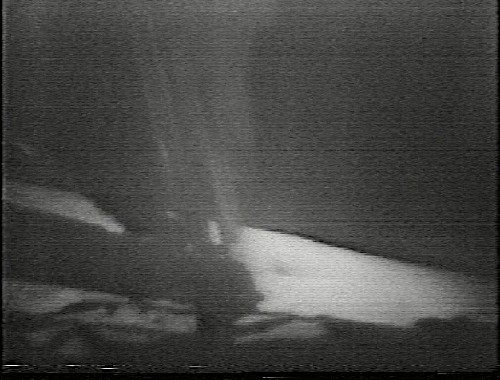
Apollo 11
16 – 25 July 1969
Index |
| AS-506/CSM-107/LM-5 | G MISSION |
NCG 725 |
...............................................................................................................................................
“The Lunar landing of the astronauts is more than a step in history; it is a step in evolution.”
The New York Times Editorial, July 20, 1969
...............................................................................................................................................
Command Module : COLUMBIA
|
Commander : Neil Armstrong Back-up Crew |
Notes
Mission Fact Box:
Launch from Pad 39A, Cape Kennedy 0932:00 USEDT / 1332 :00 UT / 2332:00 AEST Wednesday 16 July 1969 Lunar landing GET 102:45:40 / 2017:39 UT Sunday 20 July 1969 / 0617:39 AEST Monday 21 July 1969. Lunar lift-off GET 124:22:01 / 1754:00 UT Monday 21 July 1969 / 0354:00 AEST Tuesday 22 July 1969 Moon to Earth elapsed time 59 hours 36 minutes 52 seconds Total mission elapsed time 8 days 3 hours 18 minutes 35 seconds |
Site selection. Why Tranquility Base?
Science and the scientists took a back seat in choosing the first lunar landing site, as it was seen more as an operational and engineering exercise to trial all the new procedures and systems. So the operational and engineering aspects mainly dictated where the first landing would be. Thirty possible sites for the first lunar landing were originally under review by the Site Selection Board. After two years of intense analysis, which included Lunar Orbiter images and Surveyor Lander data, the choice was narrowed down to two candidates – Mare Fecunditatis or Mare Tranquillitatis.
Launch opportunities (or windows) for the chosen site and time only occurred once a month, with two windows per day. One window was a Translunar Injection over the Pacific Ocean, which used a daytime launch, and the other was over the Atlantic, which meant a night time launch (as in Apollo 17). So the first requirement by the Flight Dynamics team was for the site to be east of the lunar meridian to cater for back-up sites with suitable lighting in case the launch had to be delayed for some days. It seemed better to try a second site a few days later than wait for a whole month for the prime site to present an opportunity again. Also an easterly target was preferred because the LM would fly in from the east to land shortly after sunrise, when surface objects cast revealing shadows.
Secondly, they wanted the site to be within 5° of the lunar equator. A higher latitude site would consume more fuel, and fuel economy was one of the prime considerations for the first attempt.
A third requirement was the spacecraft was sent on a ‘free return’ translunar trajectory, so it would return back to Earth without using major manoeuvres. Finally they wanted a flat area free from sharp ridges, large boulders or awkward steep sided craters for a first attempt.
These constraints narrowed the first attempt to land on a maria near the equator, which meant either Mare Fecunditatis or Mare Tranquillitatis, with Sinus Medii as a possible back up. As Mare Fecunditatis would have provided difficulties tracking from Earth, a higher fuel consumption and the possibility of a night splashdown, it dropped out of favour.
So the choice settled on Mare Tranquillitatis, originally named by astronomers Francesco Grimaldi and Giovanni Riccioli of Bologna in 1651. Here there were two possible landing targets in the area, an easterly one near Maskelyne Crater called ALS (Apollo Landing Site)-1 and ALS-2, a bit further west. ALS-2 was only 25 kilometres southeast from Surveyor 5’s home, and Apollo 10 had made a low pass over the spot with favourable reports from Tom Stafford. ALS-2 also allowed a two-day recycle in the case of a delay to the next site Sinus Medii.
Though science did not play a major factor in the choice of the first landing site, the choice of ALS-2 made the scientists happy enough too. They felt that ALS-1 was too exotic, and for a first mission they wanted a more typical mare like ALS-2 with large subdued craters and few boulders.
 |
The Apollo 11 landing site, illustration modified by Hamish Lindsay. |
Crew choice.
With a number of options for the crew, and it being such a monumental mission, the Director of Flight Crew Operations, or ‘Chief Astronaut’ Deke Slayton, decided to stick to the normal routine of rotating the back up crews, which put Neil Armstrong, Buzz Aldrin, and Fred Haise on the Apollo 11 mission – but there was an unexpected development. Michael Collins was back on flight status after surgery for a bone spur in his neck. He was anxious for a berth, which reminded Slayton he had originally promised him a lunar landing flight. As Haise hadn’t figured in the original plans, Collins replaced him as the Command Module pilot.
On 23 December 1968, while Apollo 8 was circling the Moon, Slayton approached Armstrong and asked if he would be happy with Collins and Aldrin as his crew for Apollo 11. If Armstrong had any doubts about Aldrin, Slayton offered Jim Lovell instead. Armstrong took a day to make his mind up, and decided he would stick with Aldrin, as, “I thought he (Lovell) deserved his own command. I thought it would not be right of me to pull Lovell out of line for a command – so he ended up with Apollo 13.” Armstrong also had had no problems working with Aldrin in their role as back-up crew for Apollo 8. Another aspect that troubled Armstrong was – if Lovell came on board it would best be as CM Pilot, as he was on Apollo 8. But Collins was also a CM pilot specialist.
So Lovell wasn’t considered any more, and Aldrin joined the Apollo 11 crew. He fitted in quite well, as he had already trained on the Lunar Module before the Apollo 8-9 crew swap, so he moved across to become the Lunar Module pilot. Thus the Apollo 11 prime crew became Neil Armstrong, Commander, Michael Collins, Command Module (CM) pilot, and Buzz Aldrin the Lunar Module (LM) pilot. Collins and Aldrin were told on 4 January 1969 and on 9 January 1969 the media and public were informed, following ceremonies awarding the Apollo 8 astronauts their medals.
It should be noted that at this point the LM had yet to fly. Armstrong commented, “A lot of things we just didn’t know at that point, and I think I did not really expect that we’d get the chance to try a lunar landing on that flight. Too many things could go wrong on Apollo’s 8, or 9 or 10.”
The Crew.
Neil Alden Armstrong, aged 38 for the mission, was born in Wapakoneta, Ohio, on 5 August 1930.
 |
Neil Armstrong, Commander. |
He received a BSc in Aeronautical Engineering from Purdue University and a Master of Science in Aerospace Engineering from the University of Southern California. He was a naval aviator from 1949 to 1952, flying 78 combat missions in the Korean War. He was an engineer, test pilot, astronaut and administrator for NACA and its successor, NASA, for 17 years. Armstrong flew more than 200 different types of aircraft, from jets, rockets, helicopters and gliders to the glamorous X-1 and X-15 rocket planes. In 1962, he became an astronaut and first entered space in Gemini VIII, commanding his spacecraft to the first ever docking of two vehicles in space, before the mission was aborted off China. He was a Professor of Aerospace Engineering at the University of Cincinnati for eight years.
Michael Collins, aged 38, was born on 31 October 1930 in Rome, Italy.
 |
Mike Collins, Command Module Pilot. |
In 1952 he received his BSc from the United States Military Academy at West Point, New York. Collins joined NASA in October 1963 and was the back-up pilot for the Gemini VII flight before entering space as pilot in the Gemini X mission with John Young. In 1968 he was diagnosed with cervical disc herniation requiring two vertebrae to be fused together, which took him off flight status for three months. He was presented with the Presidential Medal of Freedom in 1969, the NASA Exceptional Service Medal and the Air Force Distinguished Flying Cross.
Dr. Edwin Eugene “Buzz” Aldrin, Jr. aged 39 was born on 20 January 1930 in Montclair, New Jersey.
 |
Edwin ‘Buzz’ Adrin, Lunar Module Pilot. |
In 1951 he gained his BSc in mechanical engineering from the United States Military Academy at West Point, New York, graduating third in his class. With a thesis on “Guidance for Manned Orbital Rendezvous” he was presented with his doctorate of Science in Astronautics from the Massachusetts Institute of Technology, Cambridge. He flew 66 combat missions in Korea, shooting down two MIG aircraft.
Armstrong, Aldrin, and Collins had watched Apollo 10 very closely, and were very relieved when it was declared a success, as it meant that their Apollo 11 mission would be the first attempt to land. Compared with Alan Shepard’s 150 hours of simulations for his first Mercury flight, they had each spent over 1,200 hours, a total of 3,521 actual training hours, working 14-hour days, 6 days a week for a full 6 months, in simulators wrestling with a continuous stream of missions, usually peppered with emergencies, equipment malfunctions, and potential catastrophes to test their knowledge, skill, and coolness to the limits. On the science side, Jack Schmitt (Apollo 17 LM Pilot) spent a lot of time preparing them for lunar rock collecting. By the time they were ready for going to the moon, the astronauts knew every twist and turn of the normal and emergency operational procedures as well as every capricious component of the spacecraft’s 26 subsystems.
Choice of names for the spacecraft.
According to Armstrong many, many people suggested the names of the spacecraft. The crew chose the two, Columbia and Eagle, as representative of the flight and the nation’s hope. Columbia stands on top of the Capitol in Washington, and was the name of Jules Verne’s spacecraft that went to the Moon. Armstrong commented that Collins was especially thoughtful about the name.
Aldrin and Armstrong chose Eagle for the Lunar Module from another long list of suggestions.
 |
The Mission patch featured an Eagle bearing an olive branch. |
Who steps onto the Moon’s surface first?
The question of who stepped out on the Moon first began a heated debate among certain people. A reporter raised the subject during the very first press conference on 9 January 1969, and the answer was it had not been decided, but the simulations would settle that point at a later date.
Aldrin had never given it much thought, always believing he would be the first out, as in Gemini the pilot always leapt out to do the EVAs. The early flight plans and timelines had the LM Pilot out first. Newspaper headlines of the time reinforced this thinking, and members of NASA Headquarters agreed. But after Apollo 9’s successful flight and it looked like Apollo 11 was really going to attempt the landing, the subject of who stepped out first began to take on a new significance.
Aldrin began to hear rumours about Armstrong being to first to step out, “because he was a civilian.” This angered Aldrin as he felt it was a slight to the military, and began to question everyone, including Armstrong, bringing up various technical reasons why he should be first out. Instead of understanding, he met with a lot of resistance from his colleagues, who could not understand his frantic lobbying to be first out.
Slayton explained to Aldrin that Armstrong was senior to him, having joined the astronaut core in the group ahead, and as Commander it was only right that Armstrong should step on the Moon first. In the end NASA explained that the first out was based solely on the LM’s interior design and the physical locations of the two astronauts inside the cabin. Aldrin, as pilot, would be on the right side and Armstrong would be on the left, next to the hatch opening. So it would not be practical to change positions with Armstrong to access the hatch opening, considering the lack of room and the chance of damaging equipment and instrument panels with their bulky backpacks.
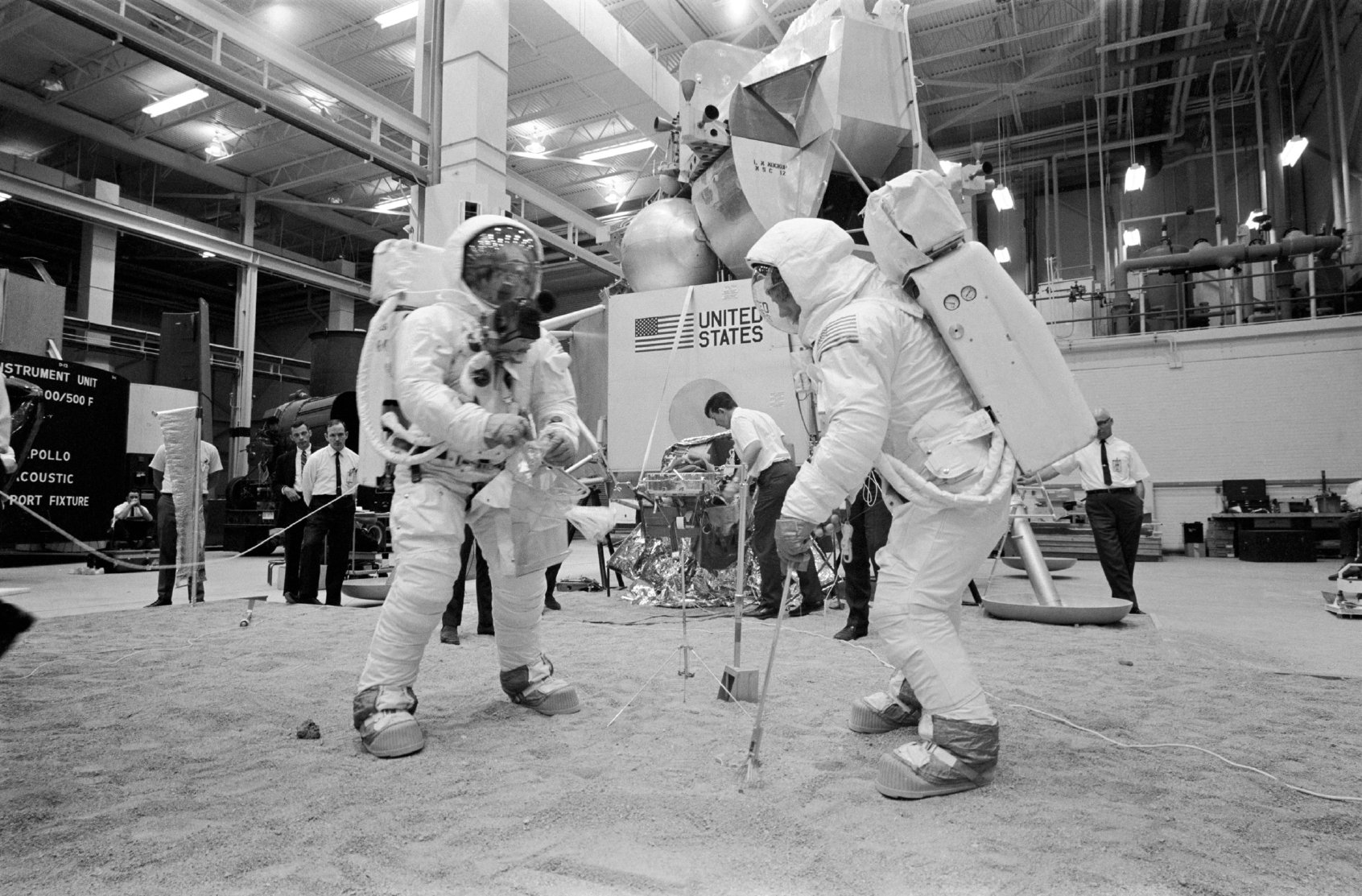 |
| Neil Armstrong (left) and Buzz Aldrin during a simulation of the EVA in Building 9 at the MSC in Houston. Image AS11-S69-31123. Courtesy of the Apollo Image Gallery. |
So it was decided that Armstrong would climb out first, Slayton announcing, “Just on a pure protocol basis I figured the Commander ought to be the first guy out.”
Did Armstrong pull any strings as alleged by some media?
“Absolutely not,” said Slayton.
“I was never asked my opinion,” said Armstrong.
“It was fine with me if it was to be Neil,” Aldrin agreed at the time. But Collins noted, “Buzz’s attitude took a noticeable turn in the direction of gloom and introspection shortly thereafter.”
Armstrong had always insisted it was not an important issue to him, it was more important to him that, “… they got four aluminium legs safely down on the surface of the Moon while we were still inside the craft.”
However the final comment on this subject should come from Director of Flight Operations, Chris Kraft. He told me in an interview, and subsequently wrote in his autobiography Flight: My Life in Mission Control, that there was a meeting in March 1969 between Deke Slayton, Director of Flight Crew Operations, Bob Gilruth, the Director of the Manned Spacecraft Center, George Low, the Apollo Program Manager and Kraft. They unanimously agreed that they wanted Armstrong, not Aldrin, to be the immortal historical figure, as he was the example of the great American hero – calm, quiet, softly spoken with absolute confidence and with no ego. They issued an order that Armstrong must be the first on the Moon’s surface.
So Neil Armstrong became the hero whose name will reverberate throughout human history for the rest of time.
Getting the television pictures from Honeysuckle Creek to the outside world.
At this point there was no provision to transmit a television picture direct from Honeysuckle Creek to the outside world, and it was decided to install a television link from Honeysuckle Creek to Canberra. Trevor Gray was a PMG (now Telstra) technician on the installation team,
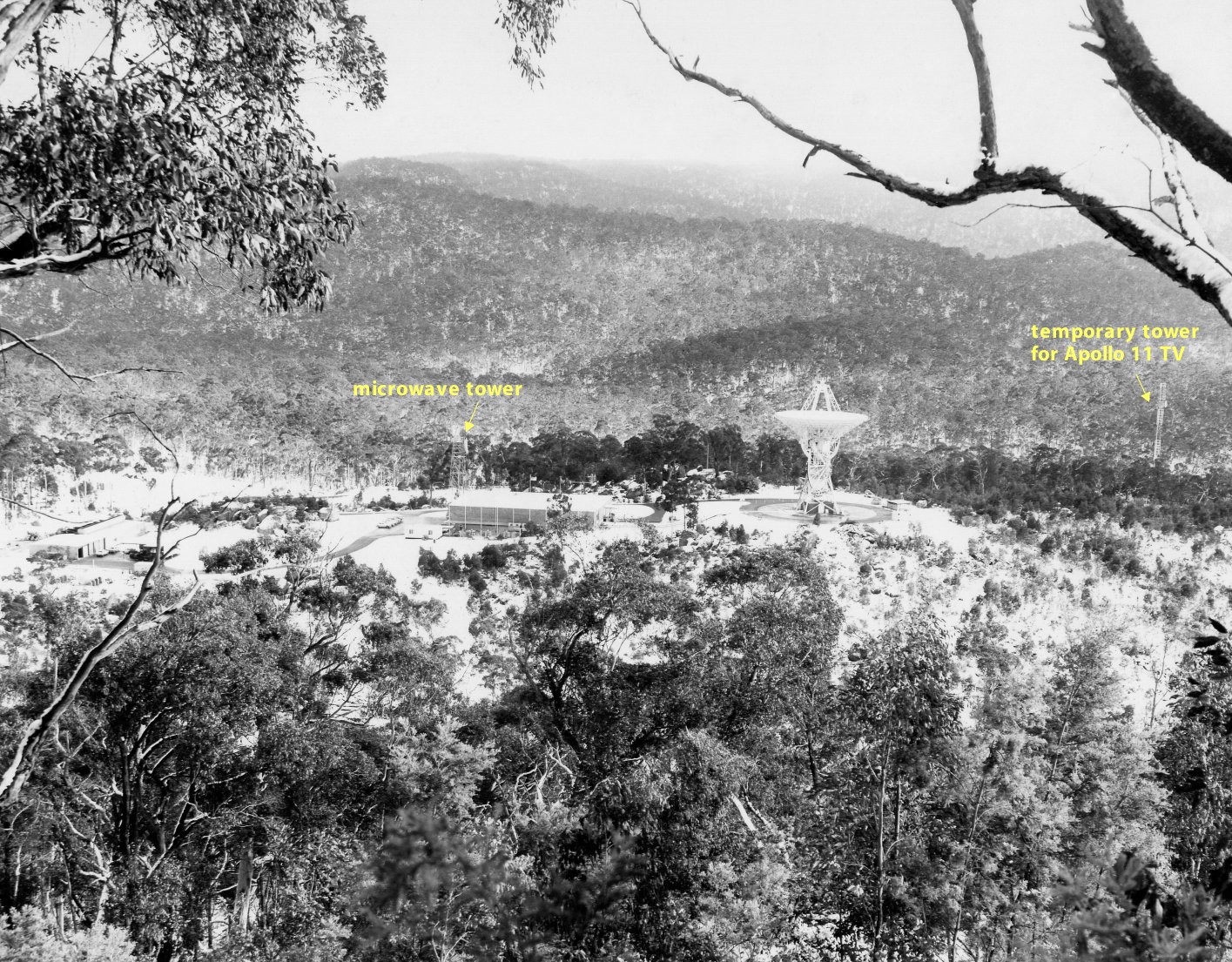 |
The temporary tower at Honeysuckle to relay the TV is seen at right. Photo: Hamish Lindsay. More details here. Unlabelled photo here. |
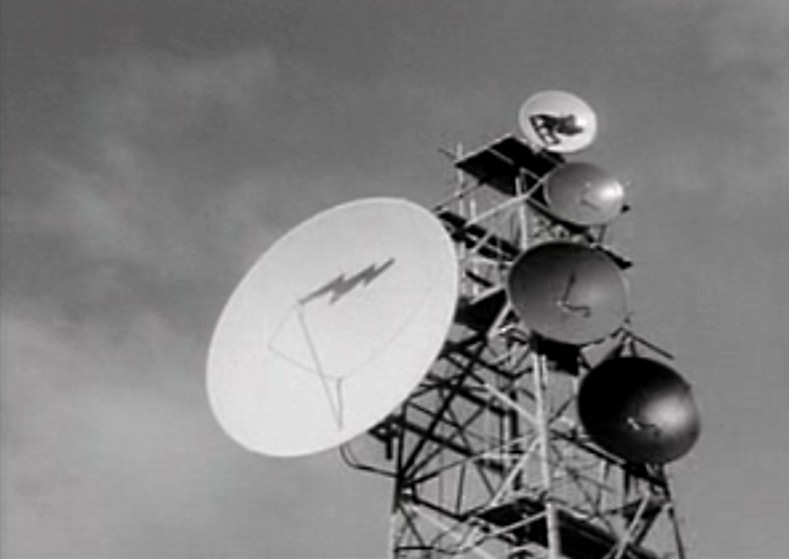 |
Mike Dinn remembers: “Two dishes were for Parkes (via Sydney) incoming – prime and backup. The other pair for outgoing TV, prime and backup.” Screenshot from ABC footage taken on the morning of the Moonwalk. Used with permission. |
Choice of launch time.
Dr. Kurt Debus, Director of the Kennedy Space Center and once a war-time V-2 launch director in Germany, finally announced, “When the weight of the paperwork equals the weight of the Stack its time to launch.” The Saturn V vehicle was commonly called “the stack.”
Actually the time to launch Apollo 11 was carefully chosen so that the Lunar Module would land on the Sea of Tranquillity with the morning sun low enough to throw strong shadows on the lunar surface for the best feature manifestation from above. The mission planners set 16° as the highest sun angle for a landing and 6° the lowest, and judged that anything greater than 20° was unsatisfactory for a manual landing. Also, Apollo 11, as with the other lunar missions, was sent to orbit around the moon in a clockwise direction so that the sun would be behind the Lunar Module, and not in the astronauts’ eyes as they came in to land.
A lunar day lasts two Earth weeks, so it takes seven days for a morning to reach a lunar midday when the temperature soars to 110°C. During the two-week lunar night the temperature plummets to minus 170°C.
Armstrong explained the choice of landing time:
Prelaunch activity.
The night before the launch, lights burned late in Cape Canaveral, in Houston, and around the world as the operational, technical, recovery and rescue teams prepared their equipment and the vast, complex, communication networks supporting the flight.
The world wide Manned Space Flight Network consisted of 17 stations, 4 ships and 8 aircraft.
On the other side of the world from Cape Canaveral, at Honeysuckle Creek, Deputy Director Mike Dinn reflected on his role:
With an event such as the Apollo missions, a lot of our daily preoccupations are no longer applicable to travellers in space. Once they have left the Earth the weather, for instance, is of no interest to the astronauts as they have no weather, and they can select any of Earth’s time zones for their day, as they have no sunset or sunrise.
Mission Control prepares.
The Mission Operations Control Room (MOCR) consisted of a tight group of exceedingly bright young specialists with an average age of 26 years working as a team under the Flight Director. They could solve almost any problem, or come up with an alternative in their field under pressure, usually working in seconds. In twenty seconds a controller could spot and evaluate a problem, discuss it with his support team and inform the Flight Director of his decision of any action to be taken, all the while monitoring events going on around him. Like the astronauts, these teams had spent countless hours suffering tough simulations to be prepared for any emergency.
The Director of Flight Operations, Chris Kraft, organised four Mission Control flight control teams for Apollo 11 – run by
Kraft himself had already retired to the back row to keep his steely eye on events. He visited the three astronauts in their pre-flight germ-isolated accommodation and checked out last minute details.
Then Kraft, aware this was the most ready space mission ever, asked, “What can we do? Is there anything we’ve missed?”
Armstrong answered, “No, Chris. We’re ready. It’s all been done except the countdown.”
Kraft looked at the three men and realised that this was the moment they had all been working towards – they were about to land on the Moon, “Our work, our dreams, our failures, and our successes all rode with them. We had come at last to this point, and for a moment I felt my legs shake.”
Armstrong speaks of the flight.
Commander Neil Armstrong said of the mission,
| LAUNCH | Wednesday 16 July 1969 | |
| Launch time : 00:00:00 GET 0932:00 USEDT, 1332:00 UT 2332:00 AEST |
||
The weather on launch day turned out to be cloudy with lazy southerly breezes up to 6 knots from the south. Cumulus clouds from a base of 2,400 feet covered 10% of the sky with alto-cumulus over 20%. High above, cirrostratus spread over 90%. The temperature had drifted up to 29.4°C and humidity 73%. The rumble of distant thunderstorms could just be heard.
 |
The Apollo 11 crew with Bill Anders (far left) and Deke Slayton (right) at the launch day breakfast. NASA photo KSC-69PC-368.
|
The three astronauts began the day at 0415 USEDT with a breakfast of orange juice, steak, scrambled eggs, toast and coffee. They emerged from breakfast still holding their toast and found their friend Joe Schmitt and his team of four technicians preparing their space suits.
 |
Armstrong suits up on launch day.
NASA image KSC-69PC-377, via the Apollo Image Gallery. |
The suits were pumped up to a pressure of 131 kPa of pure oxygen and for three hours the astronauts had to purge their bloodstreams of nitrogen. Then they walked out and climbed into the waiting Transfer Van, its flashing lights shooting red beams into the pale early morning light during the 20 minute drive. Unable to hear the small crowd of people gathered to see them off, the three astronauts just grinned and waved back.
 |
The crew enter the Transfer Van.
NASA image KSC-69PC-412. |
Meanwhile, up in the Command Module the back-up Lunar Module pilot, Fred Haise, was working with Guenter Wendt, the Pad Leader and five other technicians, steadily and systematically going over the spacecraft, checking the 678 switches and circuit breakers were in the right position. As his eyes and fingers flicked over the panels he could hear the familiar noises of the water glycol cooling system and cabin and suit fans whirring away around him.
The crew board their spaceship.
The three astronauts with their technicians climbed out of the transfer van to take the first elevator up to the base of the Saturn V rocket. Walking through a sealed compartment they saw that Guenter Wendt had placed signs along the walls which read “The Key,” followed by another one, “To the Moon,” then another, “Located In,” and finally, “The White Room.” A few more steps and they came to the base of the high-rise elevator, which took them to the 97.5 metre level where the spacecraft hatch was located.
Deke Slayton, the Director of Flight Crew Operations, had ridden out to the pad in the van and farewelled them with, “Watch your asses and have a good trip,” as they entered the elevator. At the top on the crosswalk as Armstrong walked towards the white room door he paused to look down, giving Slayton a final wave.
 |
Neil Armstrong appears deep in thought, as he and Mike Collins walk towards swing arm 9 and the White Room. Scan courtesy Kipp Teague. |
Arriving at the White Room door, they were greeted by Guenter Wendt holding a huge key, which he presented to Neil Armstrong, who in turn gave Guenter a card reading, “Space Taxi ticket, good between any two planets.”
 |
In the White Room at the top of the Stack the Apollo crew at the hatch of the Command Module. July 3rd, 1969 during the Countdown Demonstration Test. |
At 0654 local time, while Armstrong slipped out of his yellow boot protectors and swung himself through the hatch to settle down in the left couch, Collins paused on a narrow walkway from the elevator to savour the view and to consider the moment before climbing into the right couch.
Buzz Aldrin recalled,
Aldrin eased himself into the centre couch and waited for Joe Schmitt to couple him into the spacecraft systems, “My recollection,” he said “was a mass of hands reaching and tugging from several directions. Mike, Neil and I were fairly helpless at this time – three totally battened down people waiting for the ride to start.”
Schmitt, “My work station for ingress was just inside the spacecraft hatch just above the center seat, which means I had to get out each time the next crewman got in. I had to do a lot of stretching to reach the oxygen valves located in the tunnel of the spacecraft.”
With all three astronauts comfortable in their carefully contoured couches, the last task for Joe Schmitt before he left was to check the oxygen to the suits, leaving Fred Haise to the final checks – straps, loose gear, and a look around for anything abnormal. He was unable to speak directly to the astronauts, but could hear them through the intercom,
Unable to get up and look back and see the sunny world through the windows outside, the three astronauts settled down to wait for ignition, isolated from the Earth except for their intercoms. Everything was GO for launch. It was 7:52 am local time.
Walter Cronkite defines the moment of Apollo 11 before lift-off.
The legendary American television commentator Walter Cronkite described his feelings of the moment,
Suspense builds as launch time approaches.
At the launch control centre in Firing Room One, 463 technicians and engineers, backed by 5,000 specialists on standby, hunched over their consoles, intently studying their flickering screens, watching countless checks and tests of the whole Saturn V rocket being performed. When their task was completed successfully, they announced, “GO” on the intercom.
Finally all the checks were completed – the great rocket was ready. “Good luck and God speed from the launch crew,” called Paul Donnelly, the Launch Operations Manager, to the astronauts over the intercom.
Audio |
|
At Honeysuckle Creek we were approaching midnight and finishing our SRT (Site Readiness Test) and preparing for Interface with the network when the final countdown started. We paused to listen and heard, “Twenty seconds and counting… fifteen seconds… guidance is internal… twelve… eleven… ten… nine…”
The estimated 750,000 people gathered to watch the launch were hung in suspense, listening to the count on their radios. At the official viewing site 5,000 invited guests from all over the world with 3,497 journalists in the press stand peered at the tall rocket shimmering in the morning haze. All eyes were waiting for the first lick of flame at the base of the gleaming white rocket.
Nearby, fourteen men in flame protection gear in armoured personnel carriers tensed behind their bunker, ready to rush in to help the astronauts in an emergency.
The mighty Saturn V’s engines fire.
At T-8.9 seconds, Apollo 11’s five F1 engines burst into life, spewing fire and smoke down the huge flame deflector below. 127,300 litres of cold water per minute flooded out over the walls, mixed with the searing flames to generate clouds of steam. An estimated 635 kilograms of ice formed on the rocket’s skin from the super cold fuel within, flaked off in an avalanche of white. Thundering shock waves spread out, filling the sky with startled flocks of duck, heron, and small birds. Even in the bright daylight the glare from the flames became so intense it hurt the eyes.
Four giant clamps gripped the straining rocket as the engines built up to their full thrust. The launch team rapidly checked all systems were go.
Lift-off.
T0 at 0932 USEDT (2332 AEST), “....all engine[s] running. Lift off. We have lift off.”
With maximum thrust built up to the equivalent of 180 million horsepower, equal to 32 Jumbo jet aircraft at full throttle, the hold down clamps released the straining rocket. At first slowly, majestically, the mighty vehicle rose off the pad, sliding out of eight guiding taper pins for the first 15 centimetres. The rushing river of searing flames plastered the gantry and created flecks of fire dancing on the steel structure. As the vehicle set off on a flight azimuth of 72.058°, the fins at the base of the rocket cleared the tower and the flames and heat drew away to leave the blackened, blistered edifice standing empty….. alone. 77,200 litres of water per minute still tumbled down around the base to preserve it from being destroyed by the heat from the rocket blast.
“The tower is clear,” announced Launch Control, and from that moment the mission became the responsibility of Mission Control in Houston, and us in the tracking network.
 |
The Saturn V clears the tower, as seen from the LC-39 Press Stand. (Hear the launch as described from the press stand by excited Australian journalist Derryn Hinch.) |
The three astronauts were not aware of the moment of lift-off, but first felt a powerful, insistent thrust to their backs accompanied by a distant rumble, rather like an express train. They were thrown left and right against their straps in spasmodic jerks as the big vehicle adjusted itself to wind effects, and to keep on the planned course. In the first forty seconds the 36 storey vehicle was travelling faster than the speed of sound, and the noise in the cabin dropped away. Armstrong noted that those first 40 seconds of flight were uncomfortably noisy and rough, much worse than the Gemini Titan launches. He found it was hard to hear any voices in his earphones, even with his helmet on.
 |
Apollo 11 heads
for space. Audio of the launch here. |
The swampy coast of Florida rapidly receded as the Saturn V’s motors guzzled 2,128 tonnes of fuel at a rate of 13.3 tonnes per second. In an incredible two and a half minutes the 3,198 tonne monster was travelling at 10,140 kilometres per hour, losing three quarters of its launch weight.
The huge crowd of onlookers stared through the heat haze at the shimmering image of the moon ship and saw two gigantic torches of flame shoot out of the bottom and splay out to billowing clouds of fire and smoke. They watched in awe as the rocket majestically rose into the sky and picked up speed to dwindle into a dot atop a spreading plume of smoke. Fifteen seconds later the very ground vibrated as they reeled from the shock waves, louder than any thunderstorm, passed by to dissipate behind them. Australian journalist Derryn Hinch said it was like being hit in the stomach with a cricket bat, and later he found bruises in his thighs from his shuddering desk top.
Into Earth orbit.
As the three astronauts streaked through the thinning atmosphere, the blue sky in the windows darkened to the black of space.
At 3 minutes 18 seconds the launch escape tower jetted away and Aldrin and Collins could now see out.
At 11 minutes 49 seconds after launch they entered into a 185.9 x 183.2 kilometre Earth orbit with a period of 88.2 minutes and a speed of 28,055 kilometres per hour. As they went over the Canary Islands they removed their helmet and gloves, and settled down to check that the spacecraft was ready for the big voyage.
At 28 minutes after launch, after passing Canary Islands Aldrin spoke up, “How are we doing on that time, anybody? Neil, are you sort of Master of Ceremonies on time, yet?”
So the relaxed crew were playing with the still and movie cameras as they plunged into the night over Tananarive with Armstrong muttering, “Man, are we in the dark now!” On the Earth below 17 tracking stations, 4 ships, and 8 Boeing 707 ARIA (Apollo Range Instrumented Aircraft) jet aircraft followed every move by the spacecraft and reported back to Houston.
After racing across the Indian Ocean towards Carnarvon in Western Australia, Paul Oats, Deputy Station Director at Carnarvon explained,
Their powerful FPQ6 radar confirmed Apollo 11 was in the planned parking orbit.
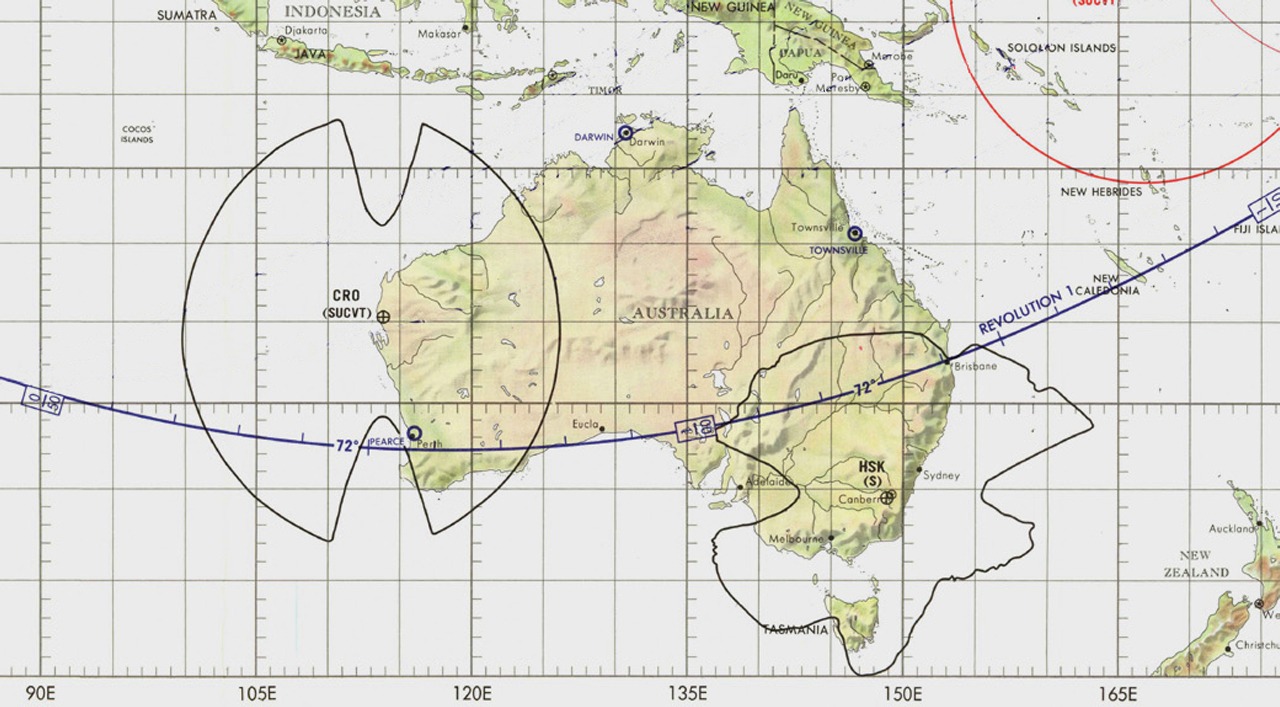 |
Apollo 11’s ground track across Australia on their first orbit. From the Apollo 11 Earth Orbit Chart. Scan: Hamish Lindsay. |
Up in the spacecraft, with 52 minutes on their GET clock, they were preparing to meet Carnarvon in Western Australia with Collins announcing, “It says here, coming up on Carnarvon AOS at…….”
 |
| HSK MISSION DAY 1 | Thursday 17 July 1969 | |
| Earth Orbit 1 | Track Duration |
|
| AOS : 0032:32 AEST | LOS : 0037:05 | 4m 33s |
Apollo 11 came up over our horizon right on time, 32 minutes after our midnight, for our first pass. The crew were busy getting ready for the pass over America with a bit of television through Goldstone.
Part of the conversation through Honeysuckle:
We’re ready to do that now.”
After leaving Honeysuckle Creek Armstrong offered his crewmates a sweet each. Aldrin declined but Collins accepted with the comment, “Can I give you the wrapping back?”
The second orbit was out of sight below our northwest horizon.
IT’S “GO” FOR THE MOON.
The second orbit over Carnarvon at 0157:30 AEST was the big moment for the Capcom at Houston to tell the astronauts they were to go ahead for the lunar burn.
 |
Apollo 11’s ground track across Australia on their second orbit, just prior to the TLI burn. From the Apollo 11 Earth Orbit Chart. Scan: Hamish Lindsay. |
 |
Capcom Bruce McCandless at his console in the MOCR, around the time of TLI. |
Translunar Injection.
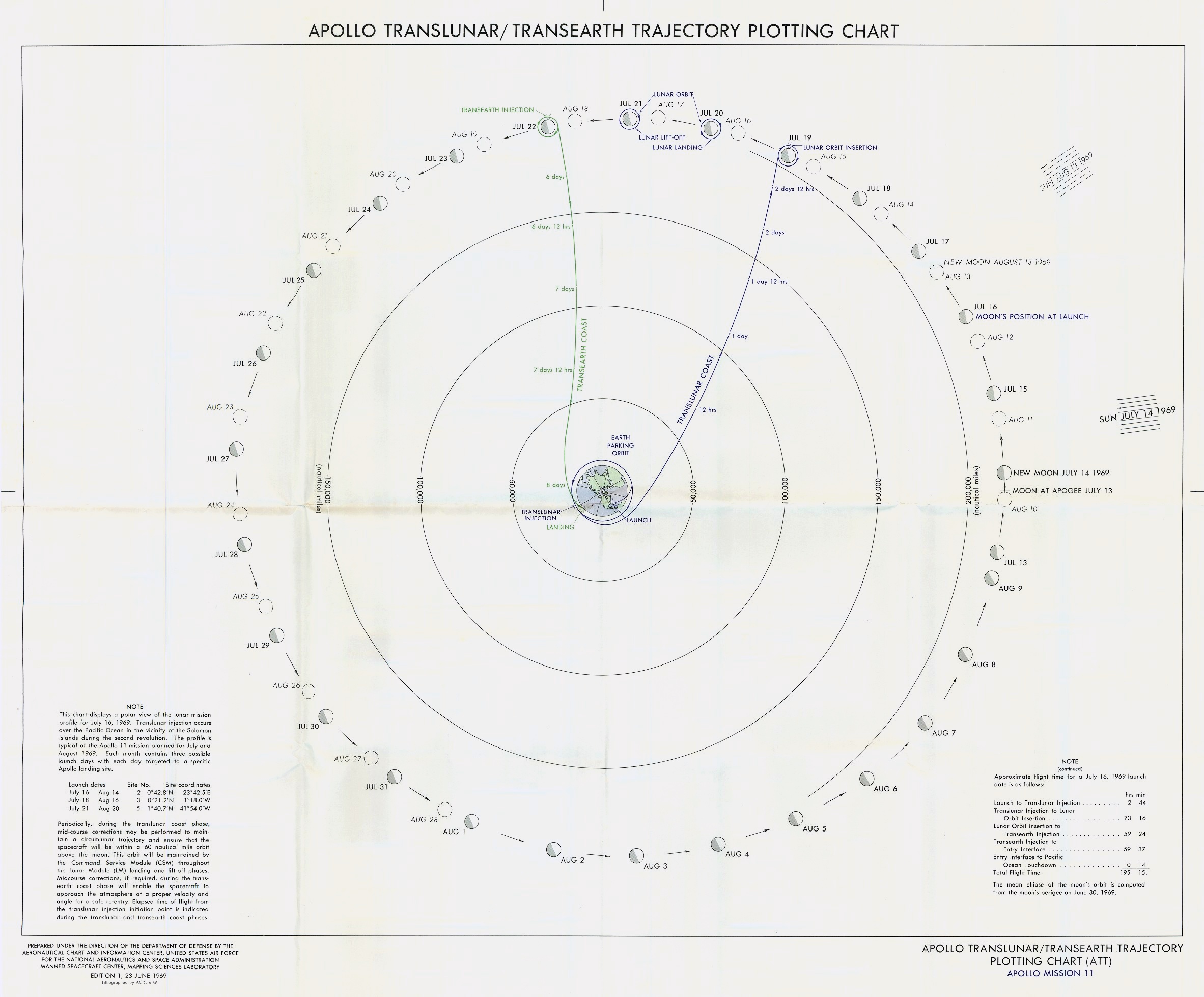
At 2:44:16.2 GET (0216:16 AEST 17 July), after 1½ Earth orbits, the Saturn IVB was lit for 5 minutes 46.83 seconds to insert the spacecraft into Trans-Lunar Injection (TLI) at 02:50:13 GET (0222:13 AEST) and send Apollo 11 off to the Moon at 39,003.5 kilometres per hour.
Unseen in the darkness below, ships stationed in the Pacific, and Apollo Range Instrumented Aircraft (ARIAs), were following every move made by the spacecraft and reporting back to Mission Control in Houston.
 |
||||||||||||||||||||
Apollo 11 Translunar / Transearth Trajectory Plotting Chart The legend reads: This chart displays a polar view of the lunar mission profile for July 16, 1969. Thanslunar injection occurs over the Pacific Ocean in the vicinity of the Solomon Islands during the second revolution. The profile is typical of the Apollo 11 mission planned for July and August 1969. Each month contains three possible launch days with each day targeted to a specific Apollo landing site.
Periodically, during the translunar coast phase, mid-course corrections may be performed to maintain a circumlunar trajectory and enjure that the spacecraft will be within a 60 nautical mile orbit above the moon. This orbit will be maintained by the Command Service Module (CSM) throughout the Lunar Module (LM) landing and lift-off phases. Midcourse corrections, if required, during the transearth coast will enable the spacecraft to approach the atmosphere at a proper velocity and angle for a safe re-entry. Elapsed time of flight is indicated during the translunar and transearth coast phases. With thanks to Bob Fish, USS Hornet Museum, for the scan. Anotations by Colin Mackellar. |
||||||||||||||||||||
| TRANSLUNAR COAST (TLC) Day 1 HSK Prime |
||
| AOS : 0957 AEST | LOS : 2045 | Track Duration : 10h 48m |
| TV on at acquisition | LOS TV : 1021 | Television : 24m |
|
||
| Handover uplink HSK to MAD : 2032 AEST | 2-way duration : 9hrs |
|
| HSKX Wing | ||
| AOS : 1040:00 | LOS : 2045 | Track Duration : 10h 5m 0s |
Honeysuckle Creek did not see the TLI burn that pressed the astronauts into their couches with a force of 1g as they broke away from a circular Earth orbit. They rapidly gained altitude, heading towards the dawn.
Armstrong described how he felt leaving the Earth,
At 2:53:03 GET (0225:03 AEST) Armstrong praised the rockets that boosted them off the Earth,
They were on their way to rendezvous with the moon, 350,980 kilometres away at that moment.
At Honeysuckle Creek our first contact with the spacecraft came at 7 hours 34 minutes after they had left Earth orbit. They had already established a PTC (Passive Thermal Control) roll of 0.3° per second to even the temperatures around the spacecraft.
Also out of Honeysuckle Creek’s view, the first task for the astronauts was to turn the CSM around and dock with the LM, still nestling in its housing at the end of the Saturn IVB. Collins backed the CSM about 30 metres away before turning around. As he brought the two vehicles gently together at 0256 AEST, he noticed the LM’s flimsy aluminium skin was so thin it rippled to the bursts of gas from the Command Module’s control jets like a breeze across long grass.
 |
Eagle, nestled atop the S-IVB as Columbia moves in for docking. |
The two spacecraft mated together, the twelve latches clamped tight, and Collins clambered down to remove the hatch before inspecting the tunnel and clamps. After assuring himself that all was in good order, he piloted the CSM/LM combination away from the Saturn rocket, now looking rather forlorn and empty. They went separate ways, the Saturn going off into solar orbit, and the CSM now locked with the LM, heading for the moon.
They unzipped their pressure suits, made difficult in the cramped space. Confusion reigned as odd parts floated about, and three men tried to stuff their bulky suits into storage bags before stowing them away under the centre couch. Then comfortably dressed in white Teflon jump suits, the three sat down to a lunch of beef and potatoes, butterscotch pudding, and brownies washed down with grape punch. During that first day the Moon didn’t seem to be getting bigger, but the Earth was visibly shrinking. Although the astronauts were now travelling over 8,690 kilometres per hour away from Earth, they seemed be in a slow-motion zone, as there was nothing nearby to indicate their speed.
At 11:20:00 GET (1052:00 AEST), early in our pass, the astronauts settled down for a sleep period, about 2 hours early, made possible by the cancellation of a mid-course correction. They set up two light mesh hammocks while Collins settled down to take the first shift in the centre seat. He quipped, “What could be better than just floating all the way to the Moon?”
So at Honeysuckle Creek we kept an eye on a silent spacecraft while the crew slept until the end of our pass.
The crew were up before McCandless called them at 22:50:15 GET (2222:15 AEST) with, “Apollo 11, Apollo 11, this is Houston. Over.”
Armstrong replied, “Good morning, Houston. Apollo 11,” and the astronauts’ day began with the usual technical discussion on the spacecraft status and updates, while our day at Honeysuckle Creek was ending.
| HSK MISSION DAY 2 | Friday 18 July 1969 | |
| TLC Day 2 | Track Duration |
|
| HSK AOS : 1037 AEST | LOS : 2047 | 10h 10m |
| Handover uplink GDS to HSK : 1132 AEST | ||
| Handover uplink HSK to MAD : 2032 AEST | 2-way duration : 9h |
|
At 25:11:14 GET (0043:14 AEST) back-up Commander Jim Lovell, in a mischievous mood, slid into the Capcom’s position and called Armstrong,
Trial television show recorded at Goldstone.
At 30:28:00 GET (0600 AEST) there was a 50 minute trial television broadcast from the spacecraft using the omni antennas. With no lines up to Houston it was recorded at the Goldstone tracking station for later playback.
Goldstone reported they could see the astronauts trying to run in their seats.
A Television broadcast showing their life on board the spacecraft.
At 33:59:00 GET (0931 AEST) the thermal control rolling (PTC) was stopped to train the high gain antenna towards Earth for a 36 minute television broadcast. It began with a view of the Earth from 238,900 kilometres before moving into the spacecraft interior where they suspended a torch in the air pointing into a dark corner, Armstrong stood on his head, Aldrin demonstrated push-ups and chef Collins dished up a chicken stew, explaining,
Collins also commented,
After the television show the astronauts looked for a laser beam directed at them, but failed to see it. They then bunked down for a 10 hour eat and rest period, going to sleep with the sounds of whirring fans and the occasional thump of thrusters keeping the spacecraft’s attitude.
Fire at Tidbinbilla Tracking Station.
At the Honeysuckle Creek Wing site at Tidbinbilla, the staff were all settled down and looking forward to their key role tracking the LM on the moon’s surface. At 1825 AEST on 18 July there was a fire in the power supply of the backup transmitter.
Audio |
|
Looking at the damage, they first estimated it would be at least a week’s work to repair it. But there wasn’t a week left.
Station Director at Tidbinbilla, Don Gray,
 |
At Tidbinbilla: Don Gray and Alan Blake. |
Alan Blake, the Transmitter Field Engineer, told me his story:
There were some replacement parts required to finish the job, and these were found at Woomera in South Australia. Trans-Australia Airlines (TAA, no longer in business), offered to fly the parts to Canberra. A DC3 flew two wooden boxes containing the precious parts from Woomera to Adelaide where the 0445 AEST flight from Adelaide to Melbourne was held back for more than an hour to collect the parts. In Melbourne the boxes were transferred to a special flight to Canberra.
Don Gray summed up the episode, “I had many fine moments during my time in the space tracking business but I can honestly say I never felt prouder of the skilled and dedicated people we worked with than when, after the next day’s countdown, the Wing was declared GREEN on the Goddard Space Flight Center’s Status Board.”
Audio |
|
 |
At Tidbinbilla: Ted Wilcox, Ken Cox, Geoff Rose were key members of the team who worked to get the Wing back on air. |
Keith Aldworth from Tidbinbilla adds: |
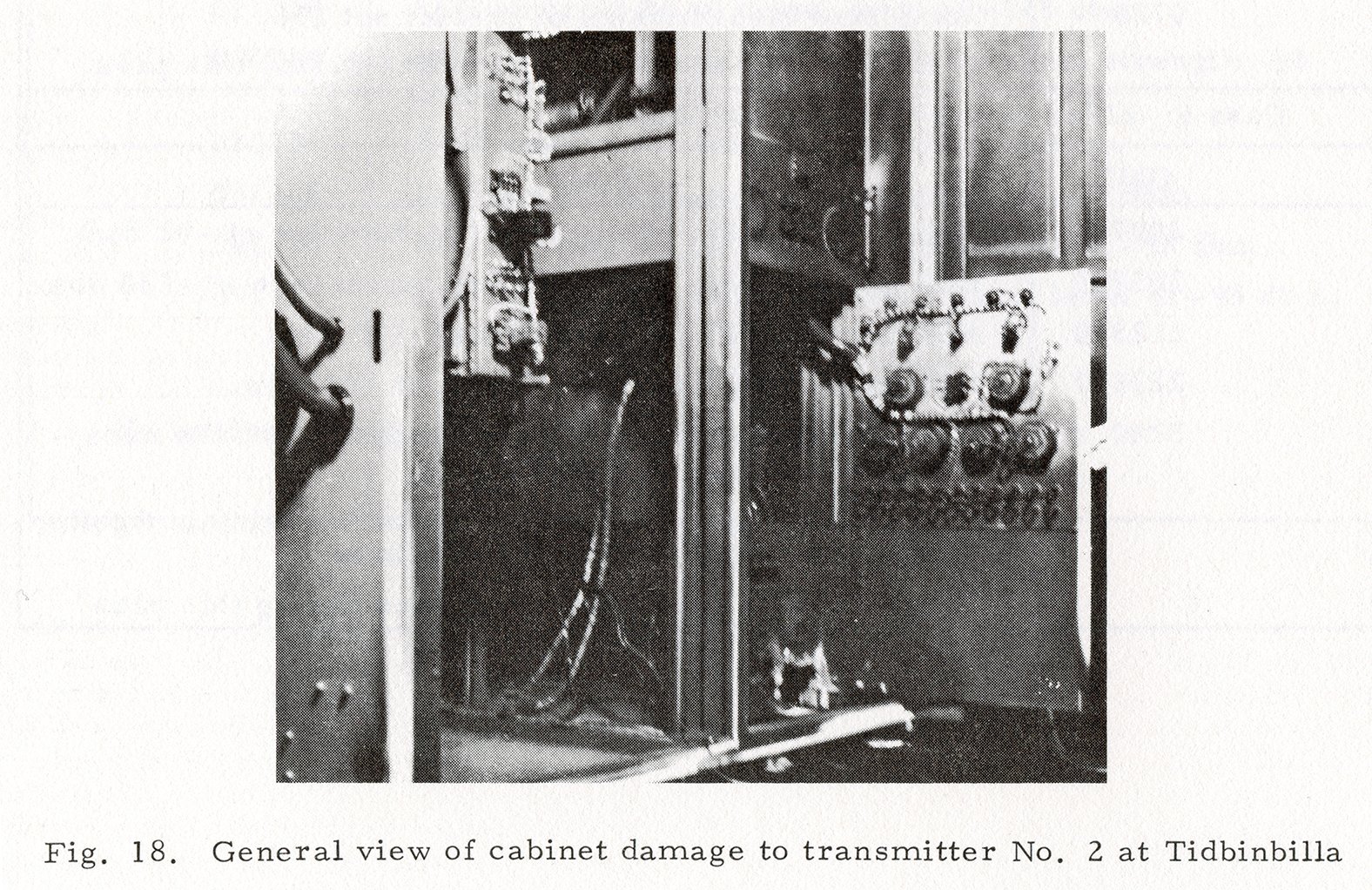 |
Here’s a report and photo from a JPL Technical Memorandum – – This report and photo appeared on pages 30 and 46 of the JPL Technical Memorandum 33-452 Volume II (“Deep Space Network Support of the Manned Space Flight Network for Apollo, 1969 – 1970”) by F.M. Flanagan, R.B. Hartley and N.A. Renzetti. Preserved by Les Whaley, scanned by Colin Mackellar. |
| HSK MISSION DAY 3. TLC DAY 3. | Saturday 19 July 1969 | |
| TLC Day 3 | ||
| HSK | ||
| AOS : 1020 AEST | LOS : 2102 | Track Duration : 10h 42m |
| Signal level from the spacecraft : -112 dbm | ||
| Handover uplink GDS to HSK : 1332 | ||
| Handover uplink HSK to MAD : 2042 | 2-way duration : 7h 10m |
| PARKES | ||
| AOS 1200 AEST | LOS : 1649 | Track duration : 4h 49m |
| Signal level : -111 dbm (spacecraft on omni antennas) | ||
At 55:08:00 GET (0640 AEST) the crew began a 96 minute colour television session through Goldstone’s 64 metre dish, which included interior views of the Command Module and Lunar Module plus views out of the windows with the Earth 324,000 kilometres away. The viewers were treated to watching probe and drogue removal, and the spacecraft tunnel hatch to the LM being opened.
Aldrin entered the LM first, followed by Armstrong and viewers were treated to a tour around the LM, with views looking back into the CM. Included were items of interest such as their EVA gear waiting to be used:
Equigravisphere.
With the astronauts resting, Apollo 11 sailed through equigravisphere at 61:39:55 GET (1311:55 AEST) where the gravity of the Earth equalled the gravity of the Moon. They were 345,281 kilometres from Earth and 62,638 kilometres from the Moon, travelling at 3,280 kilometres per hour relative to Earth and 4,149 kilometres per hour relative to the Moon. At this point Mission Control computers and displays changed from earth to lunar referenced parameters.
| HSK MISSION DAY 4 | Sunday 20 July 1969 | |
| Lunar Orbit Insertion burn | 75:49:50 GET, 0321:50 AEST | |
| Initial AOS (Orbit 4) : 1048 | Final LOS (Orbit 9) : 2107:30 | 10h 19m 30s |
When the Moon rose above the horizon on Sunday at Honeysuckle, Apollo 11 was
already on its fourth orbit.
| HSK Prime CSM Lunar Orbits | Track Duration |
|
| Orbit | ||
| 4 AOS : 1048:00 Signal level : -103 dbm |
LOS : 1115:40 | 27m 40s |
| 5 AOS : 1202:03 | LOS : 1314:01 | 1h 11m 58s |
| 6 AOS : 1402:45 | LOS : 1312:21 | 1h 09m 36s |
| 7 AOS : 1558:42 | LOS : 1710:45 | 1h 12m 03s |
| 8 AOS : 1757:16 | LOS : 1909:08 | 1h 11m 52s |
| 9 AOS : 2001:30 | LOS : 2107:30 | 1h 06m 00s |
Total Track Duration : 6h 25m 9s |
| HSKX Wing LM | Track Duration |
|
| Orbit | ||
| 4 AOS : 1053:00 Signal level : -102 dbm |
LOS : 1225:00 | 1h 32m 00s |
| 5 AOS : 1202:03 | LOS : 1314:01 | 1h 11m 58s |
| 6 AOS : 1402:45 | LOS : 1312:21 | 1h 09m 36s |
| 7 AOS : 1558:42 | LOS : 1710:45 | 1h 12m 03s |
| 8 AOS : 1757:16 | LOS : 1909:08 | 1h 11m 52s |
| 9 AOS : 2001:30 | LOS : 2107:30 | 1h 06m 00s |
Total Track Duration : 7h 29m 29s |
| Parkes | Track Duration |
|
| Orbit | ||
| 5 AOS : 1240 Signal level : -88 dbm |
LOS : 1314:01 | 1h 11m 58s |
| 6 AOS : 1407:15 | LOS : 1518:21 | 1h 11m 06s |
| 7 AOS : 1558:42 | LOS : 1710:45 | 1h 12m 03s |
| 8 AOS : 1757:16 | LOS : 1909:08 | 1h 11m 52s |
| 9 AOS : 2001:30 | LOS : 2107:30 | 1h 06m 00s |
Total Track Duration : 5h 52m 59s |
During the fourth day Collins swung the CSM around to look at the Moon. Not having seen it for a whole day the three astronauts were startled by its size – it filled their windows like a huge three-dimensional balloon suspended in space, so close they felt they could reach out and touch it. Brilliant sunlight splashed around the rim, while below them the crater-studded surface brooded in a darkness lit by the eerie glow of earthshine. While they were finishing breakfast the windows darkened as they entered the Moon’s shadow and all the stars came out. Armstrong called back,
INTO LUNAR ORBIT. (LOI)
Shortly before the spacecraft was due to go behind the moon for the first time Houston announced, “Eleven, this is Houston. You are GO for LOI, over.” The LOI (Lunar Orbit Insertion) burn had to take place behind the moon, out of sight of Earth and the tracking stations.
Aldrin: “Roger, Go for LOI.”
The crew could see the Moon through their windows:
One minute away from LOS behind the Moon, Apollo 11 was 787 kilometres from the Moon and travelling at 8,085.5 kilometres per hour. McCandless gave a final call, “Apollo 11, this is Houston. All your systems are looking good going around the corner, and we’ll see you on the other side. Over.”
Armstrong, “Roger. Everything looks okay up here.”
At 75:41:23 GET (03:13:23 AEST) on Sunday July 20 the astronauts could see the lunar horizon coming up as the spacecraft disappeared behind the moon at an altitude of 572 kilometres above the lunar surface and travelling at a speed of 8,409.6 kilometres per hour. Only Madrid was in contact, Goldstone and Honeysuckle Creek were out of sight on the far side of the Earth. The astronauts checked and rechecked the procedure for the rocket burn to put them into lunar orbit for what seemed hundreds of times as just one erroneous digit entered in the computer could turn them around and blast them into orbit around the Sun instead of the Moon.
At an altitude of 160.6 kilometres and at exactly 75:49:50.37 GET (0321:50 AEST), after a Trans-Lunar Coast that lasted for 73 hours, 5 minutes 35 seconds, they anxiously scanned their displays to keep an eye on the progress of the 5 minute 57.53 second burn to put them into a lunar orbit of 314.3 by 111.1 kilometres.
At the end of the burn Armstrong announced, “Shutdown.”
Collins quipped, “Hello Moon, how’s the old backside?”
The engine had performed flawlessly. They were safely in lunar orbit.
With the spacecraft out of contact with Earth, Mission Control in Houston went quiet, the subdued flight controllers mainly seated at their consoles, some standing up, an odd conversation taking place. Bill Anders, Jim Lovell, and Fred Haise, the Apollo 11 back up crew arrived, and joined McCandless at the Capcom console. Many of the astronauts, including John Glenn, appeared in the viewing room. They were all waiting for the spacecraft to reappear to confirm the burn had gone to schedule.
The Public Affairs loop announced, “With a good Lunar Orbit Insertion burn, the Madrid station should acquire Apollo 11 at 76:15:29 (GET). Acquisition time for no burn; 76:05:30.”
In the spacecraft behind the Moon, the astronauts were astonished at the size of the craters passing by below. As the spacecraft approached Earthrise, the astronauts were getting ready to photograph the moment:
As the Earthrise moment drew near, Collins said, “Okay, we shouldn’t take any more pictures on this roll until Earth comes, I don’t think. This is…..”
The tracking station at Madrid found the spacecraft signal right on the predicted time of 76:15:29 GET (03:47:29 AEST), the astronauts busy trying to align the high gain antenna for the best angle to Earth as they came over the lunar horizon. Goldstone came into view about 45 minutes later. Houston was anxious to know how the burn to put them in lunar orbit had gone.
Aldrin read out the figures but Houston had trouble copying the report because of the poor signal from the spacecraft.
Good communication was established with the high gain antenna aligned, and the spacecraft status was passed down by Armstrong. Collins summing the burn report with, “It was like… it was like perfect.”
Audio |
 |
The Madrid MSFN station. Photo: Larry Haug. |
During the second orbit, at 78:20:00 GET (0552:00 AEST), a 40 minute scheduled live colour television transmission was sent to Earth, showing spectacular views of the lunar surface and the approach path to the Apollo landing site 2. As they went behind the Moon:
After this orbit, while the spacecraft was behind the Moon, astronaut Charlie Duke took over as Capcom, ready for the day’s momentous events.
After two revolutions, Collins initiated a second, critical SPS burn of 16.88 seconds at 80:11:36.75 GET (0743:36 AEST) to put them into an elliptical orbit of 122.4 by 100.9 kilometres, ready for the LM to depart for the lunar surface. Critical, because even a burn two seconds too long could put them on a collision course with the other side of the moon.
As Apollo 11 approached the Sea of Tranquillity for the first time, the astronauts could see it was early dawn on the surface below them the sun was just tipping the peaks and boulders with a bright glow while long, jumbled, black shadows stretched across the endless craters. Armstrong and Aldrin were peering through their windows trying to make out the landmarks for the next day’s landing, but they were disappointed to find the actual landing site seemed to be in darkness, so they were not able to preview the landing spot.
 |
The lunar surface illuminated at a very low sun angle. |
Armstrong reported his observations:
Lunar Module checkout.
At 81:10 GET (1742:00 USCDT, late afternoon spacecraft time/ 0842 AEST) Aldrin began procedures to enter the LM to power up and check the spacecraft systems.
At 81:45:00 GET (0917:00 AEST) the spacecraft went behind the Moon again with the crew sorting out the LM, to reappear at 82:32:00 GET (1004:00 AEST) with limited conversation. Armstrong was planning on shaving his face and Collins was tracking landmarks on the lunar surface.
They passed over the planned landing site and brought up the LM power system. At 83:07:00 GET (1039:00 AEST) Houston began receiving data and voice through Goldstone from the LM, and the code name of Eagle was used for the first time:
With a successful communications test over the Goldstone station and LOS behind the Moon at 83:44:00 GET (1116:00 AEST) on their fourth orbit, they switched back to CSM power and began to prepare for a rest/sleep period.
By now Honeysuckle Creek was tracking the spacecraft on its first pass of the day, having picked up the signal during the LM communication test as the Moon rose over the horizon.
The next time the spacecraft appeared from behind the Moon it was at 84:30:03 GET (1202:03 AEST) with the crew finishing off preparing the spacecraft for sleeping. Owen Garriott replaced Charlie Duke as Capcom in Houston for the rest period.
At 85:42:01 GET (1314:01 AEST) we lost the spacecraft behind the Moon on its fifth orbit with the astronauts getting ready to go to bed. From the onboard tape recorder:
Collins was offering the two moon walkers the most comfortable sleeping positions – the thought of returning to Earth alone because of an error due to overtiredness was unthinkable.
Collins then commented, “Well, I thought today went pretty well. If tomorrow and the next day are like today, we’ll be safe.”
When the Moon rose above the horizon at 83:16:00 GET (10:48 AEST) on Sunday morning at Honeysuckle Creek, Apollo 11 was already on its fourth orbit. At the end of our tracking session we didn’t need a two-way handover with the CSM as we finished Rev 9 at 93:35:30 GET (2107:30 AEST) and Madrid picked up Rev 10. Goldstone was out of sight on the other side of the Earth.
At 93:32:39 GET, 0604:39 USCDT (early morning spacecraft time/ 2104:39 AEST) during orbit 9, Capcom Evans put in the first call to wake up the astronauts just 2 minutes 51 seconds before Honeysuckle Creek lost them going behind the Moon on our last pass of our day. The crew reported that Armstrong had 5½ hours of good sleep, Collins 6 hours and Aldrin 5 hours. Evans commented, “Looks like you were really sawing them away!” and Collins responded with, “You’re right.”
A good start to the momentous day.
 |
A daily report sent to the Network at 93:28 GET. Click image for the full page. Preserved by Larry Haug, scanned by Bill Wood. |
At 95:20:00 GET (2252 AEST) Aldrin was first into the LM in his undergarments to do some initial checks before returning to the CSM’s equipment bay to finish dressing. Half an hour later a fully suited Armstrong crawled into the LM, to be joined by Aldrin and they sealed the hatch before finishing the final checkout.
| HSK MISSION DAY 5 | Monday 21 July 1969 | |
| LUNAR LANDING AND EVA | ||
| Undocking : 100:12:00 GET, 0344:00 AEST Only Madrid tracking. DOI (Descent Orbit Insertion) burn : 102:07:33 GET, 0508:14 AEST LM Lunar Landing : 102:45:39.9 GET, 0617:39 AEST Goldstone & Madrid tracking Selenographic co-ordinates : 0.67409°N, 23.47298°E in the Sea of Tranquillity (Davis et al). LM Hatch opened : 109:07:33 GET 1239:33 AEST TV on : 1254:00 AEST First step on Lunar surface : 109:24:15 GET, 1256:15 AEST LM Hatch closed : 11:39:13 GET 1511:13 AEST TV off : 1757:50 AEST Total EVA time : 2 hours 31 minutes 40 seconds. |
||
| HSK Prime | Track Duration |
|
| LM AOS : 1112:00 AEST | LOS : 2220:00 | 11h 08m |
| Signal level : -112 dbm | ||
| Handover uplink GDS to HSK : 1543 | ||
| Handover uplink HSK to ACN (Ascension Island) : 2202 | 2-way duration : 6h 19m |
|
| HSKX Wing CSM Lunar orbits | Track Duration |
|
| Orbit | ||
| 17 AOS : 1141:08 | LOS : 1223:30 | 42m 22s |
| Signal level : -103 dbm | ||
| 18 AOS : 1348:00 | LOS : 1451:30 | 1h 03m 30s |
| 19 AOS : 1537:56 | LOS : 1648:50 | 1h 10m 54s |
| 20 AOS : 1736:13 | LOS : 1848:05 | 1h 11m 52s |
| 21 AOS : 1934:30 | LOS : 2046:28 | 1h 11m 58s |
| 22 AOS : 2132:50 | LOS : 2244:45 | 1h 11m 55s |
Total Track Duration : 6h 32m 31s |
| Parkes LM | Track Duration |
|
| AOS : 1306 AEST | LOS : 1817 | 5h 11m 00s |
| Signal level : -90 dbm |
THE LANDING.
In Mission Control, the White Team of flight controllers under Gene Kranz drifted into the control room while in the spacecraft the astronauts were eating their breakfast. Capcom Charlie Duke was already at his console. As their eyes adjusted to the dim lights, the smell of stale cigarette smoke mixed with discarded fast foods struck their nostrils. A low buzz of conversation supported the subdued feeling of urgency in the air as Glynn Lunney’s shift briefed Kranz’s team. By now every available audio outlet had a headset plugged into it. To be in the operations centre and not have access to the spacecraft communications loop to hear what was going on would be unbearable.
Kranz set himself up at the Flight Director’s console and checked out his team. They were all young men – their average age was 26 years. Every position called “GO”; the worldwide tracking network was Green.
As Kranz said, “We were about to write the book on how to land on the Moon”.
Separation.
Behind the Moon, during the 13th orbit and about two minutes before acquisition by Goldstone, Armstrong and Aldrin extended the LM’s landing gear, completed their checks and prepared to separate from the CSM.
At 100:12 GET (0344 AEST), 116.5 kilometres above the lunar surface, Collins watched the LM drift away from him and pirouette around for him to inspect it. There was less than four minutes to Earthrise and Houston.
 |
One of many photos of Eagle taken by Mike Collins during his visual inspection of the LM. (Slightly brightened.) Neil Armstrong is just visible in the Commander’s window. NASA photo AS11-44-6598 / Apollo Image Archive. |
The separation had happened behind the Moon. If all had gone according to the flight plan, the LM and CSM should be coming round the rim separated, the LM at an altitude of 15,000 metres ready to land in about 28 minutes. The first big event was over. From now on everything was going to be happening fast.
Audio |
|
Madrid and Goldstone had AOS at 0546:52 AEST on the 13th orbit, Columbia’s signal appearing at the tracking stations about three minutes before Eagle’s, but the LM’s signal was weak and dropping in and out of lock due to its antenna not being optimised.
To show the busy time these two astronauts were having, apart from flying the LM, Duke then fired two lots of data to be accurately copied down by the LM pilot, their lives depending on getting the figures right. The first was the DOI (Descent Orbit Insertion) PAD figures, giving details of the burn that would take the spacecraft to the lunar surface:
Then seconds later came the PDI PAD figures, for a series of burns that would be used to return to the Command Module in the event of an abort, after where it says ‘PDI abort’:
Aldrin read back what he had just copied down, without an error,
Next came a 9 second separation RCS burn by the Command Service Module to give the two spacecraft a safe distance apart of about 3 kilometres, timed for 100:39:52.9 GET (0411:52 AEST).
Back in the Eagle Armstrong and Aldrin were preparing for their Descent Orbit Insertion (DOI) burn to take them down to the lunar surface. Columbia’s radar was checking Eagle and Collins announced, “I’ve got a solid lock on. I have you at 0.27 miles (500 metres).”
 |
Gene Kranz invited Bill Tindall (watching at left) to sit with him during the landing phase. Tindall was an invaluable help in developing procedures, especially for critical phases of the mission. NASA photo s69-44155. Preserved by Hamish Lindsay, scanned by Colin Mackellar. |
Descent Orbit Insertion (DOI) burn.
The DOI burn required a 30 second firing of the descent engine at 101:36:14 GET (0508:14 AEST), putting the LM in a highly elliptical orbit of 108.3 x 14.4 kilometres. At 0546:52 AEST the Command Module’s signal appeared from behind the Moon and Madrid and Goldstone locked on to it.
In Houston the plot boards and console readouts all came alive with good data.
|
Among the flight controllers an uneasy exhilaration began to build, as Kranz noted, “I can finally feel the tension mixed with excitement in the room. The air starts to crackle as we anticipate coming events.” He noticed that the paper in his logbook was becoming damp from the moisture from his palms as he scribed events. “We will land, crash or abort. In forty minutes we will know which.”
Kranz decided to have a private moment with his flight controllers and told them to switch to a private conference loop where he spoke from the heart, sharing his feelings of pride with his team, and he would back every call they made.
He then ordered the control room doors to be locked and the Center configured to the military term Battle Short, that is, the main power circuit breakers were all sealed. Nobody could enter or leave the room during this critical period.
Kranz then said a prayer.
Powered Descent Initiation (PDI).
At the low point of 14.4 kilometres of the elliptical orbit Eagle fired the Powered Descent engine with a 12 minute 36.39 second burn at 102:33:05.01 GET (0605:05 AEST). The time of this burn was right on, but the spacecraft position was 7.4 kilometres further downrange than planned, resulting in the landing point being 7.4 kilometres beyond the planned spot.
By now all the flight controllers were pumped up, stretched to the limit, trying to evaluate their ratty data and make decisions on whether their GO was the right decision. With a slight spacecraft attitude change, contact with Eagle improved enough for Kranz to hear the astronaut’s final checklist before the astronauts fired the descent engine.
Aldrin called: “Ignition….10 per cent thrust,.” advising that the engine was operating at 10% of its maximum thrust of 4762.7 kilograms. The burn consisted of a 15 second burn at 10% thrust, increasing to a 40% thrust for the remaining 15 seconds.
Aldrin explained:
“The descent was divided into three stages, each controlled by its own computer program. The first was the braking phase, which did most of the slowing. Then as the landing site appeared over the horizon we entered the approach phase where Neil could see where the computer was taking him, and perhaps tell it to take him somewhere else if he didn’t like the look of it. Then we entered the terminal phase – where the LM gently descended the final 100 feet or so while Neil flew it like a helicopter to avoid any obstacles that might get in the way.
My job was to support Neil by giving him all the information from the computer.”
Altitude 12,200 metres.
Aldrin took his eyes off the instrument panel for a moment to look through the window… "And we got the Earth straight out our front window."
The LM’s legs were facing the flight path, the astronauts flying backwards unable to see where they were going. They were able to see landmarks passing by so knew where they were as they headed down for the moon's surface, the astronauts looking up at the Earth through the windows. At all times they were very conscious of their home, the Earth a blue and white jewel glittering in the black void of space hanging suspended up there in the lunar sky. The land they were heading for had no water or food or shelter, and the nearest friendly mechanic or technician and their spare parts were three days and over 321,860 kilometres away across the void. No place to have a breakdown.
The LM was now racing horizontally across the lunar landscape at 5,790 kilometres per hour and had to slow up in stages, to the speed of a jet plane, 965 kilometres per hour, down to the speed of a car at 100 kilometres per hour at an altitude of 2,133 metres, finally hovering above the surface, before dropping vertically into the dust. Armstrong and Aldrin had to make the first ever landing on the moon in one go - there was no way of pulling out for a second attempt.
Altitude 10,200 metres.
Aldrin, “We now sensed the real speed of our descent for the first time.” They began to feel the Moon’s gravity pulling on their arms and bodies, their boots beginning to press on the floor.
At 102:38:04 GET the landing radar indicated it was receiving good signals from the lunar surface and its data was accurate. Then an electrical problem appeared, a bad meter reading the AC power had the controllers worried as the AC system powered the gyro’s landing radar. The decreasing height of the LM above the lunar surface was critical now. Their height above the lunar surface measured by our ranging systems in the tracking stations on the Earth could be anything up to 2,500 metres out at lunar distances and angles, so the height measured by the on board radar was needed at Houston for evaluation and comparison. Kranz had to grapple with an increasing number of problems rearing up as the LM dropped to the lunar surface, “All through this time my mind is really running. Is there enough data to keep going?”
 |
The tension shows on the face of Capcom Charlie Duke (left), and Jim Lovell, as smoke from Deke Slayton’s cigarette (out of view to the left) hangs in the air. Screen capture from NASA 16mm footage by Colin Mackellar. |
Kranz has a final call round his team before ignition:
In the roll call only the Guidance Officer Steve Bales came on line with a doubtful call, “Flight, we’re out on our radial velocity; we’re half way to our abort limits.”
Kranz tensed when he heard the radial velocity was half way to abort limits and found it meant the spacecraft was moving a bit faster than planned. The reason was the astronauts had not fully decompressed the tunnel between the two spacecraft – it should have been a vacuum – so when they separated the slight pressure remaining pushed the spacecraft apart with more velocity than planned. As the error remained constant the problem was accommodated, but still meant they were going to land further downrange than planned, in what was expected to be a more rocky area.
The rest of the flight controllers called in with a “GO” so Kranz advised Duke, “Capcom – we’re go for powered descent.”
 |
Neil Armstrong at the Commander’s position in Eagle. (NASA photo KSC-69PC-0318 taken during a pre-mission simulation in the flight crew training building at KSC.) |
Just when they wanted to tell the LM they were GO for powered descent they momentarily lost contact with the LM and had to relay the message via Mike Collins in Columbia .
Then, quite unexpectedly, at 102:38:22 GET (0610:22 AEST) a yellow caution light winked at the astronauts from the computer control panel. It was identified as a 1202 alarm. It meant the computer was overloaded by irrelevant data from the rendezvous radar, which should have been switched off, and couldn’t do all the tasks in the time available.
Suddenly Steve Bales, a specialist in the computer systems and its alarms deep in the bowels of the LM, was now sitting in the hot seat. He had to make a decision whether to go ahead and land or abort. At this moment the lives of Armstrong and Aldrin were in his hands. The success of the mission now depended on his response.
Capcom Charlie Duke said of that moment, “When I heard Neil say 1202 for the first time, I tell you my heart hit the floor. I looked across at Steve Bales but he was busy at his console and came back with the answer almost straight away we were go.”
Jack Garman, a young back-room expert supporting Bales from another console, remembered a similar problem had been tried out in a simulation only a week or so before, quickly reassured Bales: “It’s executive overflow; if it does not occur again, we’re fine.”
 |
26 year old Steve Bales recalled that fateful moment:
The Apollo Lunar Surface Journal reminds us that during a simulation before Apollo 11 Dave Scott and Fred Haise experienced a 1201 alarm coming in to land and Houston aborted the mission. Aldrin commented that,
After the simulation fright, Kranz insisted that Bales write down every alarm that could possibly go off. Bales promptly passed the task over to Garman, who produced a handwritten sheet which they stuck under the console desk glass for quick reference. Looking at the list Garman spotted the 1202 alarm and thought, “Right, if it doesn’t occur too often, we’re fine.”
With four minutes to go to the landing, the signal from the spacecraft strengthened, and settled down, so from this point on communications with the LM were solid.
Aldrin was apprehensive,
Swiftly dropping down to the Moon’s surface the astronauts sweated out a thirty second pause while at Mission Control Kranz snapped out a final tense roll call around his flight controllers. Steve Bales’ decision alone decided the fate of the mission, to abort and terminate the mission then and there, or continue on to success or... the possibility of a disaster. As it turned out it was the right decision, and Bales later collected his Medal of Freedom from the President along with the astronauts.
Retro was advising Kranz to pass on to Duke that 6 minutes 25 seconds into the burn the crew should expect the engine to throttle down to 55 per cent power.
Altitude 2,800 metres.
Now the LM began to drop its legs to point down to the moon’s surface, and the astronauts could see the moon’s surface in the bottom of their windows.
Armstrong was trained to land the LM. The two pilots had to work together as a cohesive team, Armstrong controlling the spacecraft’s flight while looking out of the window at the landing site; Aldrin concentrating on the display panel and calling out the information he needed. Armstrong had to translate what he saw with what he heard with what he felt to the spacecraft controls to guide the Eagle safely down to the lunar surface.
 |
Flight Director Gene Kranz gives Capcom Charlie Duke the “Go for landing” call to pass to the crew. Screen capture by Colin Mackellar from NASA 16mm film. |
At 610 meters above the lunar surface another alarm winked from the computer, “1201,” said Aldrin with growing concern, “I licked my dry lips. This was a time for discipline. But the tension had me rigid in my suit. We had to trust Mission Control,” – there was no time for explanations.
 |
 |
Capcom Charlie Duke (left) gives the “We’re GO. Same type. We’re GO.” call on the 1201 alarm. Jim Lovell (Apollo 11 Backup Commander, centre) and Fred Haise (Backup LM Pilot) are with Charlie on the console. |
While the LM was searching for a landing spot Kranz noted, “My voice loops become silent, the atmosphere electric as we hang on to each of the crew’s words.” The flight control team had met all their criteria and could do no more for the landing, and could only listen to the terse dialogue from the spacecraft.
Armstrong was riveted to his controls. He gave me this description of the last moments to landing from a lecture he gave to members of the American Society of Experimental Test Pilot’s Proceedings in 1969:
Back in the Mission Control Center in Houston the flight controllers were quiet, there was little they could do now, but they were getting jittery – why wasn’t Armstrong landing? He should have landed by now, he always had in the simulations. There were no clues coming down the voice channel, just figures from Aldrin. They were all staring at their consoles, helpless, not one of them knew why the Eagle was still weaving about above the surface, but all were acutely aware that time and fuel were fast running out.
At a height of 76 metres Aldrin flicked a glance out of his window and had a fleeting impression of the LM’s shadow on the lunar surface ringed with a halo of bright sunlight before an amber warning light came on only 5 per cent fuel remained and they still weren’t down. There were only 94 seconds left to land.
Kranz remembers,
At an altitude of 15 metres they entered what was referred to as the deadman zone. In this zone, if anything had gone wrong if for example, the engine had failed it would probably have been too late to do anything about it before they crashed on the moon. There were no fail-safe abort systems available until after the landing.
From out of the black sky above the pastewhite lunar surface bathed in the contrasty early morning sunlight, the LM appeared with a stream of exhaust gases blasting down at the surface. Armstrong noticed that they were beginning to disturb the dust at a height of about 30 metres and he began to have difficulty gauging their velocity by observing surface features.
Like a prehistoric predator, its two windows like beady eyes above the four dangling legs, the LM now hovered 9 meters above the surface, instruments and astronauts desperately searching, trying to probe the lunar dust for a clear spot to land. Armstrong was suddenly aware that the LM was yawing to the left and going backwards, “I arrested the backward rate but I was unable to stop the translational rate.” He could see small boulders and rocks sticking up out of the blanket of dust blasting away from their rocket motor. A hard white surface appeared through the dust, followed by black shadows of the approaching legs and spindly probes.
Deke Slayton was desperate to hear what Buzz Aldrin was saying and felt Duke was talking too much so clipped him on the arm and said, “Shut up,” and concentrated on his earphones where Aldrin was reciting displays and events displayed on the console in front of him:
Kranz:
Everyone was waiting for the 15 second call. Back room guru Bob Nance was monitoring Armstrong’s throttle control positions and was frantically mentally calculating his fuel usage to the amount of fuel remaining.
Armstrong:
TOUCHDOWN. “The Eagle has landed!”
Just before touchdown Armstrong noticed a tan haze obscuring the horizon, then he saw the shadow of the LM stretching about 60 metres out in front. In a maelstrom of dust, shadows, legs, and spent gases, the spaceship Eagle from Earth gently touched down on the lunar surface at 102h 45m 40s GET, 1517:40 USCDT (spacecraft time) on 20 July (0617: 40 AEST 21 July, 1969.)
Aldrin:
Duke: “We copy you down, Eagle.”
When Armstrong shut the engine down he was amazed to see all the dust particles stirred up by the engine exhaust just suddenly vanish. “I was absolutely dumbfounded when I shut the engine off and the particles of dust that were going out radially from the bottom of the engine bell all the way out over the horizon just instantaneously disappeared. I had never seen anything like that.” This was due to the lack of an atmosphere.
Armstrong had landed the Eagle with negligible forward velocity, slewing 0.6 metres per second to the left, and dropping 0.6 metres per second vertically. The right and forward landing gear touched almost simultaneously, giving a roll-left and coming to rest with a tilt back of just 4½°. Apollo 11 had the least deviation from vertical of all the lunar modules to land on the Moon’s surface.
On reflection Armstrong admitted the computer readouts were very helpful,
Armstrong said after,
Suddenly all the gut-wrenching, urgent decisions were gone – just silence. They had landed safely with a 4.5° tilt from vertical and a 13° yaw left from the flight path. Only fuel for 45 seconds of burn time was left in the tank, “We’d been told to expect the remaining fuel in the descent stage to slosh back and forth after we touched down, but there simply wasn’t enough reserve fuel to do this,” wrote Aldrin.
With no atmosphere there were no familiar sounds from outside, no rustling leaves, no bird calls or human or animal noises, just the sound of their own breathing inside their helmets. A jet black sky arced over the landing site… there wasn’t a cloud – there was nothing to relieve the intense blackness of the sky. The Eagle was safe on the lunar surface in an area ringed on one side by fairly good-sized craters, and on the other side by a boulder field, about the size of a house lot.
The first human voices on the moon crackled over the intercom and were relayed to the 600 million Earthlings holding their breath. As they all heard the first words from another world in English with an American accent, it seemed that for the first time in history the human inhabitants of the Planet Earth were globally united. Armstrong and Aldrin looked at each other through their visors, reached across and vigorously shook gloved hands, excited by the tension of the events on the way down.
Armstrong confessed, “If there was an emotional high point, it was the point after touch down when Buzz and I shook hands without saying a word. That still in my mind is the high point.”
Aldrin’s thoughts were, “If there was any emotional reaction to the lunar landing it was so quickly suppressed that I have no recollection of it. We had so much to do, and so little time in which to do it, that no sooner had we landed than we were preparing to leave in the event of an emergency. I’m surprised, in retrospect, that we even took time to slap each other on the shoulders.”
Aldrin responded automatically to their training procedures and began to prepare for an emergency launch when he heard Armstrong announce:
With the Eagle safely down on the lunar surface, pandemonium broke out among the consoles in Mission Control. Cheering, backslapping, flag waving and handshaking engulfed the room as the flight controllers released their pent up emotions for a few moments. In the back row Bob Gilruth clapped Chris Kraft on the shoulder and they shook hands. Neither could speak with the emotion of the moment.
Charlie Duke gratefully sank back into his chair, took a deep breath, and exchanged grins with Deke Slayton. He could hardly believe it had happened.
 |
A relieved Charlie Duke smiles at NASA cameraman Jerry Bray from his Capcom console moments after the touchdown. Astronauts Jim Lovell (Apollo 11 Backup Commander) and Fred Haise (Backup LM Pilot) are next to him. Screen capture by Colin Mackellar from NASA 16mm footage. |
“Okay everybody – T1, stand by for T1.” Kranz rasped out to the flight controllers while Duke was still saying “We copy you on the ground”, but then for a moment he was speechless. The 35 year old crew-cut Kranz, who had the flight control team and himself under rigid control all the way down, admitted,
The sudden pain was enough for him to regain control and coolly announce, “All right, everybody settle down, and lets get ready for a T+1 STAY/NO STAY.”
 |
Flight Director Gene Kranz gives Charlie Duke the “Stay for T1” call to pass to the crew. Screen capture by Colin Mackellar from NASA 16mm footage. |
At Honeysuckle Creek a number of us left our Site Readiness Test, checking our equipment, to gather around the speaker in the Communications Room to hear the landing. I remember holding my breath for those last moments until we heard the Eagle was safely down. We had to know what to expect when the Moon rose above our horizon – with a safe landing it now looked as though we had a normal mission ahead of us.
T+1 was one minute after landing – decision time for staying or launching in a hurry if there was danger to the astronauts or spacecraft. There were only three minute or twelve minute abort points – after twelve minutes they would have to wait for Collins in Columbia to go around the Moon again.
Just after Eagle had landed there was a moment of anxiety when engineers in Mission Control noticed the pressure rising dramatically in one of the descent engine fuel lines. The residual heat from the shut down engine was creeping up to a slug of frozen fuel left in the pipe, with the consequence it might become unstable and explode like a small hand grenade and cause damage to the ascent stage. Just when the engineers were about to hit the urgent action button, the pressure began dropping and the tension was over. Kranz, “We used a cryogenic bottle to pressurise our descent engine and we are wondering if this thing is going to explode.” Armstrong and Aldrin, however, did not consider it a serious problem.
 |
Celebrations in Row 2 of the MOCR after touchdown. From right: Dick Brown, John Aaron (EECOM), Sy Liebergot (with pipe), Jack Kamman, Kathy Spencer, Buck Willoughby (GNC, writing). |
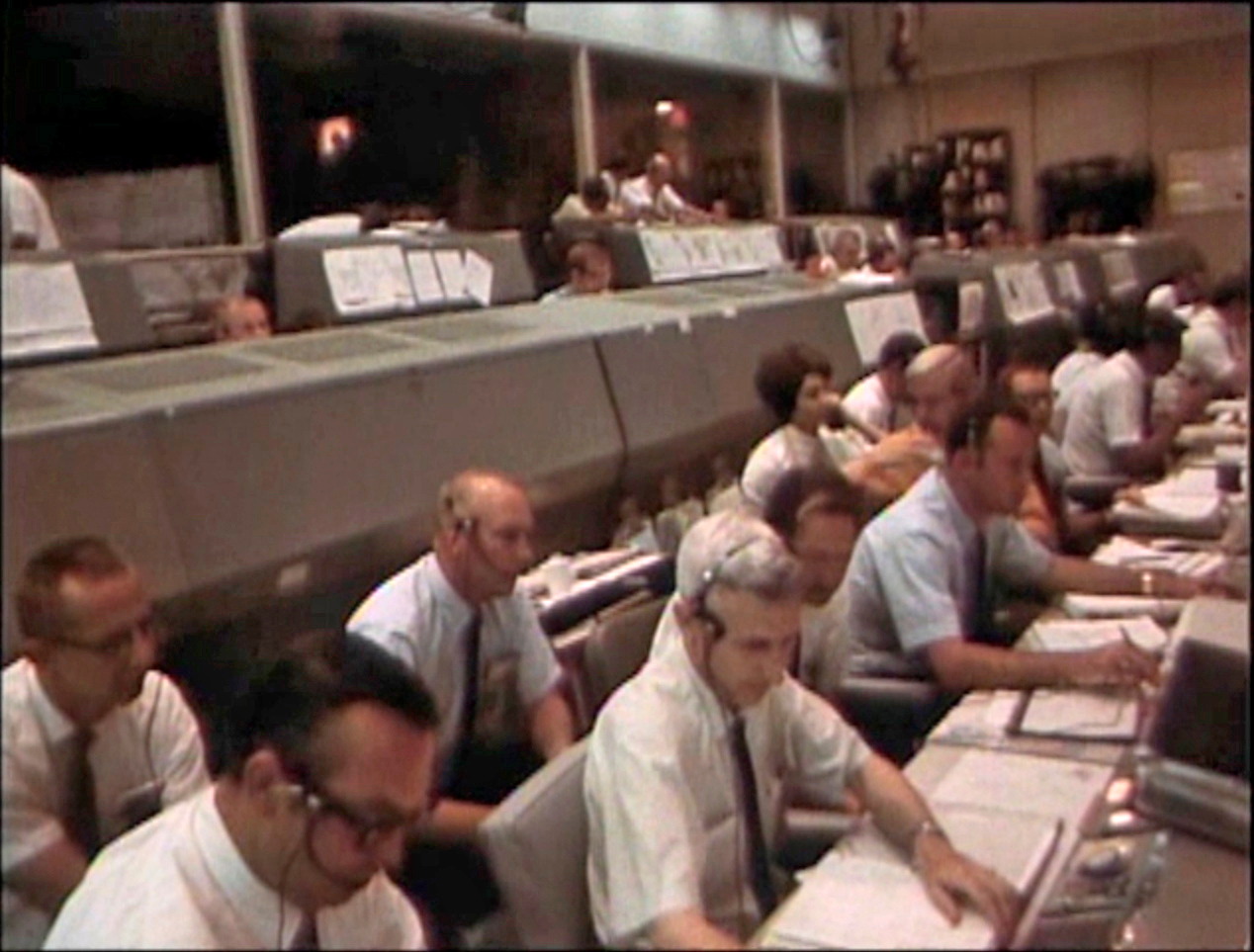 |
From the other end of Row 2 after touchdown. Bob Carlton (Control) is at centre closest to the camera. |
 |
From left to right: Milt Windler, Gene Kranz, Bill Tindall, Cliff Charlesworth. Screen captures by Colin Mackellar from NASA 16mm footage. |
Looking through his window, Aldrin tossed in a quick first impression,
Collins in Columbia tried to follow events on the lunar surface.
While Armstrong and Aldrin were in constant communication with Mission Control, Collins in the Command Module was spinning around the moon, relying on somebody relaying the events to tell him what was happening. After forty minutes of complete isolation behind the moon on each orbit, he could talk and listen to the Earth for seventy minutes through Goldstone and our Wing at Tidbinbilla, but he only had about eight minutes in touch with Eagle each time he passed over Tranquillity Base. Then it was back to another forty minutes of isolation. He happened to be in the contact zone when they landed, so heard the verbal exchanges of the landing.
Where had they landed?
But where had they landed? Nobody was sure. It wasn’t that easy the mapping people were sweating now. Tracking data indicated the Eagle had landed 7.4 kilometres beyond the planned landing point, the error suspected to be caused by residual pressure in the connecting tunnel kicking the LM away from the CSM with more velocity than expected, and possibly mascons may have affected the LM’s descent trajectory. Jerry Bostick, Flight Dynamics Officer in the Trench in Mission Control at the time, told me,
Collins in Columbia was vainly scanning the lunarscape for signs of the LM each time he passed over, guided by Houston’s latest update from the Mapping Sciences Laboratory in Houston. Using huge lunar maps and data from the spacecraft and tracking stations they narrowed it down to an 8 kilometres radius. Armstrong and Aldrin could not identify anything of significance from their position. It wasn’t until they were half way home that their position was pinpointed by a chance remark by Armstrong.
Armstrong decides on an early EVA.
The flight plan called for a four hour rest period after landing. As everything had gone according to schedule, the LM was in good shape, and the astronauts weren’t admitting to being tired, they were very keen to get out before their rest period.
At 104:39:14 GET (0811 AEST) Armstrong and Aldrin decided to postpone the four hour scheduled sleep period and go out on the lunar surface straight away. Armstrong: “We wanted to do the EVA (lunar walk) as soon as possible. It would make more sense to go ahead and complete the EVA while we were still awake and not try to put that activity in the middle of a sleep period.”
Mission Control and the tracking network get ready to support an early EVA.
Goldstone would be tracking two-way with the LM on the Moon’s surface when it came over our horizon. We began our Site Readiness Tests (SRT) checks at 0600 AEST and by 1042 AEST Honeysuckle Creek was ready for the day’s events and went into the H-30 count, ready for an 1112 acquisition.
 |
 |
Lloyd Bott (Deputy Secretary Department of Supply), Prime Minister John Gorton, Allan Cooley (Secretary Department of Supply), Station Director Tom Reid at Honeysuckle Creek on the morning of Monday 21 July 1969. |
Outside it was a freezing winter’s day with sleet showers driving in from the west as the 26 metre antenna dropped down to the horizon and patiently waited. Inside the building the atmosphere thickened with tension as the day shift geared up for the first signs of a signal.
The Moon rose above the gum-tree clad mountains to the east beside Deadman’s Hill and took a few minutes to come out of our eastern antenna keyhole at 1112 AEST. I wasn’t sure that Deadman’s Hill was a good point to acquire the LM – but we had no choice.
 |
Honeysuckle Creek, Monday 21 July 1969. Hamish Lindsay, who took this photo, writes –
|
The Eagle’s signal filled the station’s receivers, and all the station equipment locked onto the data being sent from the receivers, while anxious eyes scanned all the readouts and reported good figures to the Operations Console. The operations areas were cleared for action as the astronauts prepared for the EVA. In contrast to Houston, there were no fast foods available in the Australian bush to be left about; we only had nice cafeteria food.
There was 1 hour and 44 minutes to Armstrong putting his boot on the lunar surface. Over at the Wing at Tidbinbilla they had just begun tracking Michael Collins in the CSM on his 17th Orbit.
Carnarvon and Western Australia improvise television links.
At the time there was no television connection to the Australian eastern states. So, for this monumental occasion the Australian Broadcasting Corporation (ABC) planned to bring the moment to Western Australian viewers through the Carnarvon OTC Satellite Earth Station.
The signal would be transmitted in reverse along the new Perth/Carnarvon coaxial cable, that is everything along the cable route had to be reversed for the signal to flow from Carnarvon to Perth. Temporary equipment was installed at Carnarvon. OTC, PMG and ABC staff working furiously away managed to have the links ready just one day before the step on the Moon. With the knowledge that they would actually see the first step on the Moon, moonwalk fever gripped Perth and TV rental companies were swamped with requests, schools prepared to suspend classes with TV sets made available, and shops set up monitors in their windows for crowds gathering outside to witness this historic moment.
The original signal was transmitted from Honeysuckle Creek and Parkes to the Moree OTC station in New South Wales, up to the Intelsat III F4 satellite over the Pacific Ocean, and down to the Carnarvon OTC station.
 |
TV from the Moon was relayed from Honeysuckle Creek and Parkes, via Sydney to the Moree Earth Station. From there it was transmitted to the Pacific Intelsat III F-4 satelllite. Any Earth Station which could see the satellite (i.e. anything in the highlighted area) could receive the TV intended for Jamesburg and then Houston. |
Only one small television set was set up in the Carnarvon RSL theatre for local townsfolk to witness the event – for many, the first television they had ever seen.
Parkes suffers antenna-threatening gale force winds.
Nearly an hour after Honeysuckle had acquired the signal, away over the paddocks, 250 kilometres to the north-northwest as the crow flies from Canberra, the CSIRO’s famous 64 metre radio telescope at Parkes was wound down to its limits, waiting for the Moon to rise.
 |
David Cooke, Parkes Senior RF Engineer, took this photo of the control room at Parkes, showing the NASA equipment installed for Apollo 11. |
The Director, John Bolton, and Neil Mason were at the controls, and about 20 other operators were gathered in the control room and tea room below, listening to the astronauts, trying to figure out when they were going to open the hatch and climb down to the surface.
Neil Mason,
 |
Parkes Telescope Driver Neil “Fox” Mason at the Parkes Radio Telescope, 20th July 2014. Photo: Colin Mackellar. |
The big question was, would the Moon be in their main feed when they did exit the LM? It looked as though it was going to be a race.
Powerful gusts of wind stirring thick dust clouds could be seen to the south, racing towards their vulnerable antenna. Unable to do anything at this late stage they winced as 112 kilometre an hour gusts (well over the specified safety limit of 48 kilometres per hour) attacked the big dish, slamming it against the zenith angle drive pinions. The Director, John Bolton, checked the strain gauges on the walls and said, “This is only going to happen once…” and decided to keep tracking and take the chance the structure would survive.
 |
David Cooke took this photo at Parkes, after the wind storm had died down, around 5:00pm, just before sunset. |
 |
Here’s a lightened version of David Cooke’s photo. |
Luckily, the winds eased a bit before Armstrong climbed out and Parkes was able to provide one of history’s greatest telecasts, despite the winds continuing to batter the antenna beyond its safety limits.
Using a less sensitive ‘off-axis’ detector, Parkes was able to receive the television pictures just as the LM’s camera was switched on, but because they would have a lower quality picture and could expect a break in their data switching to the main feed, were not selected to be broadcast to the networks until the LM’s signal reached the main beam.
In Mission Control there were two teams of controllers, one led by Clifford Charlesworth to run the EVA, and one led by Milton Windler to run the sleep period. These two teams now had to stand by while the EVA decision was under way. Charlesworth, nicknamed ‘the Mississippi Gambler’ by his peers because of his apparent laid back attitude, won the next shift when the decision to go for a walk first came down the line. He took over from Kranz, and settled in with his controllers to support the EVA. A poll confirmed everyone was GO.
Mission Control was ready for the history making EVA.
 |
 |
 |
Honeysuckle Creek prepared for action.
John Saxon, Operations Supervisor at Honeysuckle:
Kevin Gallegos, who was working on the Data Demodulators (SDDS) using an oscilloscope to watch the images (in phosphor green) remembered:
 |
Kevin Gallegos at SDDS (the Signal Data Demodulation System) just after the conclusion of the EVA on Monday July 21, 1969. |
The astronauts get ready for their EVA.
On the Moon, Armstrong and Aldrin were slowly hurrying into their EVA suits in the cramped space of the LM’s cabin, surrounded by vulnerable switches and instrument panels. The preparation time was expected to take about two hours but nobody was surprised when it took 3½ hours. Every move had to be meticulously carried out and checked. A lot of the drill took longer than planned because they never had a chance to simulate all of it under the right conditions – such as clearing away the remnants of their last meal.
Armstrong took a look out the window to see the conditions outside and commented,
Opening the LM’s hatch.
By the time Honeysuckle Creek had locked on to the LM’s signal at 1112 AEST the astronauts were nearly ready to open the hatch. At 1239 AEST, 1 hour and 27 minutes after we had acquired the LM’s signal, Aldrin reached for the handle to open the hatch.
The hatch stayed stubbornly shut as there was still some pressure remaining in the LM’s cabin. Aldrin tried peeling a corner of the hatch seal back and that released the pressure to allow the hatch to open.
“The hatch is coming open,” said Armstrong as he watched a little flurry of ice particles burst through the widening slot.
With the hatch open he eased himself though the opening, careful to guide the bulky EMU backpack and its antennas through the hatch without snagging anything.
Armstrong was so engrossed in working his way through the hatch, Aldrin had to remind him to open the MESA (Modular Equipment Stowage Assembly).
|
 |
A mockup of the MESA with the camera mounted upside
down. |
Armstrong found that what they had learned during their simulations in the water tank and airplane, such as body positioning, when to arch the back, keeping clear of snags and helping each other, were very close to the real thing. As he was a communication relay station for Aldrin still inside, both astronauts were following their checklists, which called for confirmation they had radio contact through the external EVA antenna. Houston also reminded Aldrin to turn the TV Camera on. He was now outside the LM.
 |
This is the scene in the MOCR (Mission Control), moments before the television camera is turned on. The image on the large back-projection screen shows the test bars being sent from Goldstone. |
Armstrong was surprised to hear Houston had a picture, not expecting the system to work so quickly, in fact later he admitted he was very surprised it had worked at all as it had never worked during simulations.
At Honeysuckle Creek, television technician Ed von Renouard was watching his screen intently for the first signs of a picture. He heard Aldrin say the circuit breaker was in and suddenly, at 109:22:00 GET (1254 AEST), an image appeared. There was a flurry of energetic activity as the television operators tried to decipher the strange fuzzy shapes on their screens.
This was the conversation on the interstation communication channel as the operators stared at the historic images on the screens before them.
|
Bryan Sullivan, Technical Officer in the computer area remembers:
|
Goldstone tracking station suffers television picture problems.
The first television frames used were sent by the big 64-metre Mars antenna at the Goldstone Tracking Station in California, but they were in trouble as Bill Wood, USB Lead Engineer at Goldstone explains:
 |
 |
This comparison shows that the scan-converted picture coming from Goldstone (top) was very dark, even though the signal was received on their 210 foot (64 metre) dish. The same frame of TV, received via Honeysuckle’s smaller 85 foot (26 metre) dish, and scan-converted at the station, shows much more detail. |
See the ‘Parkes and Honeysuckle’ page in
the Apollo 11 TV
section for more.
Honeysuckle Creek saves the day.
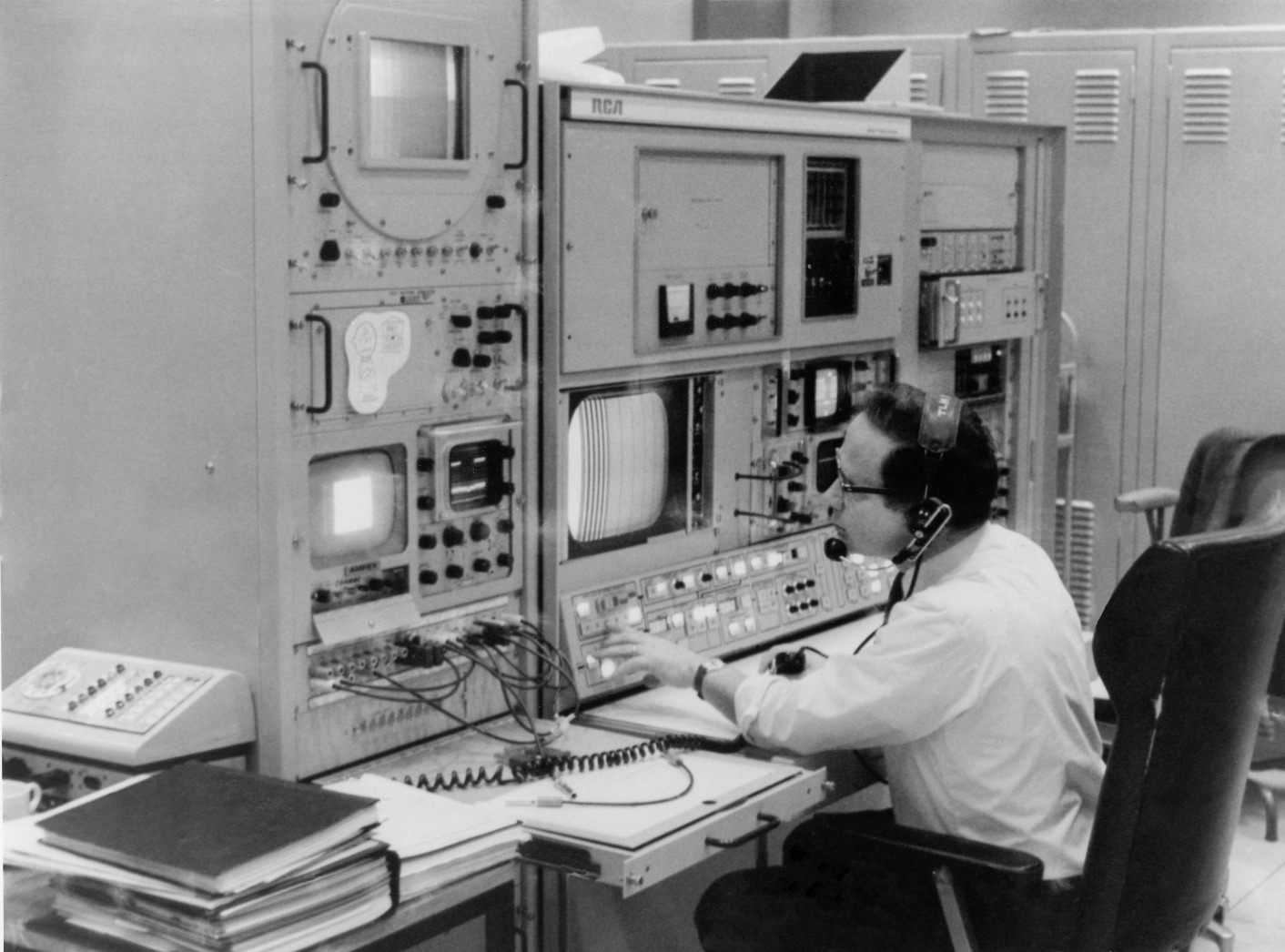 |
Honeysuckle’s video tech Ed von Renouard at the scan converter. The slow scan TV picture from Apollo 11 was displayed on the monitor at the top left. The switch to invert the image is the small toggle switch directly above his head. Scan by Hamish Lindsay, photo taken during Apollo 12. Large, Larger. |
Ed von Renouard, the television technician at Honeysuckle Creek:
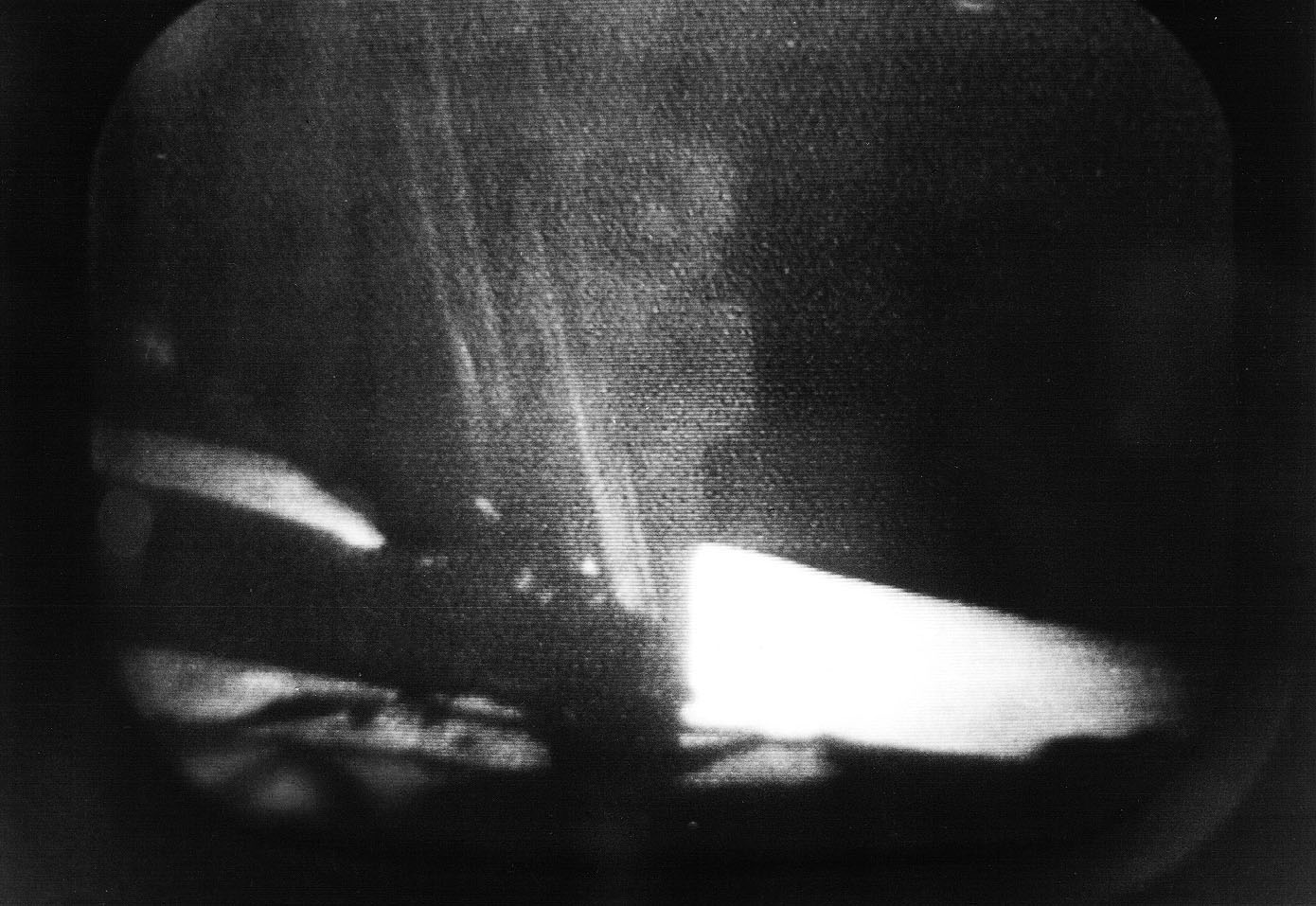 |
Neil Armstrong descends the ladder. GET 109:22:40 Photo taken from the video console at Honeysuckle Creek. |
Tom Reid, Honeysuckle Creek Station Director:
THAT FIRST STEP ON THE MOON’S SURFACE.
With troubles at Goldstone, and Parkes yet to receive a main beam signal, Houston video switched to the Honeysuckle Creek video signal being sent to them by Sydney Video, though they left the sound from Goldstone, and viewers around the world were able to make out the ghostly looking scene of the black sky and white lunar surface with Armstrong’s legs carefully seeking each rung of the LM’s ladder.
|
This video recording of the feed from Honeysuckle Creek to the Sydney Video switching centre was preserved by Kipp Teague and identified by Colin Mackellar in 2006. The tape is damaged at the start. This second or third generation copy is the only known recording of the Honeysuckle picture from the start. It begins just as Bruce McCandless calls, “We’re getting a picture on the TV!” It’s available here as a 20MB MPEG4 video file – click on the picture to open the file in a new window, or right click to download. |
|
This is stabilised version of the above recording, and has Honeysuckle Alpha loop and Net 2 added to the right channel. See it in full screen on Vimeo, where the file can also be downloaded. Video by Colin Mackellar. |
Unaware of the television picture dramas back on Earth, Armstrong worked his way to the bottom of the ladder and looked down. The impact of landing should have compressed the LM’s legs and only given him a reasonable step down but his landing had been so gentle he still had a metre to jump down from the bottom rung.
He jumped for the LM’s dish-shaped footpad and, to check he could still get back on the ladder, immediately jumped back up. With the Moon’s weaker gravity, it was no problem. Armstrong returned to the footpad and looked down at the surface.
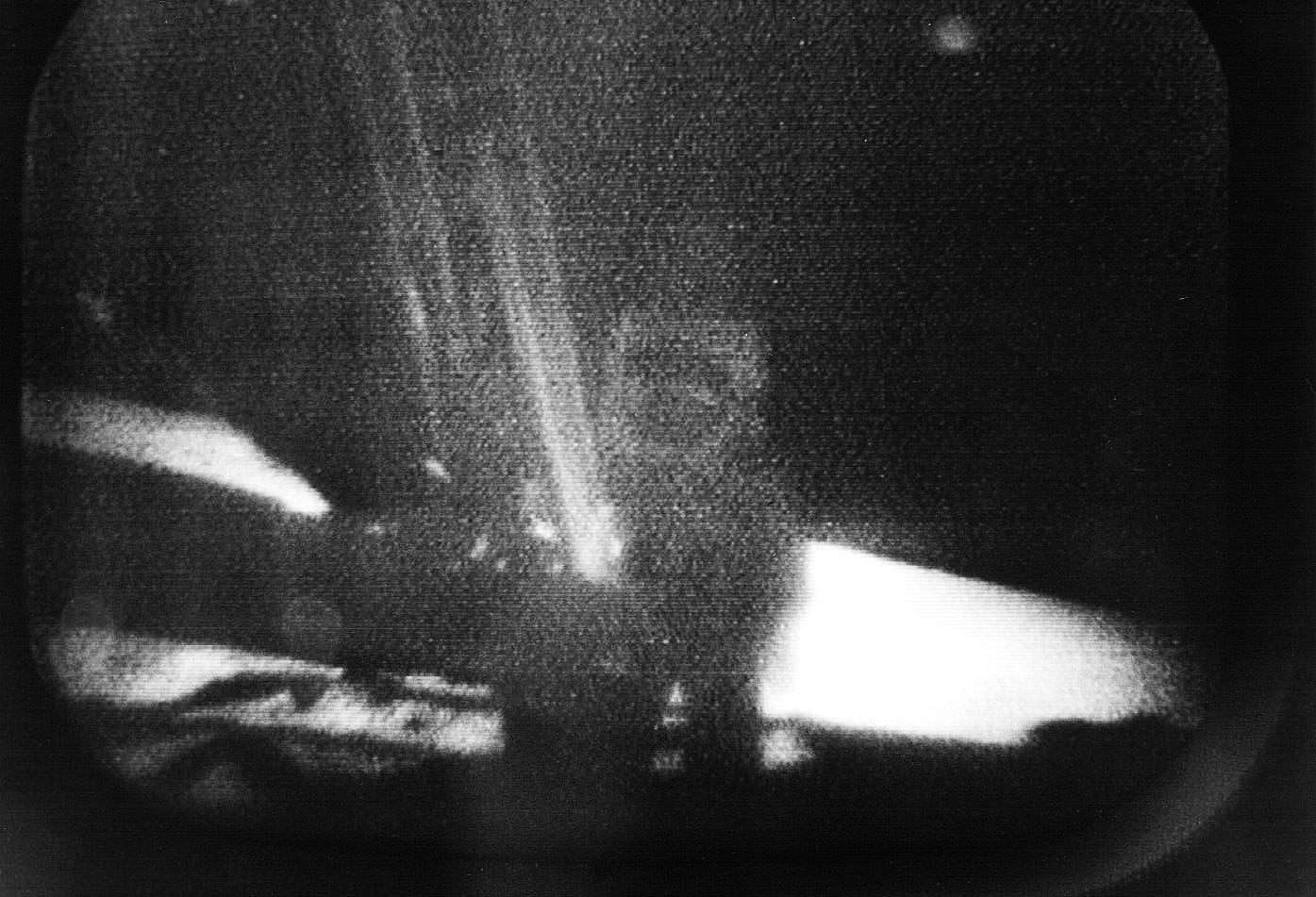 |
Neil Armstrong on the footpad, about to
step onto the surface. |
Carefully he raised his left boot and planted it onto the soil, checking it would take his weight.
At 109:24:15 GET , 2156:15 USCDT (late evening spacecraft time), July 20 (1256:15 AEST July 21 1969) 38 year old Neil Alden Armstrong from Wapakoneta, Ohio, USA, stepped onto the lunar surface and spoke those immortal words:
A breathless world glued to every television and radio set available on the planet, was mesmerised by the moment. Buzz Aldrin was watching through the hatch.
 |
Still holding on to the LM, Armstrong dragged his boot across the soil, making furrows. The dusty lunar soil clung to his boot like a fine black powder. Now confident, he let go of the LM and tried walking around. He felt quite buoyant, his 163 kilogram weight with the spacesuit on Earth now only 27 kilograms.
One of the first tasks was to get a contingency sample of lunar soil, but Armstrong was so anxious to get the Hasselblad camera and take pictures that he had to be reminded a couple of times to scoop up some samples. Back in mission control, the scientists were nervous that a sudden unexpected life-threatening crisis might send Armstrong scuttling back into the LM and it seemed ridiculous to go all that way and not bring back some lunar samples for scientific analysis, but Armstrong felt that a quick sequence of panoramic pictures before picking up the samples was the way to go.
Collins in Columbia misses the moment.
At this point Columbia was out of sight behind the moon. Collins had been trying to locate the LM from orbit (he never did), but he desperately wanted to hear what Armstrong was going to say when he stepped on the moon and he realised he was the only person out of contact with the epoch making events. All the billions of people around Earth with his two mates on the other side of the moon, and he was the only person completely cut off from it all! Complete silence except for the spacecraft noises. Columbia did not reappear until Armstrong and Aldrin were raising the flag, so Collins missed hearing Armstrong’s momentous step onto the lunar surface.
Armstrong had planned the first still picture would be his first boot print in the lunar surface but to his dismay when he came to take the picture he found he had already trodden all over the imprint, obliterating all traces of it.
After taking the first photographs, Armstrong moved into the sunlight and began collecting the first contingency soil samples. Using a long-handled scooper to dig into the lurain, he found the topsoil was quite loose, but became hard and cohesive about 17 centimetres under the surface. He added a couple of small rocks, and dropped the samples into a strap-on pocket on his right thigh.
Parkes locks on to Eagle’s signal
Eight minutes and fifty one seconds after the television was switched on, the CSIRO’s 64 metre antenna at Parkes came on line at 1306 AEST when the LM on the moon rose high enough above the horizon for its signal to enter the main feed of the big dish providing a 12db increase in signal strength over the Honeysuckle signal.
Neil Mason hunched over his controls, concentrating on following the LM’s signals while around him he could still hear alarm bells mixed with creaks and thumps as the motors tried to hold the antenna against the onslaught of the wind tearing at the dish. Director Bolton gave the order to keep going.
When a clear picture appeared on their screens from the main feed at Parkes, Sydney Video switched the Parkes signal through to Houston who fed it to the waiting world. Parkes’ signal was used for the rest of the two-and-a-half hour broadcast.
|
 |
From left: Charlie Goodman, Verne McGlynn, Richard Holl (standing at the Fairchild slow scan monitor), Elmer Fredd (seated at the scan-converter), Ted Knotts, and Ray Louve (seated at the Ampex VR-660). |
|
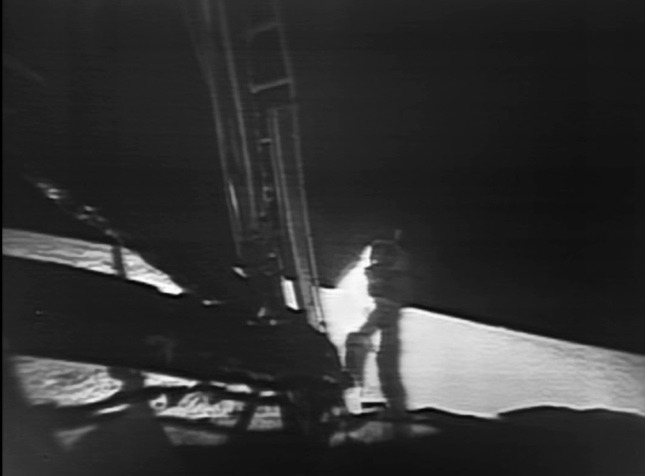 |
Armstrong steps into the Sun as he waits for Aldrin to descend the ladder. Picture through Parkes. |
Within 16 minutes of Armstrong’s step onto the lunar surface Aldrin began backing cautiously out of the Lunar Module’s hatch.
 |
Buzz backing out of the hatch of the LM. NASA image AS11-40-5863. Johnson Space Center. |
Aldrin worked his way down the ladder and jumped onto the LM’s footpad. He also tried to leap back onto the ladder, but missed the bottom rung by about two centimetres, so tried again –
FIRST WALK IN ANOTHER WORLD.
Aldrin,
Both astronauts found their suits comfortable to walk around in, except when bending down to pick an object up, when they had difficulty getting back up. There were no noticeable warm spots or differences in temperature between shadow and sunlight. The suits were designed to cope with the extreme conditions expected in the lunar environment, isolating the astronauts from the vacuum outside and the wildly fluctuating temperatures. The temperature of the ground they were walking on could vary from 110°C in sunlight to -170°C in the shade.
As Armstrong didn’t wear his inner gloves he found his hands were warm and very wet all the time, which made it more difficult to handle objects and get a firm grip on things. He tried some high jumps, but found once he came close to falling over backwards decided, “… that was enough of that.”
Armstrong,
The portable life support system (PLSS) on their backs had weighed 38 kilograms on Earth, but on the Moon they were a mere 6.3 kilograms.
Aldrin:
Armstrong,
Aldrin added,
Armstrong felt they had landed in a timeless place, with no changes to mark time passing as we know it. Although the astronauts were locked into the time in Texas, at Tranquillity the scene would have been just the same a thousand years ago, and probably will be the same a thousand years in the future. With no atmosphere, they found that everything they could see was starkly clear; features on the horizon were as sharp and clear as the rocks at their feet.
Aldrin looked above the LM. The Earth hung in a black sky, a disk cut in half by the day night terminator. It was mostly blue, with swirling white clouds, and he could make out a brown landmass – North Africa and the Middle East. Glancing down at his boots, he realised that the soil he and Armstrong were stomping through had been there longer than any of those brown continents.
 |
EVA Flight Director Cliff Charlesworth smiles from his console position in the MOCR as the EVA continues. Screen capture by Colin Mackellar from NASA 16mm footage. |
Unveiling the plaque.
At 109:52:19 GET (1324:19 AEST) the two astronauts gathered around the Eagle’s steps and ‘unveiled’ a small plaque (by removing its cover) mounted on a strut between the third and fourth rungs of the ladder, to commemorate the historic landing.
Armstrong read the inscription aloud,
 |
Aldrin (centre) and Armstrong unveil the plaque. Picture through Parkes, from the Apollo 11 TV video restoration. |
Relocation of the TV camera.
Armstrong changed the TV camera’s wide angle lens to a normal focal length lens before unveiling the plaque, then with Aldrin helping pull out the cable he set the camera on a stand 18 metres north west of the LM at 109:55:02 GET (1327:02 AEST).
 |
Neil has carried the TV camera out to its final position, approximately 18 metres from the LM. |
Armstrong,
Setting up the flag.
Next, not listed on their procedure checklist, at 110:09:43 GET (1341:43 AEST) the astronauts set up the Stars and Stripes flag, finding it difficult to punch the pole into the lunar soil. They found the first 10 centimetres was reasonably easy, but then the regolith hardened and they only managed to sink it into the soil about 20 centimetres, then leant it so the weight of the flag didn’t pull it over.
At 110:16:00 GET (1348 AEST) Collins appeared from behind the Moon, tracked by Tidbinbilla. Houston called him,
 |
After a debate on which flags to use, it ended up as the Stars and Stripes as the Congress of the USA financed the whole project. It was not a territorial claim but was seen as a symbol of freedom and to identify the nation that achieved the first landing. |
 |
As the flag was erected on the lunar surface, an identical flag was raised in the MOCR. In December 1972, the Apollo 17 mission took this flag to the lunar surface – |
 |
During a video meeting with Australian space trackers on 21 July 2023, Apollo 17 Lunar Module Pilot Dr. Harrison Schmitt, explained, |
At this point Aldrin announced,
 |
David Cooke, Parkes Senior RF Engineer, took this photo of the Parkes Slow Scan monitor, as Buzz Aldrin demonstrates mobility. |
There was a pause as he turned at the TV camera and then headed toward the LM.
There was another pause as he turned toward the TV camera and started to do a two-footed hop.
Buzz paused, turned at the TV camera, and headed back to the LM.
President Richard Nixon speaks to the astronauts.
In Washington President Richard Nixon was watching the moon walk in the White House with astronaut Frank Borman (Commander of Apollo 8) and Bob Haldeman. It was approaching midnight local time as they were standing around the television set in his private office when they watched Neil Armstrong step onto the moon. They went into the Oval Office next door where the media TV cameras had been set up for his split screen phone call to the moon. Armstrong’s voice was coming through loud and clear through Goldstone.
Away up beyond the sky, on the Moon’s surface where it was a bright sunlit lunar morning, but 1045 pm Houston time by their watches.
Armstrong and Aldrin were behind the camera when they heard McCandless call them,
The two lunar walkers moved to the front of the camera and paused to listened to their President. His voice was being transmitted through Goldstone to the lunar surface, and through the Wing at Tidbinbilla to Collins in the CSM. It was 110:16:30 GET, (1348:30 AEST).
|
President Nixon,
 |
Neil Armstrong (left) and Buzz Aldrin listen to President Richard Nixon in this frame from the restored EVA TV. Picture through Parkes. |
Aldrin saluted the camera again, followed by Armstrong a moment later. Then, they turned to work, beginning with kicking the dust to see how it behaved, and the task of collecting more samples of moon rocks. Although Armstrong had been warned there might be a special communication during their EVA, and Aldrin was told nothing – neither were prepared for the President’s call.
 |
One of the few photos of Armstrong on the surface, here working at the MESA. NASA image AS11-40-5886. Johnson Space Center. |
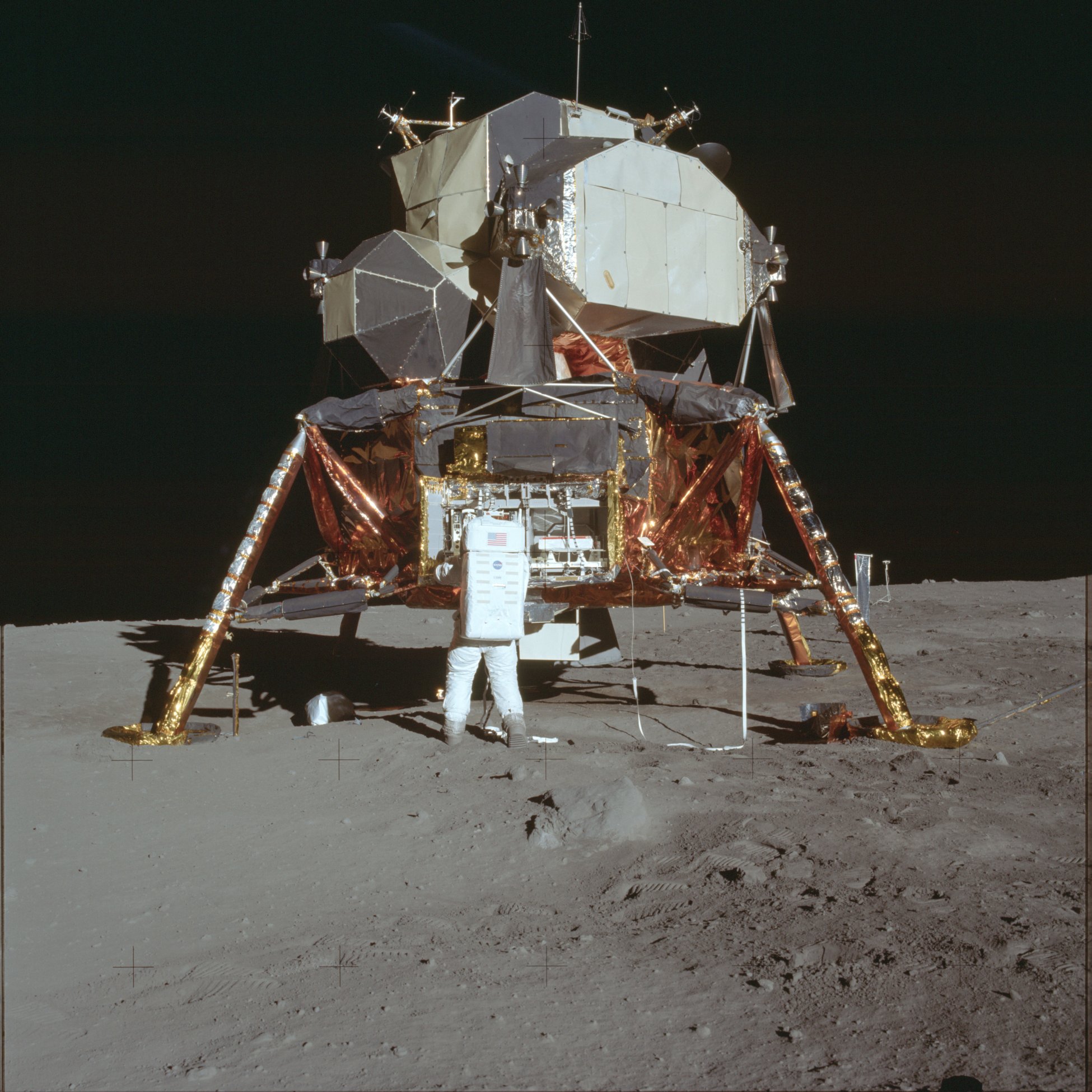 |
Buzz Aldrin working at the LM. NASA image: AS11-40-5927. Johnson Space Center. |
Core sample and setting up the EASEP.
As soon as the President had finished, Armstrong headed for the MESA to begin the geological work, using the next 17 minutes to observe phenomena and collect the bulk samples.
At 110:55:42 GET (1427 AEST) Aldrin began setting out the EASEP (Early Apollo Scientific Experiments Package). It was an important part of the Apollo missions to leave a scientific package on the moon’s surface for the tracking stations on Earth to monitor conditions around the landing site after the astronauts left.
Aldrin began with trying to drive a core tube into the regolith, “I picked up the hammer, went out into the vicinity of where the solar wind experiment was, and drove the first core tube into the ground. I pushed it in about 3 or 4 inches (7.6 or 10 centimetres) then started tapping it with the hammer.” From that moment he found he could make little progress, no matter how hard he tried to belt it in with the hammer. He managed another 5 centimetres, but it tended to want to fall over. He had no difficulty pulling it out, and found the core sample had no inclination to fall out of the tube. It seemed to have the cohesiveness of wet sand.
Aldrin tried another location with the same results before changing over to setting out the EASEP. He began with the seismometer [see separate EASEP/ALSEP essay for details of EASP]. The EASEP instruments measured particles from the sun, the moon’s seismic activity, and a laser beam reflector for accurately measuring the distance between the Earth and moon. Carnarvon’s 9-metre dish was scheduled to track EASEP, at times it was the prime support.
At 111:20:00 GET (1452:00 AEST) Armstrong spotted a sizeable crater about 20 metres to the east of the LM and veered over to inspect it and take some pictures,“I had some personal reservations in taking the time to go over and snap a picture of the crater, but I thought it was of sufficient interest that it was worth getting.” He estimated it was almost 24 metres in diameter and up to 6 metres deep and found the sides of the crater showed signs of layering that he thought the geologists would be interested in. For a moment he thought of it as a baby crater which made him think of his little daughter who had died of a brain tumour, and called it Muffie’s Crater, with an image of her sliding down the sides to the bottom.
Back to the Lunar Module.
At 111:20:00 GET (1452 AEST) Aldrin collected the Solar Wind Experiment panel and climbed back into the LM.
Armstrong threw a rock with the comment, “You can really throw things a long way out here.” As he darted about collecting the rock samples, his pulse rate went up from 90 to 140, peaking at 160, as he hauled the samples up into the LM with a special tackle called the LEC (Lunar Equipment Conveyor) he nick-named the “Brooklyn clothes line.”
Aldrin found the first step of the ladder was a good height, but Armstrong could leap the 1.8 metres directly to the third step, “I did a deep knee bend with both legs and got my torso down absolutely as close to the foot-pad as I could. I then sprang vertically up and guided myself with my hands by use of the handrails.”
At 111:39:13 GET, (0011:13 spacecraft time, USCDT) (1511:13 AEST) the hatch was closed to complete a 2 hour 31 minute 40 second, 1 kilometre moonwalk. The extent of Armstrong and Aldrin’s excursions around the LM could be contained within a football pitch.
As the two astronauts struggled with the rocks and suits in the cramped LM cabin there was a 10 minute break in voice communications with the ground as they had to fold their back pack antennas to avoid damage to the LM’s interior.
 |
The boresight television camera shows Honeysuckle Creek’s 85 foot antenna is pointed straight at Tranquility Base. From the Super 8 movie by Ed von Renouard, at around 3:30pm Monday 21 July 1969. |
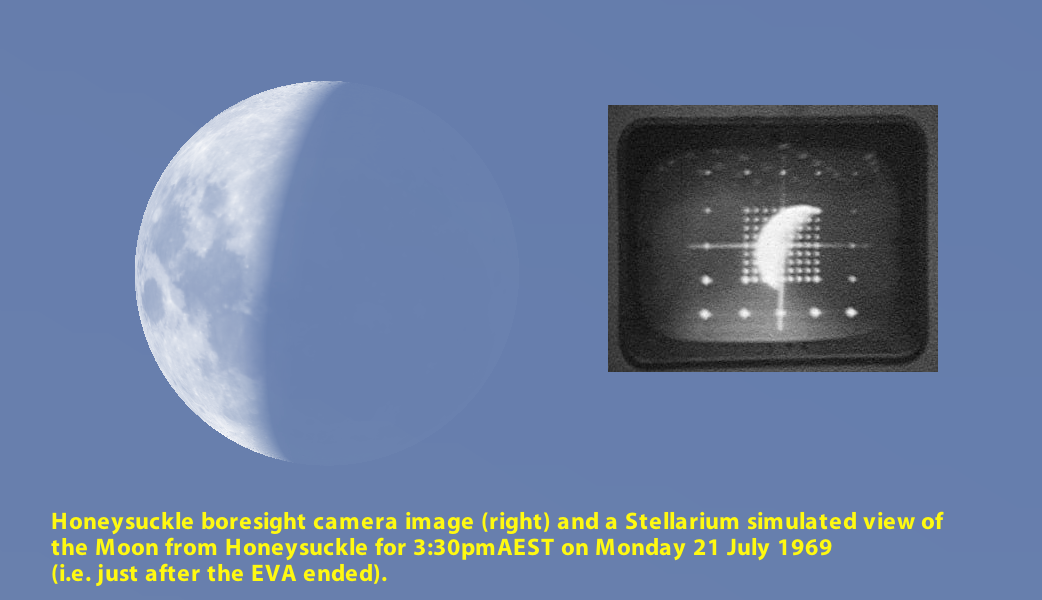 |
Here’s a simulated view for comparison. (The boresight TV picture is rotated as the antenna turns on its axes to follow the Moon, which is why the orientation doesn’t match the simulated view.) |
Their first chore was to pressurise the LM’s cabin and to begin stowing the rock boxes, film magazines, and anything else they wouldn’t need until they were docked again with Columbia.
They removed their boots and the EMU’s, opened the hatch and threw them onto the lunar surface with any other gear not required on the journey back home. They had to clear enough space so the two could find room to sleep.
 |
Honeysuckle Creek’s Ed von Renouard captured the PLSSs being dumped on his Super 8 movie camera. In this frame, the second backpack is dumped down the ladder. It has just been pushed out of the door and is on the porch, about to tumble end over end down the ladder. The first PLSS rests at the bottom of the leg. Taken from Ed von Renouard’s Super 8 movie of the scan converted monitor at Honeysuckle Creek. Screenshot: Colin Mackellar. |
Houston did not miss anything,
They expected the lunar dust particles to float around inside the LM, but were surprised to find that they never did, generally staying where they lodged, probably due to the fact they were so dry they were attracted to anything with static electricity. This meant they were able to remove their helmets without the worry of the dust getting in their eyes and noses.
When asked if there were any surprises on the Moon Armstrong responded with,
 |
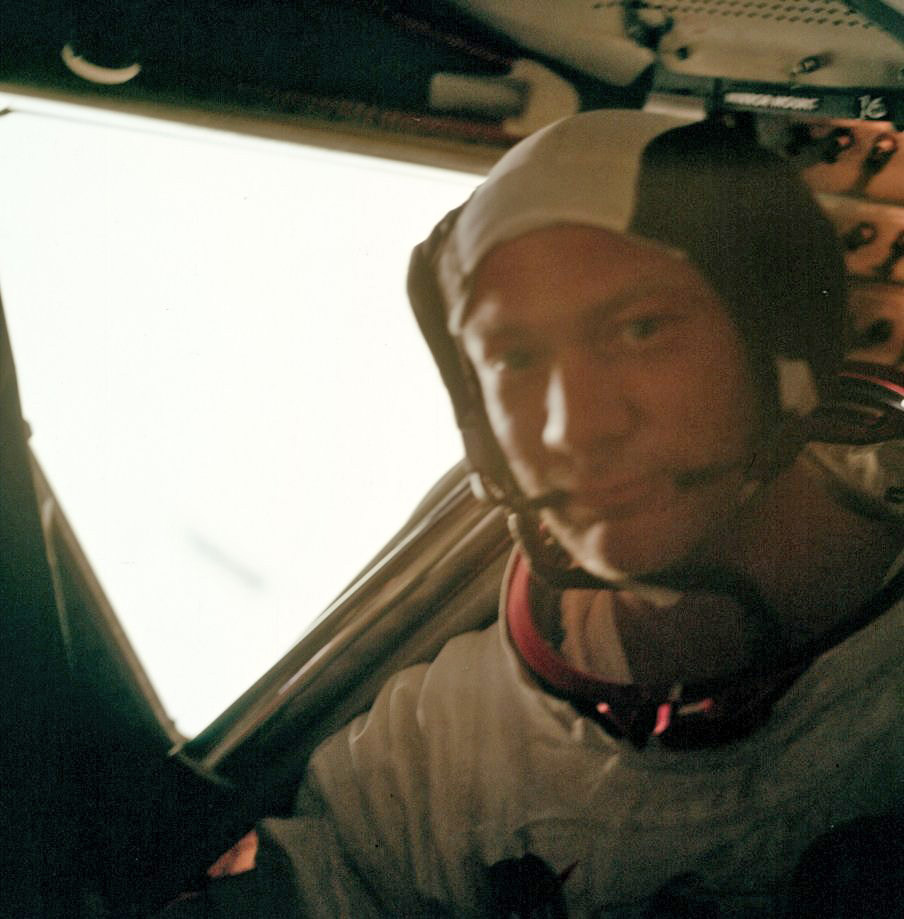 |
Back inside Eagle, Neil and Buzz take each other’s photograph after their successful EVA. |
|
 |
| Buzz Aldrin took this portrait of an elated but tired Neil Armstrong inside the Lunar Module after the EVA. Image AS11-40-5874. This and the two above, courtesy of the Apollo Image Gallery. |
At 114:33:30 GET (1805:30 AEST) the Green Team at Mission Control changed shift over to the Maroon Team and the new Capcom Owen Garriott conducted a debriefing with Eagle’s crew.
Time to rest and get some sleep.
At 114:52:00 GET (1824:00 AEST) the tired astronauts finally put blinds over the windows and curled up to rest. They both decided to sleep with their helmets and gloves on, hoping there would be less noise, they would be warmer, there was less chance of breathing lunar dust, and they would not have to find somewhere to stow them.
The later missions supplied hammocks for sleeping, but not for Apollo 11, so Aldrin lay on the floor with his feet up against the side, or bent his knees, as the cabin wasn’t wide enough to stretch out. Armstrong sat on the cover of the ascent engine, leaned against the rear of the cabin, and suspended his legs through a loop of waist tether he had rigged up from a handhold. After he settled down Armstrong found there was an annoying pump gurgling somewhere near his head, and he could not avoid seeing the Earth glaring at him like a big blue and white eyeball through the Alignment Optical Telescope, so he had to get up and block the Earth light off. The window blinds did not block light out enough either, in fact they could see the horizon through them. It was a never-ending battle to get a minimum level of sleeping conditions, “… and we never did. Even if we had, I’m not sure I would have gone to sleep,” admitted Armstrong.
After a rest period of 12½ hours, both astronauts agreed they did not sleep very well. Apart from the emotional high from excitement of the day they became progressively colder, though they tried turning the suit water temperature up to maximum, then disconnecting the water flowing through their suits. Aldrin finally adjusted the temperature of the airflow through the suit and they felt better. Although it was over 93°C outside, the cabin temperature was steady at 16°C. Dr. Kenneth Biers at Houston said the data he received from Armstrong (they were not monitoring Aldrin) indicated that he may have slept fitfully and dozed, but stirred around quite a bit. Armstrong admitted he found it hard to unwind after the excitement of the day. He wasn’t concerned that lack of sleep would affect his concentration flying the LM the next day.
Bryan Sullivan in computers remembers driving home at the end of his shift,
Heading Home
| HSK MISSION DAY 6 | Tuesday 22 July 1969 | |
| LM Liftoff : 124:22:01 GET 0354 AEST only Madrid tracking. | ||
| Docking : 128:03:00 GET 0735 AEST Goldstone and Madrid tracking. | ||
| LM Jettison : 130:09:31 GET 0941 AEST only Goldstone tracking. | ||
| Lunar stay period : 21 hours 36 minutes 21 seconds. | ||
| LM/CSM separation period : 27 hours 51 minutes. | ||
| TEI burn : 135:23:42 GET 1455:42 AEST | ||
| Final Lunar Orbits |
| HSK Prime LM | Track Duration |
|
| Orbit | ||
| 29 AOS : 1142:00 AEST | LOS : 1231:56 | 0h 49m 56s |
| 30 AOS : 1317:45 Two-way Final CSM orbit around the Moon. |
LOS : 1429:48 | 1h 12m 03s |
| HSK Wing CSM | Track Duration |
|
| Orbit | ||
| 29 AOS : 1157 AEST | LOS : 1231:43 | 0h 55m 56s |
| 30 AOS : 1317:45 AEST | LOS : 1429:48 | 1h 12m 3s |
At 121:40:36 GET (1012:36 spacecraft time USCDT) on July 21 (0112:36 AEST 22 July) the LM astronauts were woken up by Ron Evans, the Houston Capcom with,
After more than 21½ hours on the lunar surface, the two lunar explorers prepared their ship for lift off. Ron Evans in Houston passed a message up:
LUNAR LAUNCH
Just one minute behind the Flight Plan scheduled time at 124:22:01 GET (1254 spacecraft time July 21) (0354 AEST 22 July), the rocket engine that had to fire, fired.
Aldrin:
Pushed by the 1,587 kilogram thrust of the LM ascent engine for seven minutes 14.9 seconds, the tiny spacecraft shot up into the black lunar sky, picking up speed from 48 kilometres per hour after 10 seconds to 2,890 kilometres per hour. The astronauts heard no sounds but only felt the acceleration and a high frequency vibration through their feet. As the rocket’s exhaust gases shredded the gold foil insulation and sprayed the pieces around the landing place, Aldrin looked out of the window long enough to see their flag topple over in the blast from the rocket motor.
Only Madrid was tracking the LM as it soared up into the black lunar sky.
(Link to page.) |
Seconds after liftoff, the LM pitched forward about 45 degrees, and though the astronauts had anticipated it would be an abrupt manoeuvre, the harnesses securing them cushioned the tilt enough to make it barely noticeable. Both astronauts were busy with their respective tasks, Aldrin working on the computer, and Armstrong keeping track of the flight and navigation. Armstrong commented, “I observed one sizeable piece of the spacecraft flying along below us for a long period of time after lift-off. I saw it hit the ground below us somewhere between one and two minutes into the trajectory.”
Spearing upwards the astronauts had a very different ride from the descent. Now they were facing down and could see the lunar surface scrolling past, while experiencing a rocking-chair movement as the thrusters fired intermittently.
With the ascent stage of the LM on its way home the two astronauts now began to feel confident that Apollo 11 was really going to make it. There had been no real surprises on the moon’s surface after all.
Eagle returns to Columbia
Up in the Command Module Collins was preparing to meet his companions with a book of 18 different procedures to rendezvous slung around his neck.
While Columbia kept a steady course 97 kilometres above the lunar surface, Eagle climbed into a 75.6 kilometres orbit and soon Collins had a radar lock on it, showing it to be 400 kilometres behind. As the Earth waited for the two spacecraft to emerge from behind the moon, it wasn’t long before Collins could see a tiny blinking light in the darkness, then as they passed over the landing site, Eagle was only 24 kilometres below, and 80 kilometres behind.
As they entered into sunlight on the back side, Collins saw the blinking light slowly resolve into the LM skimming over the crater scarred surface below, but looking quite different now without the descent stage and its dangling legs. Armstrong took up a position 15 metres from Columbia and kept station. The rendezvous was over and for the first time the astronauts began to feel they were going to bring this amazing stunt off.
At Honeysuckle we were
beginning our SRT for the day’s track.
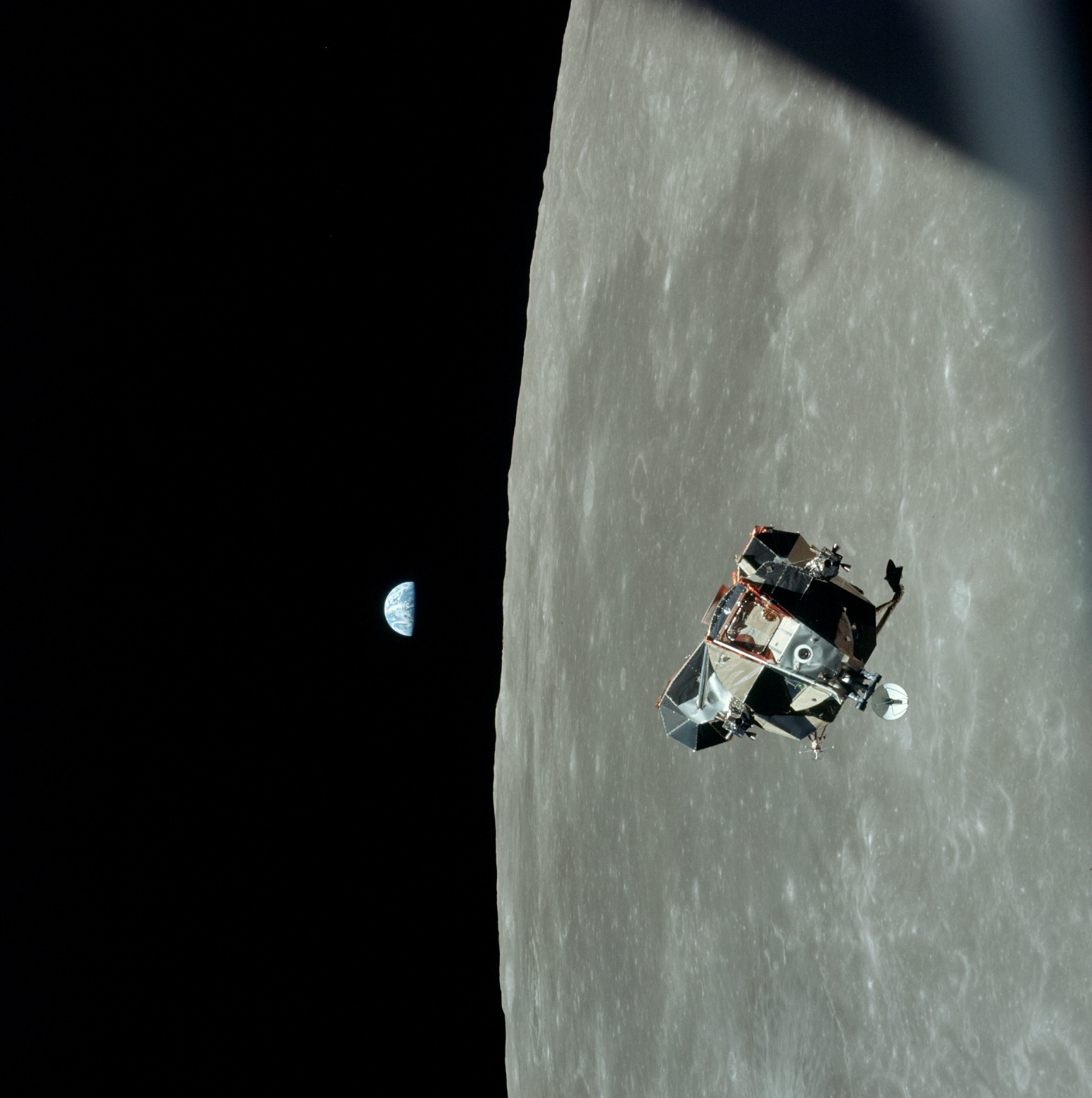 |
“I got the Earth coming up... it’s
fantastic,” shouted Collins Photo courtesy of the Project Apollo Archive. |
Back together again. Eagle successfully docks with Columbia.
As they came around the rim of the Moon Houston was agog to know how things were going, but not wanting to interfere with the docking process: “Eagle and Columbia, Houston standing by.”
“Roger, we’re station keeping,” Armstrong’s pithy response told Houston everything. All three astronauts steeled themselves for this critical moment docking the two spacecraft together again. The success of the mission; their return home; their lives, relied on switches, relays, mechanical latches, and valves all working faultlessly, complementing their own skills. At 128:03:00 GET (0735 AEST) the LM’s docking probe gently entered the cone, and with a satisfyingly loud thud the twelve latches slammed home to lock Eagle and Columbia together again.
Then, just as they began to feel they were safely together again, the spacecraft suddenly began jerking around, both spacecraft thrusters firing in anger. The astronauts all jumped, thinking they might be in trouble, but it was the LM and CSM automatic attitude systems competing with each other until the LM’s automatic pilot was turned off and the spacecraft quietened down to wait for the astronauts’ next instructions.
They were back together again just a mere three minutes behind the time specified by the original Flight Plan published many months earlier, an amazing achievement considering what they had been through.
Aldrin was first through the hatch, with a triumphant grin on his face. Collins gleefully shook his hand, then turned to the tunnel to welcome Armstrong, and an excited reunion took place, before they dragged the lunar rock bags into the Command Module. It took 2 hours to configure the systems and prepare to ditch the LM.
The LM is jettisoned.
Going behind the moon for the 29th time, Collins threw the right switches, and at 130:09:31 GET (0941:31 AEST) at an altitude of 114 kilometres, with a slight bang, the LM backed off, watched sadly by Armstrong and Aldrin. Collins, though, was very pleased to see it steadily disappearing into the distance, taking all its complications with it. Armstrong commented, “Jettison went as planned. The separation was slow and majestic; we were able to follow it visually for a long time.” The Eagle would continue to circle the moon until it finally joined the other spacecraft corpses on the lunar surface.
COMING HOME
| TEC–Day 1 | Track Duration |
|
| HSK Prime | ||
| CSM | ||
| AOS : 1506:15 Two-way | LOS : 1930:00 | 4h 23m 45s |
| Handover uplink Prime to Wing : 1743:41 | 2-way duration : 2h 37m 26s |
|
| EASEP | ||
| AOS : 1946:28 AEST | LOS : 2145:00 | 1h 58m 32s |
| CSM | ||
| AOS : 2152 | LOS : 2342:00 | 1h 50m |
| HSKX Wing | ||
| LM Rev 32 | ||
| AOS : 1714:37 Two-way | LOS : 1731:25 | 0h 16m 48s |
| At 1741 AEST a twx message advised no further LM support was required. | ||
| HSKX Wing reconfigured for CSM support. | ||
| AOS CSM : 1737:38 | LOS : 2342:00 | 6h 04m 22s |
| Handover uplink Prime to HSKX Wing : 1743:41 | ||
| Handover uplink HSKX Wing to MAD : 2304:08 | 2-way duration : 5h 20m 27s |
|
Transearth Injection (TEI). Heading for home.
An orbit later, behind the Moon, at an altitude of 97 kilometres, they carefully lined up the horizon and checked they were in the right attitude before firing the SPS motor for 2 minutes 31.41 seconds on time at 135:23:42 GET (1455:42 AEST) to set them on a safe course for home at an initial speed of 9,424.5 kilometres per hour. The CSM had completed 30 orbits of the Moon in 59 hours 30 minutes 26 seconds.
“Just about midnight in Houston town,” mused Armstrong nostalgically.
Honeysuckle Creek’s antenna was pointing at the edge of the moon, waiting for the first signs of a signal. In the spacecraft the astronauts saw the Earth rise above the moon’s horizon for the last time and the voice of Charlie Duke in Houston filled their earphones,
|
As they left the Moon, the three astronauts looked back at the huge grey and tan orb suspended in front of them it was an awesome moment to realise where they were and what they had just done.
 |
The Moon quickly recedes. NASA photo AS11-44-6661 courtesy of the Apollo Image Gallery. |
They tried to use the remaining film to take as many pictures as possible of the moment. Collins, however, felt that he never wanted to return. 8,000 kilometres from the moon, the three weary space travellers were able to catch up on their sleep, turning in at about 0530 spacecraft time.
They set up the Passive Thermal Control (PTC) rolling at 0.3°/second but this time they had a pitch angle of 270° instead of the 90° on the way out. A rest period began at 137:22:00 GET (1654:00 AEST) with the following final exchange of the historical day:
| HSK MISSION DAY 7, TEC–Day 2 | Wednesday 23 July 1969 |
| HSK Prime CSM | Track Duration |
|
| AOS : 1322 AEST | LOS : 0001 (Thursday) | 10h 39m |
| Handover uplink GDS to HSK : 1532 | ||
| Handover uplink HSK to MAD : 2347:01 | 2-way duration : 8h 15m 01s |
| HSKX Wing CSM | Track Duration |
|
| AOS : 1145 AEST | LOS : 0001 (Thursday) | 12h 16m 00s |
After about ten hours rest, the astronauts were left to wake up on their
own at 147:37:00 GET (0309:00 AEST).
They passed through the gravity hump between the moon and Earth at 148:7:22 GET (0339:22 AEST) eating
their breakfast, 322,021 kilometres from Earth, and 62,553 kilometres from
the moon. Columbia now began picking up speed as the Earth’s
gravity strengthened.
There had been a major effort to try and locate exactly where Apollo 11
had landed in the Sea of Tranquillity, and they were still trying to pinpoint
the position when Armstrong dropped a casual remark during a debriefing
as they were returning to Earth,
That description was all the geologists needed they immediately knew the landing spot from their maps, confirmed by pictures from the 16mm sequence camera of the landing: 0° 41'15" North latitude, 23° 25'45" East longitude. If only Armstrong had mentioned that crater before!
At 155:36:00 GET (1108:00 AEST) there was an 18 minute television show, starting with pictures of the Moon and Earth. Capcom Charlie Duke in Houston mistook the Moon on his large monitor for the Earth, and was ragged by the astronauts:
Armstrong showed the boxes of lunar samples to the camera for the scientists,
Collins tried to show sipping water from a teaspoon for the kids that may be watching, then showed how they actually drank water using a water gun,
At 159:53:43 GET (1525:43 AEST) the crew celebrated the half-way point by distance – 269,620 kilometres to go. Another sleep/rest period began at 160:42:00 GET (1614:00 AEST).
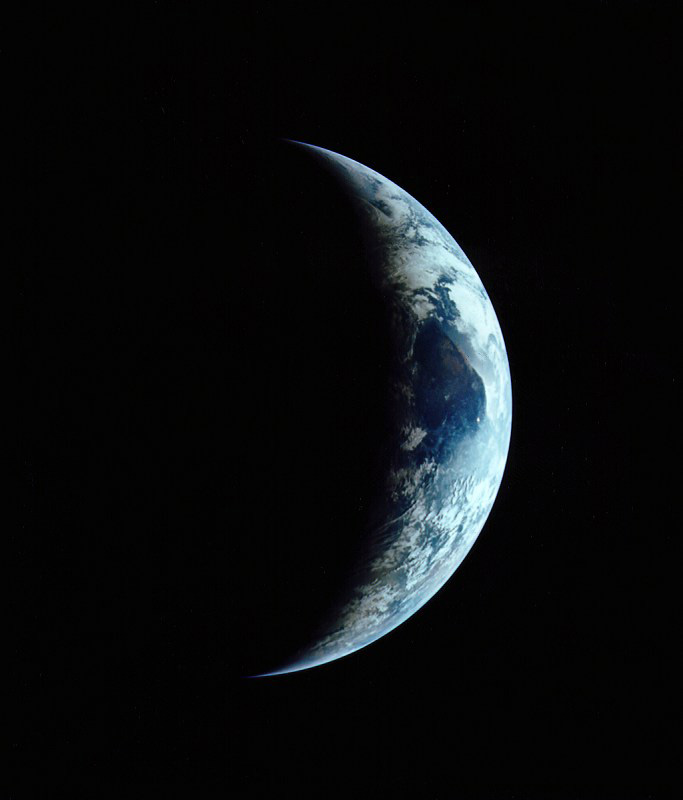 |
As Columbia returned to Earth a crescent Earth filled their windows ahead. |
| HSK MISSION DAY 8, TEC–Day 3 | Thursday 24 July 1969 |
| HSK Prime CSM | Track Duration |
|
| AOS : 1152:50 AEST | LOS : 1632:00 | 4h 39m 10s |
| Handover uplink GDS to HSK : 1217:00 | ||
| Handover uplink HSK to Guam : 1356:00 | 2-way Duration : 1h 39m |
|
| EASEP | ||
| AOS : 1728:00 | LOS : 0017:45 (Friday) | Track Duration : 6h 49m 45s |
| CSM | ||
| AOS : 0047:00 | LOS : 0231:09 (Friday) | 1h 44m 9s |
| HSKX Wing CSM | Track Duration |
|
| AOS : 1159 AEST | LLOS : 0231:16 (Friday) | 14h 32m 16s |
The crew slept soundly for 7 to 8 hours until Capcom Owen Garriott called them at 170:59:56 GET (0231:59 AEST).
Meanwhile at the Guam tracking station a ten year old boy saved the day. A bearing had seized from lack of grease, immobilising the antenna, and no adult could reach it through a narrow hole for a quick fix. So Charles Force, the Station Director, called on Greg, his son, to reach in and apply the grease. Neil Armstrong later thanked the lad personally.
During the last evening in Houston at 177:32:00 GET (0904:00 AEST), 169,219 kilometres from Earth, they sent their final television session, rather a philosophical one.
Collins pointed out the number of components involved in the whole spaceship and said,
Part of Aldrin’s talk said:
Armstrong wound the session up with:
At 1217 AEST Goldstone handed over two-way tracking to Honeysuckle Creek on the spacecraft omni antennas, then we handed over to Guam at 1356.
At 1632:00 AEST Honeysuckle Creek Prime broke track from Apollo 11, leaving the Wing looking after the CSM while we crossed over to lock on to EASEP and we had a quiet period tracking a blind and dumb box before returning to the excitement of re-entry.
At 189:28:35 GET (2100:35 AEST) the astronauts woke up for their last day in space and prepared for splashdown. They had to separate from the Service Module before they came scorching into the 64 kilometres wide corridor at nearly 40,000 kilometres per hour. The entry corridor into the Earth’s atmosphere is extremely critical, too steep an entry would burn them up, and too shallow an entry would make them skip out into solar orbit, to be lost forever.
| HSK MISSION DAY 9, TEC Day 4 Arriving back home on Earth |
Friday 25 July 1969 |
| HSK Prime CSM | Track Duration |
|
| AOS : 0047 AEST | Final LOS : 0231:44 | 1h 44m 44s |
| HSKX Wing CSM | Track Duration |
|
| AOS : 0047 AEST | Final LOS : 0231:31 | 1h 44m 31s |
Jettison the Service Module.
During the final moments of our track, at 194:49:12 GET (0221:12 AEST), they jettisoned the Service Module and prepared for re-entry. The 4.9 tonne Apollo 11 Command Module, was all that remained of the original vehicle of 3,198.4 tonnes that left the Earth over eight days before.
Re-entry.
Moments after Honeysuckle Creek lost Apollo 11’s signal for the last time, while the Houston controllers were working around their lunch breaks, Columbia dived into the Earth’s atmosphere 122 kilometres above the Earth at 39,715.4 kilometres per hour at 195:03:05 GET (0235:05 AEST). Strapped to their couches the now thoughtful, subdued astronauts looked out of the spacecraft windows to see the black of space gradually turn to a shimmering orange yellow tongue of flame with bluegreen edges. It grew in intensity with the denser air, until it became an eyeball searing white, covering the entire window.
The crew said it was quiet, Collins commenting, “There wasn’t any sizzling, popping or any noises that you commonly associate with entry heating. I thought it was smooth.” The temperature of their heat shield, only inches away behind their backs, was reaching a blistering 2,800°C as the ablative material roasted and streamed off into the superheated wake.
 |
The Apollo 11 re-entry, photographed from a USAF KC-135 at 43,000 feet. Here, the Service Module disintegrates. |
| See the footage here. |
The three astronauts also began to feel the effects of gravity, gradually pressing them harder and harder until they were under six and a half times the pressure of normal gravity, which after their weightless days, seemed enormous, dragging their arms down, but luckily it didn’t last long.
Drogue and Main chutes deployed.
Right on time at 195:12:06 GET (0244:06 AEST) the small drogue parachutes whipped out and flogged around in the slipstream, before hauling the three main orange-and-white striped parachutes out, and the spacecraft began floating down through some stratocumulus clouds. To the astronauts, trying to adjust to the now heavy weight of their arms and legs, it was a pleasant welcome back to Earth to see familiar clouds and soft atmospheric haze again in contrast to the stark, contrasty light of space and the lunar surface.
At Honeysuckle Creek we listened to the last moments of the mission on our headsets as we shut down our equipment and prepared to drive home. For us a very successful mission was over. It was now time to party.
| SPLASHDOWN! | ||
| Ground Elapsed Time (GET) : 195h 18m 35s | 0250:35 AEST Friday 25 July 1969 | |
The final moments of the mission were threatened by a deadly thunderstorm, with tops rising to 50,000 feet, brewing over the planned landing area. Rear Admiral Don Davis, commander of Task Force 30, aboard the prime recovery ship USS Hornet, ordered the recovery forces to move 398 kilometres down range. This proved a wise move as the new area had good conditions with 1 metre high waves and a 16 knot breeze. Columbia changed its inbound trajectory using a modified skip manoeuvre to redirect its course to the new target.
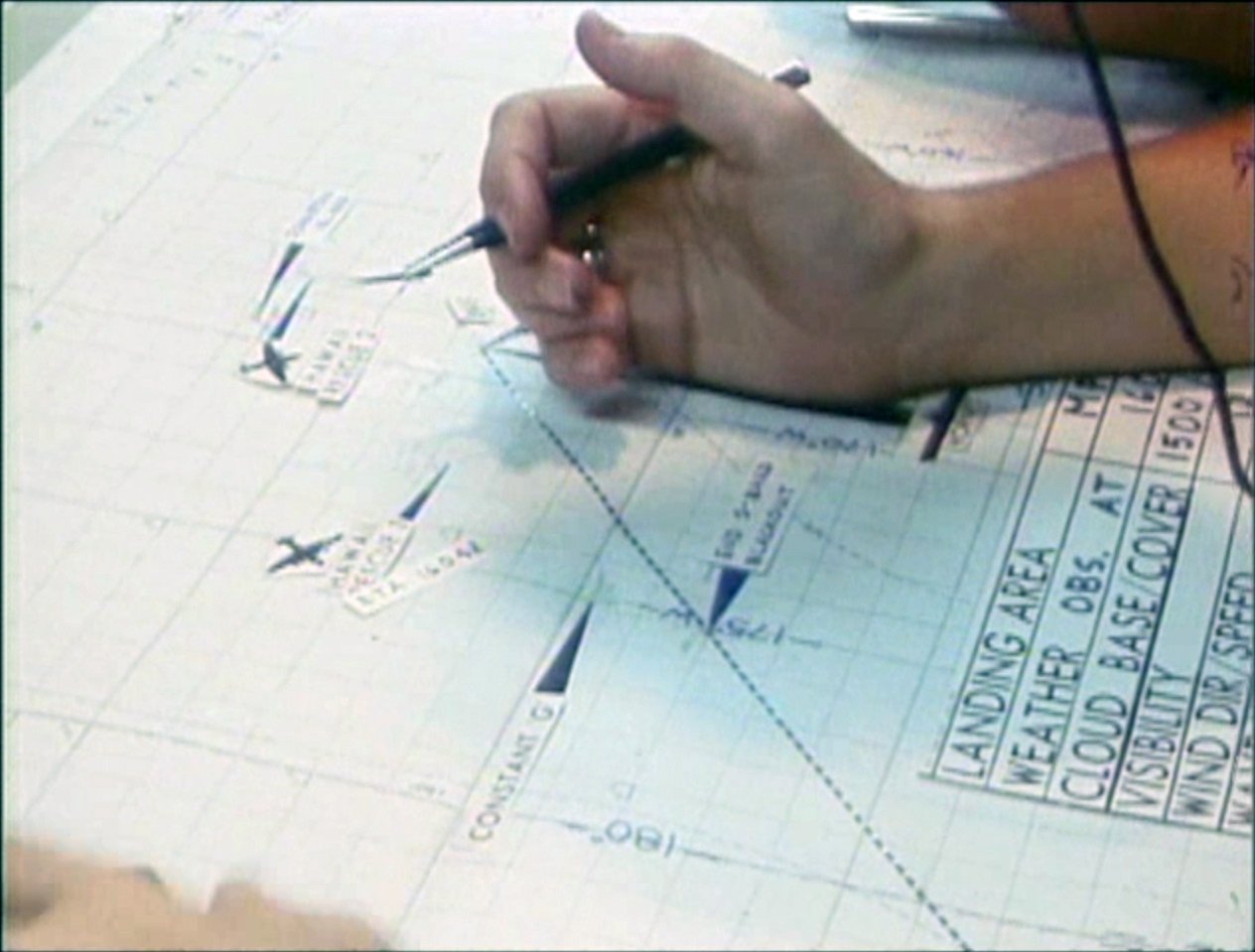 |
Columbia’s splashdown position is plotted in the Recovery Room, adjacent to the MOCR in Building 30 for display on the large projection screen. Screenshot from NASA 16mm footage. |
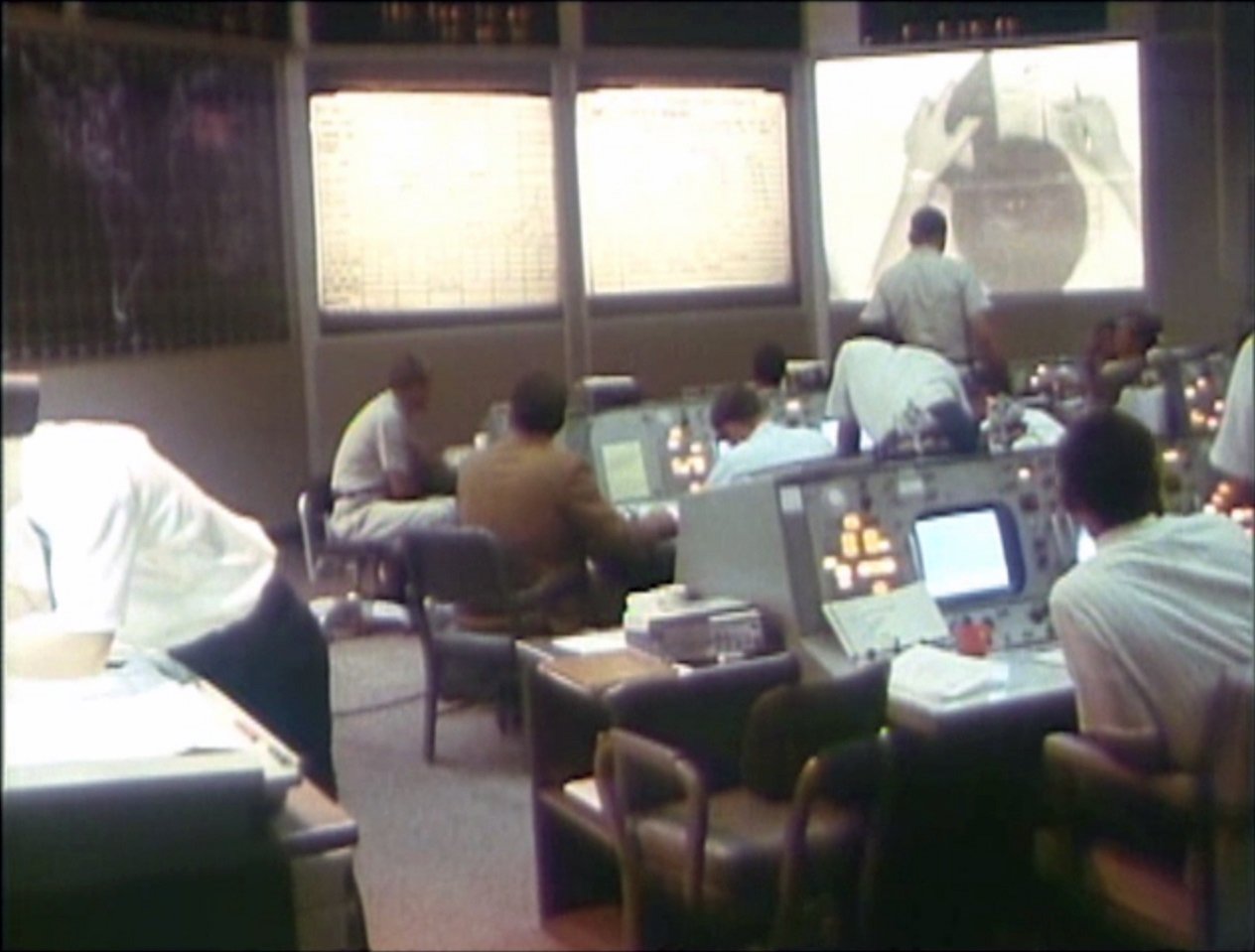 |
Columbia’s splashdown position is plotted (at left) in the Recovery Room in Building 30 for display on the large projection screen (at right). Screenshot from NASA 16mm footage. |
Dawn was just breaking when Columbia was spotted entering some clouds from the USS Hornet nine minutes before splashdown, coming into view again, swinging gently under its three parachutes. The Apollo 11 mission ended at 195 hours, 18 minutes 35 seconds GET, 1150:35 spacecraft time (0750:35 local Hawaii time) on Thursday 24 July. It was 0250:35 the next morning for us at Honeysuckle Creek, when the Command Module splashed down into the Pacific Ocean, just 1,530 kilometres south west of Honolulu. This was just 24 seconds ahead of the time specified in the original Flight Plan, published on 1 July 1969, an amazing achievement!! The return voyage from the Moon had taken 59 hours 36 minutes 52 seconds.
The spacecraft landed upside down (Stable 2 position) with the astronauts hanging head down by their straps, staring at the sloshing seawater through the windows. It took the floatation bags almost 8 minutes to flip it over to an apex up mode (Stable 1 position), allowing access to the astronauts. Armstrong commented, “The wave height was between three and four feet, but it looked more like thirteen or fourteen. And it felt like it too.”
Armstrong called Air Boss One, Squadron Commander Colonel Robert Hoffman, “Air Boss, Apollo 11. Everyone is okay inside. Our checklist is complete. Awaiting swimmers.” Collins commented, “Houston stayed off the air and we pretty much stayed off the air except to speak when spoken to.”
Waiting for the navy frogmen to arrive the three astronauts sat in silence, each trying to quell any signs of seasickness, each with their own thoughts of what was going to happen after the mission.
Commander Donald Jones, pilot of the recovery helicopter code named Swim Two, dropped three frogmen into the sea and stood by with the basket to pick up the astronauts. Frogman Lieutenant Clancy Hatleberg opened the hatch and tossed the biological isolation garments into the hatch.
With the arrival of the Biological Isolation Garment (BIGs) the astronauts climbed into them in the lower equipment bay, Armstrong first, followed by Collins and Aldrin in the right hand seat, and that was the order they climbed out of the hatch. After some trouble closing the hatch the swimmer started scrubbing the spacecraft down with Betadyne, while the astronauts sprayed each other down with Sodium Hypochlorite.
 |
The Apollo 11 crewmen in their BIGs prior to being winched to the helicopter. NASA photo S69-21698, courtesy of Kipp Teague’s Apollo Image Gallery. |
Armstrong was winched up first, followed by Collins then Aldrin. Collins felt strange when he first stood up in the helicopter – tired and light-headed. His body seemed heavy, especially his legs because the blood was pooling in his lower body.
 |
A box of cigars is opened in Mission Control, and US flags are distributed in preparation for Recovery celebrations. Screenshot from NASA 16mm footage. |
In Houston, Mission Control was flowing with excited people waving flags and smoking the traditional splashdown cigars, while a big television screen displayed a picture of Columbia bobbing about in the Pacific Ocean and another flashed up,
“Task accomplished .....
July, 1969”
 |
Mission Control went wild with euphoria once the astronauts were safely on board the USS Hornet and their responsibility was over. It was specially satisfying to have met their President’s deadline. At Honeysuckle Creek it was just a happy ending and going off to a free weekend with a splashdown party to come later. |
 |
Some of the key people who made Apollo 11 a success: From left – Robert Gilruth (MSC Director), NASA photo S-69-44017. With thanks to Kathleen Phillips Esposito. |
 |
From left – Cliff Charlesworth (Flight Director, Green Team), NASA photo S-69-44027. With thanks to Kathleen Phillips Esposito. |
Columbia had just travelled 1,534,832 kilometres in 8 days, 3 hours 18 minutes and 35 seconds. Gathered around the landing point to greet the three intrepid space travellers were 9,000 men in 9 ships and fifty four aircraft, spearheaded by the aircraft carrier USS Hornet.
 |
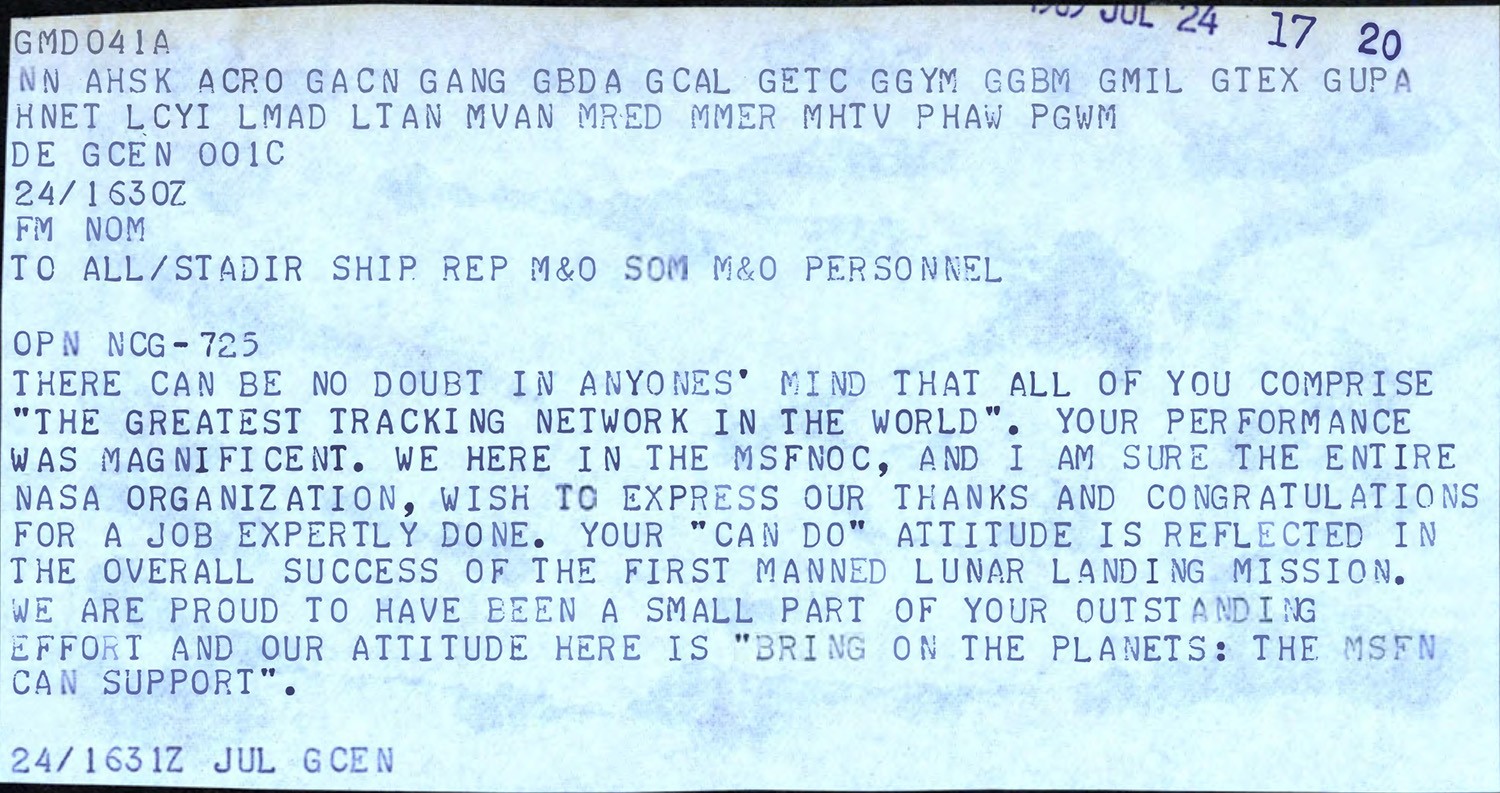 |
Congratulatory TWXs were sent to "All Network Personnel". Preserved by Larry Haug, scanned by Bill Wood. |
Isolation in the Lunar Receiving Laboratory.
The astronauts were placed in quarantine in the Lunar Receiving Laboratory for 11 days.
 |
The Apollo 11 crew (Collins, Aldrin, Armstrong) relax in the quarantine van. |
 |
Released from the Lab they were swept up in a frenzy of welcome back celebrations.
 |
New York welcomes the Apollo 11 crew with a ticker tape parade on August 13th 1969. Courtesy of Kipp Teague’s Apollo Image Gallery. |
Before setting off on a trip around the world, New York showered them with ticker tape, Chicago blasted off fireworks, and Los Angeles fed them with a superb dinner at a White House state occasion where they were toasted by 1,400 guests which included the President of the United States and diplomats from 88 countries, 44 of the 50 state governors and the greatest collection of aerospace pioneers gathered under one roof. One of the pioneers was Grover Loening, the factory manager for the Wright Brothers, who saw it all in a single lifetime from Kitty Hawk to Tranquillity Base on the Moon.
Buzz Aldrin summed the trip up with, “The footprints on the Moon are a true symbol of the human spirit… they show we can do what we want to do, what we must do, and what we will do…”
Referring to the plaque left behind on the LM, Neil Armstrong added, “I hope that some wayward stranger in the third millennia may read it and say, ‘This is where it all began.’ It can be a beginning of a new era when man begins to understand his Universe and man begins to truly understand himself.”
 |
The astronauts in Sydney, towards the end of their world trip. |
..........................................................................
Tracking and Communications Summary.
From our point of view communications were very good during this mission. Any breaks in transmission from the CSM were mainly due to the high-gain antenna alignment during spacecraft manoeuvring, fixed either by a spacecraft attitude change or switching to the omni antennas.
The real test came when the astronauts were on the Moon’s surface. The high-gain antenna on the stationary LM had no problems finding the Earth, and the telemetry from the EMU’s (Extravehicular Mobility Unit) was solid as a rock throughout the EVA. The signals from the EMU’s worked well even when the astronauts were out of sight of the EVA antenna on top of the LM due to good reflections from the lunar surface.
However, there were a few problems with Buzz Aldrin’s voice. Vox (voice operated transmission) was used all the time to keep the astronaut’s hands free. The EMU vox was very fast, but the series vox in the LM’s S-Band transmitter had not been set to maximum sensitivity, which caused some breaks in Aldrin’s voice transmissions. He also had some problems with the placement of his microphones inside the helmet. It appears to have been displaced as he moved about. Mission Control had to ask him to talk into his microphone a couple of times. In the thin pure oxygen atmosphere and lower ambient pressure of about 3.5 psi inside the suits sound did not travel so well. It did not help that Aldrin spoke with a jerkiness and had a more inflected voice than Armstrong, which added to his vox’s difficulties.
One exchange between Capcom Charlie Duke and Aldrin went like this:
Other minor problems were the distant echoing of sentences of the voice relay from Earth, particularly during Nixon’s speech and the noise caused by the MSFN VOGAA (a noise suppression device [voice-operated gain-adjust device]). The LM crew complained it sounded like “somebody banging chairs around the back of the room….” and was disabled.
Communications between the orbiting CSM and the LM on the lunar surface had its own problems. Although the two spacecraft were in sight of each other for up to 23 minutes as the CSM passed over the landing site, VHF inter-vehicle frequencies only allowed about 8 minutes of contact each pass. Outside the 8 minutes in sight of the LM, Collins communicated with it via an S-Band relay through the tracking stations on Earth. This relay had a round trip delay of 3 seconds so a lot of the time a one-way S-Band link was set up for Collins to hear what was going on, but he could not talk directly to the astronauts on the surface.
The planning of the Apollo 11 mission – The Flight Plan.
In all the hype surrounding the Apollo missions nobody seems to have commented on the stunning accuracy of the pre-mission planning – all of us were following an official Flight Plan which laid down every step of the mission. Armstrong’s decision to come out early, and the amazing result, when the Eagle coupled up with Columbia just three minutes behind the Flight Plan, and at the very end Columbia dropped into the Atlantic Ocean a mere 42 seconds behind the revised Flight Plan, but only 24 seconds ahead of the original Flight Plan published on 1 July 1969!!
I spoke to Rod Rose, Chairman of the Mission Planning and Analysis Division of Flight Operations, about his phenomenal accuracy in planning such a complex mission that had never been done before This is what he said to me,
The following table lists the updated Flight Plan compared to the actual execution, as published in the NASA Manned Spacecraft Center Roundup newspaper, Volume 8, No 21, dated 8 August 1969, page 3. Main events are highlighted in yellow.
GET = Ground Elapsed Time; i.e. time from launch.
 |
Click the image for the table in PDF format. |
 |
The three astronauts with President Nixon after the flight. |
With the safe return of Apollo 11, the Apollo team had met President Kennedy’s deadline. The whole concept of the Apollo mission had now been proved to work with outstanding success, which meant that exploring the Moon was now a reality, and the remaining Apollo missions could concentrate on the scientific side of the flights.
After Apollo 11, four “H” missions were planned, each of which would be able to carry a complete Apollo Lunar Surface Experiments Package (ALSEP), could support two periods of surface activity by the astronauts, and would be targeted for a smaller, more accurate landing zone than the first mission. On the later “H” missions engineers expected to be able to land within a 1-kilometre circle. After the “H” missions, six “J” missions would be flown, but it wasn’t long before budget restrictions chopped into this ambitious program. It is interesting to note that the magazine Aviation Week & Space Technology dated 4 August 1969 was still listing Apollos 18, 19, and 20, complete with landing latitude and longitude coordinates. A landing in the crater Copernicus was planned to be the Grand Finale to the Apollo Program with Apollo 20, as the walls of the crater exposed almost 6 kilometres of vertical lunar crust. One fanciful proposal was to use flying vehicles to explore terraces on the surrounding cliffs.
Now that would have been a spectacular finale.
ACRONYMS USED IN THE TEXT.
The following table explains the official acronyms used:
References:
Books, periodicals and papers:
Personal interviews with:
Essay by Hamish Lindsay.
Images, illustrations and captions by Hamish Lindsay and Colin Mackellar.
Audio files sourced and edited by Colin Mackellar.
Back to the Honeysuckle Creek home page
See also –
Apollo 11 TV – section
©. www.honeysucklecreek.net 2014.